Abstract
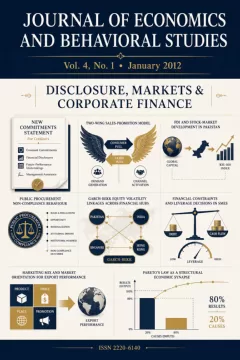
The study focuses on the marketing mix and market orientation on export performance due to the significance of foreign businesses. Theory posits that marketing mix and market orientation have a positive impact on export performance. Although the paper is conceptual base and the model proposed is required to check their reliability that firm with size, information system, and commitment with availability of market mix and market orientation formally. However, with the modification of technology enhances the export performance in a better way. The authors concluded that the practical implementation of export’s marketing strategies identically facilitated the companies for future success.
Keywords
- Firm's Commitment Search this journal for Firm's Commitment (opens in a new tab)
- Export-Marketing Strategy Search this journal for Export-Marketing Strategy (opens in a new tab)
- Marketing Mix Search this journal for Marketing Mix (opens in a new tab)
- Market Orientation Search this journal for Market Orientation (opens in a new tab)
References
- Aaby, N. E. & Stanley, F. S. (1989). Management Influences on Export Performance: A Review of the Empirical Literature 1978–1988. International Marketing Review , 6(4), 7–26.
- Armario, J. M., David, M. R. & Armario, M. E. (2008). Market Orientation and Internationalization in Small and Medium-Sized Enterprises. Journal of Small Business Management , 46(4), 485–511.
- Beamish, P. W., Ron, C. & Kerry, M. (1993). The Performance Characteristics of Canadian versus U.K. Exporters in Small and Medium Sized Firms. Management International Review , 33(2), 121–137.
- Cadogan, J. W. & Diamantopoulos, A. (1995). Narver and Slater, Kohli and Jaworski and the Market Orientation Construct: Integration and Internationalization. Journal of Strategic Marketing , 3(1), 41– 70.
- Calantone, R. J., Tamer, C. S., Jeffrey, B. S. & Shin, G. C. (2004). Internationalization and the Dynamics of Product Adaptation-An Empirical Investigation. Journal of Product Innovation Management , 21(3), 185–198.
- Diamantopoulos, A. & Souchon, A. L. (1999). Measure Export Information Use: Scale Development and Validation. Journal of Business Research, 46(1), 1–14.
- Donthu, N. & Kim, S. H. (1993). Implications of Firm Controllable Factors on Export Growth. Journal of Global Marketing , 7(1), 47–63.
- Francis, J. & Collen, C. D. (2000). The Impact of Firms’ Export Orientation on the Export Performance of HighTech Small and Medium-Sized Enterprises. Journal of International Marketing , 8(3), 84–103.
- Kacker, M. P. (1975). Export Oriented Product Adaptation: Its Patterns and Problems. Management International Review , 15(6), 61–70.
- Kotler, P. (1971). Marketing Decision Making: A Model Building Approach, New York: Holt, Rinehart and Winston.
- Kotler, P. (2003). Marketing Management, 11* Edition, Prentice Hall International Editions
- Kirca, A. H., Satish, J. & William, O. B. (2005). Market Orientation: A Meta-Analytic Review and Assessment of Its Antecedents and Impact on Performance. Journal of Marketing , 69, 24–41.
- Matsuno, K. & Mentzer, J. T. (2000). The Effects of Strategy Type on the Market Orientation–Performance Relationship. Journal of Marketing, 64(4), 1–16.
- Morgan, N. A., Anna, K. & Katsikeas, S. C. (2004). Antecedents of Export Venture Performance: A Theoretical Model and Empirical Assessment. Journal of Marketing , 68 (January), 90–108.
- Narver, J. & Slater, S. F. (1990). The Effect of Market Orientation on Business Profitability. Journal of Marketing, 54(4), 20–35.
- Porter, M. E. (1990). Competitive Advantage of Nations, New York: Free Press.
- Racela, O. C., Chawit, C. & Amonrat, T. (2007). Market Orientation, International Business Relationships and Perceived Export Performance. International Marketing Review , 24(2), 144–63.
- Samiee, S. & Roth, K. (1992). The Influence of Global Marketing Standardization on Performance. Journal of Marketing, 56(1), 1–17.
- Singer, T. O. & Michael, R. C. (1994). Factors Associated with Effective Use of Export Assistance. Journal of International Marketing , 2(1), 53–71.
- Shoham, A. (1996). Marketing-Mix Standardization: Determinants of Export Performance. Journal of Global Marketing, 10(2), 53–73.
- Sousa, C., Francisco, M. P., Martínez-López, J. & Filipe, C. (2008). The Determinants of Export Performance: A Review of the Research in the Literature between 1998 and 2005. International Journal of Management Reviews , 10(4), 343–74.
- Sorenson, R. Z. & Wiechmann, U. E. (1975). How Multinationals View Marketing Standardization. Harvard Business Review, 53 (May–June), 38–54, 166–167.
- Szymanski, D. M., Sundar, G. B. & Varadarajan, P. R. (1993). Standardization versus Adaptation of International Marketing Strategy: An Empirical Investigation. Journal of Marketing, 57, 1–17.
- Webster, F. E. (1992). The changing role of marketing in the corporation. Journal of Marketing, 56(4), 1-17.
- Zou, S. & Simona, S. (1998). The Determinants of Export Performance: A Review of the Empirical Literature between 1987 and 1997. International Marketing Review , 15(5), 333–56.
Downloads
No downloads have been recorded for this article yet. Figures appear here once readers begin downloading the full text.
How to Cite
Share this article
License
Copyright (c) 2012 Muhammad Usman, Irfan Ullah, Muhammad Bilal Kayani, Faisal Haroon, Muhammad Aslam Khan (Author)

This work is licensed under a Creative Commons Attribution 4.0 International License.
Author (s) should affirm that the material has not been published previously. It has not been submitted and it is not under consideration by any other journal. At the same time author (s) need to execute a publication permission agreement to assume the responsibility of the submitted content and any omissions and errors therein. After submission of revised paper in the light of suggestions of the reviewers, the editorial team edits and formats manuscripts to bring uniformity and standardization in published material.
This work will be licensed under Creative Commons Attribution 4.0 International (CC BY 4.0) and under condition of the license, users are free to read, copy, remix, transform, redistribute, download, print, search or link to the full texts of articles and even build upon their work as long as they credit the author for the original work. Moreover, as per journal policy author (s) hold and retain copyrights without any restrictions.
Keywords
- Firm's Commitment Search this journal for Firm's Commitment (opens in a new tab)
- Export-Marketing Strategy Search this journal for Export-Marketing Strategy (opens in a new tab)
- Marketing Mix Search this journal for Marketing Mix (opens in a new tab)
- Market Orientation Search this journal for Market Orientation (opens in a new tab)
Section
Published
Submissions
Have research to publish? Journal of Economics and Behavioral Studies welcomes submissions.
Make a Submission