Abstract
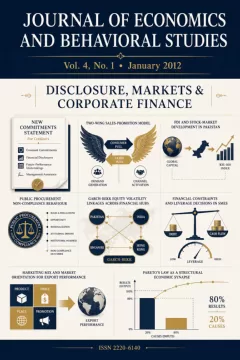
Starting from the observations of Italian economist Vilfredo Pareto, in the early days of XX-th century, refering to personal income distribution, we are coming to understand that it is not enough heightens the wealth of a nations, so that collective welfare to increase. It requires that the wealth created to be equitably distributed and not equally. Today, the famous Paretian Principle 80/20 demonstrates that we must wisely use the resources (i.e. 20%), enhance productivity, competitiveness and sustainability of the entities on the markets, so as to maintain the favourable results in 80 % ratio, but also to be overcome. Due to the elements composing the concept of Pareto’s Law, but mainly to the practical use of the theoretical pattern of an ex-post nature, we consider it a true synapse within economics, in order to facilitate an well-functioning of the society and economy and to motivate a rising of productivity in all domains.
Keywords
- Managerial Skills Search this journal for Managerial Skills (opens in a new tab)
- Income Distribution Search this journal for Income Distribution (opens in a new tab)
- Productivity Search this journal for Productivity (opens in a new tab)
- Well-Being Search this journal for Well-Being (opens in a new tab)
- Elite Search this journal for Elite (opens in a new tab)
References
- Cohen, A. (2011). The Law of the Vital Few, www.kajama.com (last accessing March 2011).
- Certo, S. C. (2002). Management modern, Ed. Teora, Bucureşti.
- Facione, N. & Facione, P. (2007). Thinking and Reasoning in Human Decision Making. The Method of Argument and Heuristic Analysis, The California Academic Press.
- Kahneman, D. & Tversky, A. (1979). Prospect Theory: An Analysis of Decision under Risk, in Econometrica XLVII.
- Kerjean, A. (2002). Le manager leader, Ed. D’Organisation, Paris.
- Koch, R. (2008). The 80/20 Principle. The Secret of Achieving More with Less, second edition, The Doubleday Publishing Group, New York.
- Koch, R. (2005). The 80/20 Individual. How to Build on the 20% of What You Do Best, The Doubleday Publishing Group, New York.
- Parmenter, D. (2007). Pareto 80/20 Rule for Corporate Accountants, John Wiley & Sons.
- Trifu, A. (2006). Eseu privind panoptic de sinapse organice ale economiei (Essay regarding economics organic synapses), Ed. Performantica, Iasi.
- Trifu, A. (2005). Gândirea economică în unitatea spaţio-temporală (Economic Thoughts in Time and Space Unity), Ed. Performantica, Iasi.
- Vroom, V. H. & Jago, A. G. (1988). The new leadership: Managing participation in organizations, Englewood Cliffs, NJ: Prentice Hall.
Downloads
No downloads have been recorded for this article yet. Figures appear here once readers begin downloading the full text.
How to Cite
Share this article
License
Copyright (c) 2012 Alexandru Trifu (Author)

This work is licensed under a Creative Commons Attribution 4.0 International License.
Author (s) should affirm that the material has not been published previously. It has not been submitted and it is not under consideration by any other journal. At the same time author (s) need to execute a publication permission agreement to assume the responsibility of the submitted content and any omissions and errors therein. After submission of revised paper in the light of suggestions of the reviewers, the editorial team edits and formats manuscripts to bring uniformity and standardization in published material.
This work will be licensed under Creative Commons Attribution 4.0 International (CC BY 4.0) and under condition of the license, users are free to read, copy, remix, transform, redistribute, download, print, search or link to the full texts of articles and even build upon their work as long as they credit the author for the original work. Moreover, as per journal policy author (s) hold and retain copyrights without any restrictions.
Keywords
- Managerial Skills Search this journal for Managerial Skills (opens in a new tab)
- Income Distribution Search this journal for Income Distribution (opens in a new tab)
- Productivity Search this journal for Productivity (opens in a new tab)
- Well-Being Search this journal for Well-Being (opens in a new tab)
- Elite Search this journal for Elite (opens in a new tab)
Section
Published
Submissions
Have research to publish? Journal of Economics and Behavioral Studies welcomes submissions.
Make a Submission