Abstract
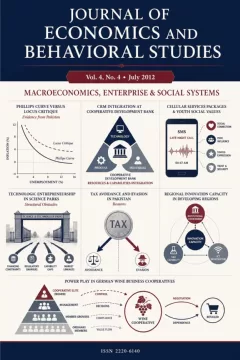
Amount of taxes serves as life blood for government. This paper aims to recognize reasons/causes of tax avoidance and evasion in Pakistan. Relationship between variables of reasons/causes of tax avoidance and evasion are also examined. A questionnaire is developed after reviewing literature to collect responses. Data are analyzed using percentages, arithmetic mean, standard deviation, variance, central limit theorem, cumulative normal distribution calculator, factor analysis, and correlation technique. Results indicate that all variables of reasons/causes of tax avoidance and evasion in Pakistan are correct. Furthermore, there exists a highly significant positive relationship between individual variables of reasons/causes of tax avoidance and evasion in Pakistan at 100% significance level.
Keywords
- Tax Evasion Search this journal for Tax Evasion (opens in a new tab)
- Tax Avoidance Search this journal for Tax Avoidance (opens in a new tab)
- Causes Search this journal for Causes (opens in a new tab)
- Central Limit Theorem Search this journal for Central Limit Theorem (opens in a new tab)
- Pakistan Search this journal for Pakistan (opens in a new tab)
References
- Allingham, M. & Sadmo, A. (1972). Income Tax Evasion: A Theoretical Analysis. Journal of Public Economics, 1, 323-338.
- Boylan, S. & Sprinkle, G. (2001). Experimental Evidence on the Relation between Tax Rates and Compliance: The Effect of Earned vs. Endowed Income. Journal of the American Taxation Association, 23(1), 75-90.
- Fisher, R., Goddeeris, J. & Young, J. (1989). Participation in Tax Amnesties: The Individual Income Tax. National Tax Journal , 42(2), 15-27.
- Lefebvre, M., Pestieau, P., Riedl, A. & Villeval, M. C. (2011). Tax Evasion, Welfare Fraud, and the Broken Windows Effect: An Experiment in Belgium, France and the Netherlands. IZA Discussion Paper No. 5609.
- Orewa, G. O. (1957). Taxation in Western Nigeria. London Oxford University Press.
- Pommerehne, W., Hart, A. & Frey, B. (1994). Tax Morale, Tax Evasion and the Choice of Policy Instruments in Different Political Systems. Public Finance , 49, 52-69.
- Schneider, F. & Enste, H. D. (2000). Shadow Economies around the World - Size, Causes, and Consequences. IMF Working Papers 00/26.
- Skinner, J. & Slemrod, J. (1985). An Economic Perspective on Tax Evasion. National Tax Journal, 38, 345353.
- Srinivasan, T. (1973). Tax Evasion: A Model. Journal of Public Economics, 2(3), 339-346.
- Uadiale, O. M., Fagbemi, T. O. & Ogunleye, J. O. (2010). An Empirical Study of the Relationship between Culture and Personal Income Tax Evasion in Nigeria. European Journal of Economics, Finance and Administrative Sciences , 20, 116-126.
- Warner, S. (1965). Randomized response: a survey technique for eliminating evasive answer bias. Journal of the American Statistical Association , 60, 63-69.
Downloads
No downloads have been recorded for this article yet. Figures appear here once readers begin downloading the full text.
How to Cite
Share this article
License
Copyright (c) 2012 Muhammad Muazzam Mughal, Muhammad Akram (Author)

This work is licensed under a Creative Commons Attribution 4.0 International License.
Author (s) should affirm that the material has not been published previously. It has not been submitted and it is not under consideration by any other journal. At the same time author (s) need to execute a publication permission agreement to assume the responsibility of the submitted content and any omissions and errors therein. After submission of revised paper in the light of suggestions of the reviewers, the editorial team edits and formats manuscripts to bring uniformity and standardization in published material.
This work will be licensed under Creative Commons Attribution 4.0 International (CC BY 4.0) and under condition of the license, users are free to read, copy, remix, transform, redistribute, download, print, search or link to the full texts of articles and even build upon their work as long as they credit the author for the original work. Moreover, as per journal policy author (s) hold and retain copyrights without any restrictions.
Keywords
- Tax Evasion Search this journal for Tax Evasion (opens in a new tab)
- Tax Avoidance Search this journal for Tax Avoidance (opens in a new tab)
- Causes Search this journal for Causes (opens in a new tab)
- Central Limit Theorem Search this journal for Central Limit Theorem (opens in a new tab)
- Pakistan Search this journal for Pakistan (opens in a new tab)
Section
Published
Submissions
Have research to publish? Journal of Economics and Behavioral Studies welcomes submissions.
Make a Submission