Articles

  • Article 1 in this issue

    Phillips Curve or Locus Critique: Time Series Evidence from Pakistan

    • Author: Ihtisham Ul Haq, Shaista Khan, Alam Khan, Ejaz Ahmed

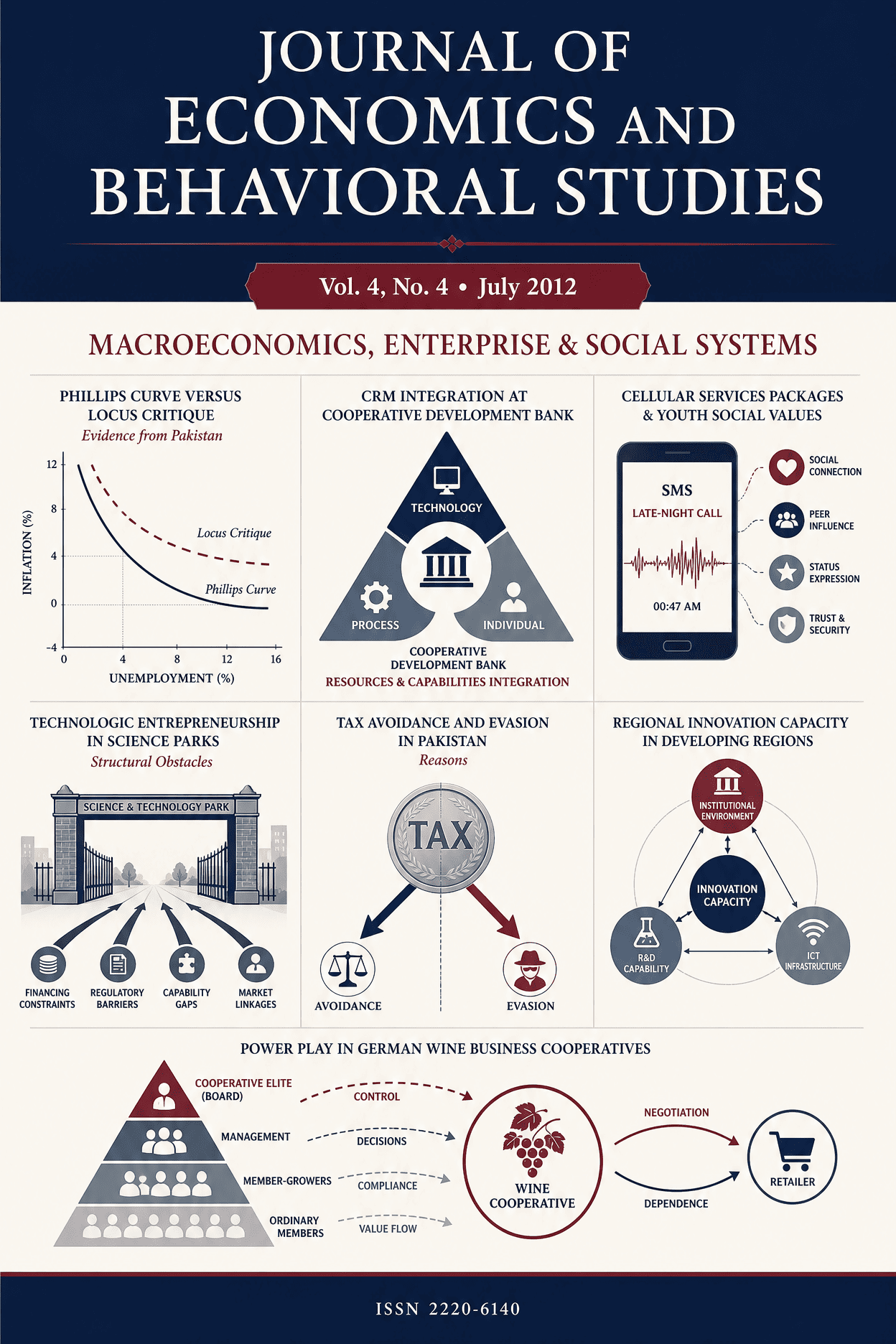
    Some economic problems facing by any economy are addressed such that minimum levels of these are acceptable. Inflation and unemployment are among such macroeconomic issues of which certain minimum level of both are accepted by economists. Nature of relationship between unemployment and inflation is important in economic literature. This study was performed to find this nature for a developing country. Time series data on both variables was analyzed for Pakistan from 1974 to 2010. ADF test was applied for detection of non-stationary. Problem of non-stationary was detected when variables were at level, which was eliminated by taking variables at first difference. Johansen co-integration confirmed one cointegration vector, which suggested the presence of long run relation between variables. VECM was used to find short and long run estimates. A short run relation was witnessed when unemployment worked as dependent variable and inflation as explanatory variable. This model was in equilibrium and thirty five percent disequilibria were adjusted annually as ECT value suggested. Inflation had a significant positive association with unemployment in study period. This study supported the Locus critique as opposed to Phillips curve hypothesis. Policy makers should pay special attention to this relationship between inflation and unemployment when they are going to design macroeconomic policies for Pakistan’s economy.

    Pages 190-193

    PDF - Phillips Curve or Locus Critique: Time Series Evidence from Pakistan (opens in a new tab)
  • Article 2 in this issue

    Integration of Resources and Capabilities to Implement CRM: Case of Cooperative Development Bank

    • Author: Alireza Shahraki, Fatemeh Kaveh, Samira khaniki

    In the past few years, due to various economic, social, and state banking system problems and above all, increasing the demand on supply, country's banks have always ignored customer orientation and its pillars, and have not been able to utilize modern marketing. This complete and comprehensive study, which has been developed chronologically, refers to this fact that although basic resources and capabilities such as information resources, analytical ability and operational capacity may affect on maintenance and protection process of under control properties, they are not sufficient to achieve desired performance in terms of acquisition and development of customers' relationships. In this study, Cooperative Development Bank (CDB) confirms that customer's satisfaction must be considered as a vital prerequisite for both acquisition and development processes of successful relationships for each company (both of them entail employees with relatively more familiarity with customers). Therefore, this paper emphasize on significance of trilateral resources and capabilities including technology, process and individual to implement an organizational CRM strategy successfully.

    Pages 194-203

    PDF - Integration of Resources and Capabilities to Implement CRM: Case of Cooperative Development Bank (opens in a new tab)
  • Article 3 in this issue

    Cellular Services Packages and their Impact on Social Values of Youth

    • Author: Syed Saad Hussain Shah, Sidra Waris, Jabran Aziz, Ahsan Raza Jaffari, Maira Fatima, Wasiq Ejaz, Syed Kamran Sherazi, Kashif Ur Rehman

    Youth plays a significant role in building of the nation and in the development of a country. Their adoption, aspiration, and objective lead towards change in social value of a culture. Ongoing study investigates the impact of telecom cellular services packages like late night call & unlimited Short Messaging Service (SMS) on the social values of Pakistani youth. In today’s competitive environment cellular companies are mainly targeting youth through their advertisements and would like the youth to get indulge in these activities in order to increase their sales but the point is up to what extent youth showing receptiveness and emotional attachment to these packages. Study was conducted in capital city of Pakistan i.e. Islamabad, mainly considering three famous universities; Iqra University, Bahria University & Foundation University with the sample of 250 respondents; convenient sampling technique is used & results are measured using multiple regression test. Major findings concluded that cellular advertisements of unlimited Short Messaging Service (SMS) and late night call packages have a negative impact on youth but youth is still willing to accept these advertisements as they are negatively attached to the advertisement and use of these packages.

    Pages 204-210

    PDF - Cellular Services Packages and their Impact on Social Values of Youth (opens in a new tab)
  • Article 4 in this issue

    Recognition of Structural Obstacles of Technologic Entrepreneurship in Science & Technology Parks

    • Author: Peyman Pournasr Khakbaz, Mehdi Salimi Torkamani

    Nowadays, a large ratio of nation's educated population suffers from unemployment problem. Since the available capacity of employment in governmental jobs is limited, hence the entrepreneurship can be a solution for resolving this problem or at least reducing it. The entrepreneurship centers in universities can play an important role in developing and promoting the entrepreneurship. The aim of current research is to investigate the structural obstacles of technologic entrepreneurship in Tehran University's science & technology Park. The research methodology is descriptive & survey and is of applied type. The research statistical society is the technological entrepreneurs of Tehran University's science & technology centers. Data gathering was carried out using researcher's questionnaire with a stability of α=0.92. Data analysis was performed in two descriptive and inferential levels using software SPSS 16. The research results revealed that the entrance of unskilled individuals into technologic topics, the lack of skilled labor force required by technologic entrepreneurship and the lack of sufficient infrastructures for technologic businesses are among the structural obstacles of technologic entrepreneurship. The obtained results are in line with researches of Phan and Der-Foo (2004). Regarding the obtained results, one can promote the technological entrepreneurship through planning and adoption of applied strategies for resolving the recognized obstacles.

    Pages 211-216

    PDF - Recognition of Structural Obstacles of Technologic Entrepreneurship in Science & Technology Parks (opens in a new tab)
  • Article 5 in this issue

    Reasons of Tax Avoidance and Tax Evasion: Reflections from Pakistan

    • Author: Muhammad Muazzam Mughal, Muhammad Akram

    Amount of taxes serves as life blood for government. This paper aims to recognize reasons/causes of tax avoidance and evasion in Pakistan. Relationship between variables of reasons/causes of tax avoidance and evasion are also examined. A questionnaire is developed after reviewing literature to collect responses. Data are analyzed using percentages, arithmetic mean, standard deviation, variance, central limit theorem, cumulative normal distribution calculator, factor analysis, and correlation technique. Results indicate that all variables of reasons/causes of tax avoidance and evasion in Pakistan are correct. Furthermore, there exists a highly significant positive relationship between individual variables of reasons/causes of tax avoidance and evasion in Pakistan at 100% significance level.

    Pages 217-222

    PDF - Reasons of Tax Avoidance and Tax Evasion: Reflections from Pakistan (opens in a new tab)
  • Article 6 in this issue

    Regional Innovation Capacity in Development Regions and Cities: A Sustainable Approach

    • Author: Peyman Pournasr Khakbaz

    This paper aims to identify innovation capacity factors affecting the development of regional by using the main index of legal and regulatory framework, research and development, communications and information technology, environment and institutional and human capital, education and social coverage. The research method is Qualitative and by focal group. Therefore, by choosing 6 from academic experts, the group was formed. To clarify the principles and basic format, explanations about of the meeting and a detailed description of the research model presented. Then to get more accurate and clearer data, and 5 core indicators parted to theirs sub indicators and the group members discussed them. The results showed that all five the main index of the "institutional environment", "R&D"1, "Using information and communication technology", "Legal and regulatory framework" and "human capital, education and social coverage" are impact on the development of region. The “country politic assessment " and "efficient and proper administration" which are two sub indicators of institutional environment and tow sub indicators of human capital, education and social coverage which are education and social coverage have impact on regional development .Also doing business and infrastructure of R&D which are sub indicators of legal and regulatory framework and R&D have impact on regional development. In the sub indicators of communications and information technology, “internet, computer and TV” and “government using of ICT “and quality of infrastructures have impact on regional development.

    Pages 223-226

    PDF - Regional Innovation Capacity in Development Regions and Cities: A Sustainable Approach (opens in a new tab)
  • Article 7 in this issue

    Power Play in the German Wine Business: Are German Wine Co-operatives able to Use their Power to manage their Business Relationships?

    • Author: Jon Henrich Hanf, Vera Belaya, Erik Schweickert

    Due to the pyramidal-hierarchical structure of supply chain networks power is an essential part of them and the fact that it is very often unequally distributed among the participants is quite obvious, which might represent great difficulties for member-owned enterprise coops. By clarifying the concept of power and identifying its five different sources, we were able to build hypotheses of how power affects cooperation and coordination – the two main elements of chain management in wine business. The first aim of our research is to elaborate on the question of power. Furthermore, we will construct some hypotheses regarding the use of power as a chain management instrument. Our second aim is to apply our general findings to the wine production chain, analysing the power play between cooperatives and retailers, and between cooperatives and their members. Due to the explorative nature of our study, we based the elaboration of our second aim on oral interviews, which were conducted in 2009, as well as in 2010, at five major international food and beverage fairs (twice ProWein, Anuga, and twice Fruit Logistica) in Germany. In addition, we conducted a comprehensive review of the Lebensmittelzeitung – the leading German food and beverage newspaper – for the last five years. Discussing our hypotheses in the context of the German wine sector, in which cooperatives are still of high importance, we were able to show that power is a very useful tool for managing strictlycoordinated chains. However, depending on which source the power originates from, its effect may be completely different.

    Pages 227-238

    PDF - Power Play in the German Wine Business: Are German Wine Co-operatives able to Use their Power to manage their Business Relationships? (opens in a new tab)