Abstract
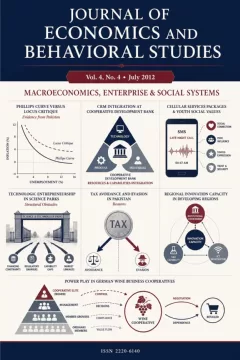
This paper aims to identify innovation capacity factors affecting the development of regional by using the main index of legal and regulatory framework, research and development, communications and information technology, environment and institutional and human capital, education and social coverage. The research method is Qualitative and by focal group. Therefore, by choosing 6 from academic experts, the group was formed. To clarify the principles and basic format, explanations about of the meeting and a detailed description of the research model presented. Then to get more accurate and clearer data, and 5 core indicators parted to theirs sub indicators and the group members discussed them. The results showed that all five the main index of the "institutional environment", "R&D"1, "Using information and communication technology", "Legal and regulatory framework" and "human capital, education and social coverage" are impact on the development of region. The “country politic assessment " and "efficient and proper administration" which are two sub indicators of institutional environment and tow sub indicators of human capital, education and social coverage which are education and social coverage have impact on regional development .Also doing business and infrastructure of R&D which are sub indicators of legal and regulatory framework and R&D have impact on regional development. In the sub indicators of communications and information technology, “internet, computer and TV” and “government using of ICT “and quality of infrastructures have impact on regional development.
Keywords
References
- Albino, V., Carbonara, N. & Messeni, P. A. (2007). Technology districts: proximity and knowledge access. Journal of Knowledge Management , 11, 98-114.
- Asheim, B. T. (1996). Industrial districts as ‘learning regions: a condition for prosperity? European Planning Studies , 4, 379-400.
- Archibugi, D. & Michie, J. (1995). Technology and innovation: an introduction. Cambridge Journal of Economics , 19, 1-4.
- Balconi, M., Breschi, S. & Lissoni, F. (2004). Networks of inventors and the location of academic research: an exploration of Italian patent data. Research Policy , 33(1), 127-45.
- Becattini, G. (1990). The Marshallian industrial district as a socio-economic notion, in Pyke, F., Becattini, G. and Sengenberger, E. (Eds), Industrial Districts and Inter firm Cooperation in Italy, International Institute of Labour Studies, Geneva, 37-51.
- Camagni, R. (1991). Local milieu, uncertainty and innovation networks: towards a new dynamic theory of economic space, in Camagni, R. (Ed.), Innovation Networks: Spatial Perspectives, Belhaven, London, 121-44.
- Claros, A. l. (2009). The Innovation Capacity Index: Factors, Policies, and Institutions Driving Country Innovation.
- Cohen, W. M. & Levinthal, D. (2008). Innovation and Learning: The Two Forces of R&D. Economic Journal , 99, 569-596.
- Cooke, P. & Memedovic, O. (2003). Strategies for Regional Innovation Systems: Learning Transfer and Application Policy Papers, UNIDO, Vienna.
- Cooke, P., Gomez, U. M. & Extebarria, G. (2004). Regional innovation systems: institutional and organizational dimensions. Research Policy , 26, 475-91.
- Dakhli, M. & De-Clercq, D. (2004). Human capital, social capital, and innovation: a multi-country study. Entrepreneurship & Regional Development , 16, 107-28.
- Doloreux, D. (2002). What should we know about regional systems of innovation. Technology in Society , 24, 243-63.
- Florida, R. (1995). Towards the learning region. Futures , 27, 527-36.
- Freeman, C. (1995). The National System of Innovation in historical perspective. Cambridge Journal of Economi , 19, 5-24.
- Edqvist, C. (2004). Systems of innovation – a critical review of the state of the art, in Fagerberg, J., Mowery, D. and Nelson, R. (Eds), Handbook of Innovation, Oxford University Press, Oxford.
- Furman, L. J., Porter, E. M. & Stern, S. (2000). The Determinants of National Innovative Capacity. JEL NO , 03, 033-057.
- Katz, D. & Kahn, R. (1996). The Social Psychology of Organizations, Wiley, New York, NY.
- Lundvall, B. A. (1992). National Systems of Innovation: Towards a Theory of Innovation and Interactive Learning, Pinter, London.
- Marshall, A. (1916). The Principles of Economics, Macmillan, London.
- Malerba, F. (2002). Sectoral systems of innovation and production. Research Policy , 31(2), 247-64.
- Malerba, F. & Orsenigo, L. (1995). Schumpeterian patterns of innovation. Cambridge Journal of Economics , 19(1), 19-47.
- Piore, M. & Sabel, C. (1984). The Second Industrial Divide, Basic Books, New York, NY.
- Storper, M. (1995). Competitiveness policy options: the technology-regions connection. Growth and Change, 285-308.
- Storper, M. (1997). The Regional World: Territorial Development in a Global Economy, Guilford Press, New York, NY.
- The Council on Competitiveness Organization. (2005). Measuring Regional Innovation, A Guidebook for Conducting Regional Innovation Assessments.
- Tura, T. & Harmaakorpi, V. (2005). Social capital in building regional innovative capability. Regional Studies , 39(8), 1111-25.
Downloads
No downloads have been recorded for this article yet. Figures appear here once readers begin downloading the full text.
How to Cite
Share this article
License
Copyright (c) 2012 Peyman Pournasr Khakbaz (Author)

This work is licensed under a Creative Commons Attribution 4.0 International License.
Author (s) should affirm that the material has not been published previously. It has not been submitted and it is not under consideration by any other journal. At the same time author (s) need to execute a publication permission agreement to assume the responsibility of the submitted content and any omissions and errors therein. After submission of revised paper in the light of suggestions of the reviewers, the editorial team edits and formats manuscripts to bring uniformity and standardization in published material.
This work will be licensed under Creative Commons Attribution 4.0 International (CC BY 4.0) and under condition of the license, users are free to read, copy, remix, transform, redistribute, download, print, search or link to the full texts of articles and even build upon their work as long as they credit the author for the original work. Moreover, as per journal policy author (s) hold and retain copyrights without any restrictions.
Keywords
Section
Published
Submissions
Have research to publish? Journal of Economics and Behavioral Studies welcomes submissions.
Make a Submission