Abstract
Financial economists believe that the arbitrage forces in the market are the main reason of market efficiency and these forces are the fundamental concept of efficient market hypothesis (EMH). During last few years, various theoretical and empirical evidences have been presented to support the work of financial modeling for the markets with less than rational investors whose trading strategies are based on psychological factors like mood and emotions. Weather condition is among the substantial factors affecting investors’ mood and emotions. Present study investigates the impact of temperature on stock market returns in emerging economy of Pakistan. Using the daily temperature records and stock market indices of Karachi and Islamabad, the study has employed auto regressive (AR) – generalized autoregressive conditional heteroscedasticity (GARCH) model from 2006 to 2010. Based on AR (1)-GARCH (1, 1) estimation the study has found that weather temperatures of both Karachi and Islamabad are negatively related with Karachi Stock Exchange (KSE) and Islamabad Stock Exchange (ISE) index returns, respectively.
Keywords
- Behavioral Finance Search this journal for Behavioral Finance (opens in a new tab)
- Market Anomaly Search this journal for Market Anomaly (opens in a new tab)
- Weather Effect Search this journal for Weather Effect (opens in a new tab)
- AR-GARCH Model Search this journal for AR-GARCH Model (opens in a new tab)
- Temperature Effect Search this journal for Temperature Effect (opens in a new tab)
References
- Barberis, N. C. & Thaler, R. H. (2003). A Survey of Behavioral Finance. In: George M. Constantinides, Milton Harris, and Ren_e M. Stulz, eds. Handbook of the Economics of Finance: Volume 1B, Financial Markets and Asset Pricing. Elsevier North Holland , 18, 1053-1128.
- Bollerslev, T. & Wooldridge, J. M. (1992). Quasi-maximum likelihood estimation and inference in dynamic models with time varying covariances. Econometric Reviews , 11, 143-72.
- Cao, M. & Wei, J. (2002). Stock market returns: a temperature anomaly. Working Paper, Schulich School of Business, York University, Canada.
- Cao, M. & Wei, J. (2005). Stock market returns: a note on temperature anomaly. J Banking Finance , 29, 155973.
- Frijda, N. (1988). The laws of emotion. Cognition and Emotion, 1, 235-258.
- Hirshleifer, D. & Shumaway, T. (2003). Good Day Sunshine: Stock Returns and the Weather. Journal of Finance , 58, 1009-1032.
- Keef, S. P. & Roush, M. L. (2005). Stock prices and Wall Street weather: revisited. Eurasian Review of Economics and Finance , 1, 31– 44.
- Loewenstein, G. F., Elke, U. W., Christopher, K. H. & Welch, N. (2001). Risk as feelings. Psychological Bulletin , 127, 267–286.
- Saunders, E. M. J. (1993). Stock prices and Wall Street weather. American Economic Review, 83, 1337-1345.
- Schwartz, N. (1990). Feelings as information: informational and motivational functions of affective states. In Higgins and Sorrentino, Handbook of Motivation and Cognition New- York, Guildford Press. 2, 527561..
- Schwarz, N. & Clore, G. L. (1983). Mood, misattribution and judgments of well-being: indirect functions of affective states. Journal of Personality and Social Psychology , 45, 513-523.
- Selden, G. C. (1912). Psychology of the Stock Market: Human Impulses Lead To Speculative Disasters. New York: Ticker Publishing.
- Sriboonchitta, S., Chitip, P., Sriwichailamphan, T. & Chaiboonsri, C. (2011). Stock market returns and the temperature effect. Thailand International Research Journal of Management and Business Studies, 1(1), 012-016.
- Tufan, E. & Hamarat, B. (2004). Do Cloudy Days Affect Stock Exchange Returns: Evidence from Istanbul Stock Exchange? Journal of Naval Science and Engineering 2(1), 117-126.
Downloads
No downloads have been recorded for this article yet. Figures appear here once readers begin downloading the full text.
How to Cite
Share this article
License
Copyright (c) 2012 Hammad Hassan Mirza, Muhammad Jam e Kausar Ali Asghar, Naveed Mushtaq (Author)

This work is licensed under a Creative Commons Attribution 4.0 International License.
Author (s) should affirm that the material has not been published previously. It has not been submitted and it is not under consideration by any other journal. At the same time author (s) need to execute a publication permission agreement to assume the responsibility of the submitted content and any omissions and errors therein. After submission of revised paper in the light of suggestions of the reviewers, the editorial team edits and formats manuscripts to bring uniformity and standardization in published material.
This work will be licensed under Creative Commons Attribution 4.0 International (CC BY 4.0) and under condition of the license, users are free to read, copy, remix, transform, redistribute, download, print, search or link to the full texts of articles and even build upon their work as long as they credit the author for the original work. Moreover, as per journal policy author (s) hold and retain copyrights without any restrictions.
Keywords
- Behavioral Finance Search this journal for Behavioral Finance (opens in a new tab)
- Market Anomaly Search this journal for Market Anomaly (opens in a new tab)
- Weather Effect Search this journal for Weather Effect (opens in a new tab)
- AR-GARCH Model Search this journal for AR-GARCH Model (opens in a new tab)
- Temperature Effect Search this journal for Temperature Effect (opens in a new tab)
Section
Published in
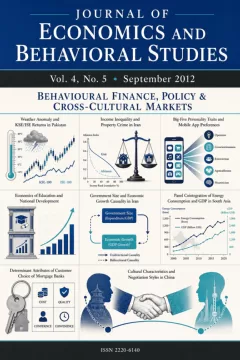 Vol. 4 No. 5 (2012)
Behavioural Finance, Policy & Cross-Cultural Markets
View issue contents
Published
Submissions
Have research to publish? Journal of Economics and Behavioral Studies welcomes submissions.
Make a Submission