Articles

  • Article 1 in this issue

    Stock Market Returns and Weather Anomaly: Evidence from an Emerging Economy

    • Author: Hammad Hassan Mirza, Muhammad Jam e Kausar Ali Asghar, Naveed Mushtaq

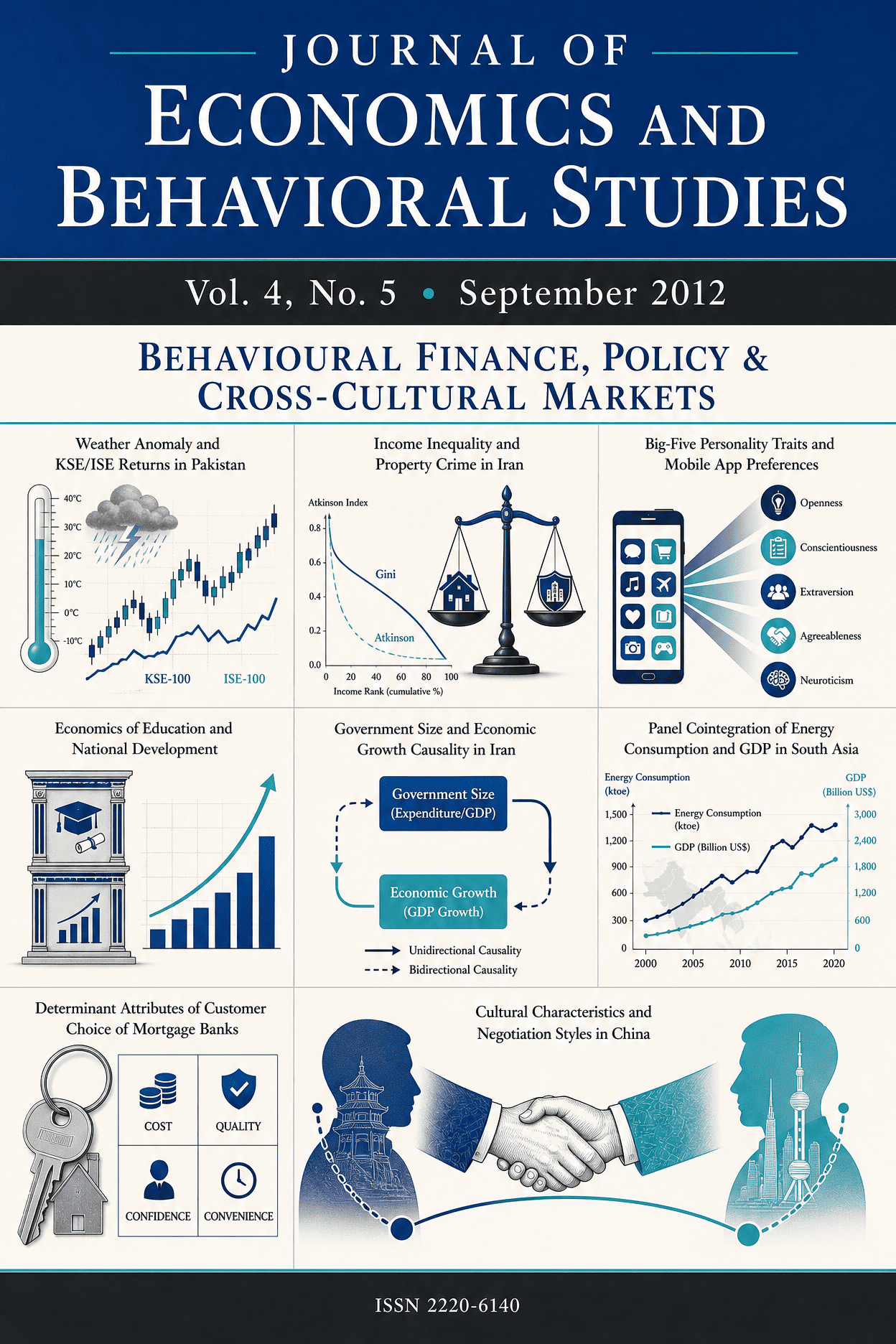
    Financial economists believe that the arbitrage forces in the market are the main reason of market efficiency and these forces are the fundamental concept of efficient market hypothesis (EMH). During last few years, various theoretical and empirical evidences have been presented to support the work of financial modeling for the markets with less than rational investors whose trading strategies are based on psychological factors like mood and emotions. Weather condition is among the substantial factors affecting investors’ mood and emotions. Present study investigates the impact of temperature on stock market returns in emerging economy of Pakistan. Using the daily temperature records and stock market indices of Karachi and Islamabad, the study has employed auto regressive (AR) – generalized autoregressive conditional heteroscedasticity (GARCH) model from 2006 to 2010. Based on AR (1)-GARCH (1, 1) estimation the study has found that weather temperatures of both Karachi and Islamabad are negatively related with Karachi Stock Exchange (KSE) and Islamabad Stock Exchange (ISE) index returns, respectively.

    Pages 239-244

    PDF - Stock Market Returns and Weather Anomaly: Evidence from an Emerging Economy (opens in a new tab)
  • Article 2 in this issue

    The Effect of Income Inequality on Property Crime: Evidence from Iran

    • Author: Najmeh Izadi, Khosrow Piraee

    The main purpose of this study is to examine the relationship between income inequality and property crime rate, including auto theft, burglary and larceny, in Iran from 1984 to 2009. Income inequality measures include Gini coefficient and Atkinson index, with 1 and 2 degrees of inequality aversion (e=1, 2). Unrestricted error correction model (UECM)is employed to do bounds test and to examine the presence of cointegration. The results indicate that there is not any long-run relationship between income inequality and property crime rate.

    Pages 245-251

    PDF - The Effect of Income Inequality on Property Crime: Evidence from Iran (opens in a new tab)
  • Article 3 in this issue

    The Influence of Personality Traits on Mobile Phone Application Preferences

    • Author: Wilburn Lane, Chris Manner

    Understanding mobile phone users' preferences and behavior is essential for the commercial success of new application development. This study aims to enhance this understanding by identifying the personality traits associated with smart phone application use. Multiple regressions were used to analyze results from a sample of 233 participants. Consistent with recent personality research, we found that the "Big Five" personality dimensions are related to the application of smartphone technology. Extroverted individuals reported greater importance on gaming applications, but they viewed productivity applications as less important. Also, neurotics placed greater importance on travel applications, while less conscientious people indicated that communication, productivity, and utilities applications were less important to them.

    Pages 252-260

    PDF - The Influence of Personality Traits on Mobile Phone Application Preferences (opens in a new tab)
  • Article 4 in this issue

    The Economy of Education and its Role in National Development

    • Author: Yousef Mehnatfar, Abbas Rahi

    We can say indubitable that education is one of the main elements of economic growth and development of each country. Even, some believe that evolution and progress of this part causes progress of the other parts. Economics education is a combination of word “economy” and “education” that study usage of economics in the education system; hereby, it considers a branch of economics. And it considers one of the courses of education science because it attends to recognition of economic issues of education and improvement of efficiency of education system. So, for acquaintance with economics education, it’s necessary to first understand the economics and its related objects; it means that we should have perfect and exact recognition about current expenditure that pay for education of manpower. Moreover, it can be mentioned to the role of education as a collector of force and human capital needed for economic and social development of communities. In this article, it is mentioned to education in Iran as for its high expenditure.

    Pages 261-267

    PDF - The Economy of Education and its Role in National Development (opens in a new tab)
  • Article 5 in this issue

    The Relationship between Government Size and Economic Growth in Iran; Bivariate and Trivariate Causality Testing

    • Author: Salma Keshtkaran, Khosrow Piraee, Farzane Bagheri

    The aim of this study is to demonstrate the relationship between government size and economic growth in Iran within bivariate and trivariate causality framework. For this purpose, Vector Auto Regressive Model, Johansen Test and Auto Regressive Distributed Lag Model were used for analyzing the long run relationship, whereas Error Correction Model was considered for the short run. Moreover Wald Coefficient was used for bivariate and trivariate causality test. The results show that the relationship between government size and economic growth in Iran is negative. Furthermore there is a one-way causality relationship for the long run and the short run-from government size to economic growth. Inclusion of unemployment and oil revenue (separately) as the third variable causes the relationship to remain negative. However the direction of causality depends on the choice of the third variable. If unemployment rate is considered as the third variable instead, there will be no causality between the two variables in the long run. Although in the short run government size is still the cause of economic growth. However, consideration of oil revenue as the third variable results in a two-way causality relationship between the government size and the economic growth in the long run and the short run.

    Pages 268-276

    PDF - The Relationship between Government Size and Economic Growth in Iran; Bivariate and Trivariate Causality Testing (opens in a new tab)
  • Article 6 in this issue

    Panel Cointegration and Pooled Mean Group Estimations of Energy-Output Dynamics in South Asia

    • Author: Anupam Das, Murshed Chowdhury, Muhammad Akhtaruzzaman

    This study employs the panel cointegration and pooled mean group (PMG) techniques to examine the long run relationships between energy consumption and GDP for 5 South Asian countries from 1981 to 2009. Unit root and panel cointegration tests find a long run relationship between energy consumption and GDP after allowing for country-specific effect. Furthermore, we use the PMG technique to identify the magnitude of this relationship. Our results are consistent with the theory that suggests a role of energy use in GDP. On average, a 1% increase in energy consumption leads to a 0.61% increase in the long run GDP in South Asia from 1981 to 2009. Hence, it is apparent that energy is an important component to maintain the economic activities in these countries. These results have important implications for policy makers of South Asian countries which have experienced magnificent growth performance along with a sharp rise in consumption demand for energy in last few decades.

    Pages 277-286

    PDF - Panel Cointegration and Pooled Mean Group Estimations of Energy-Output Dynamics in South Asia (opens in a new tab)
  • Article 7 in this issue

    Determinant Attributes of Customer Choice of Banks, Supplying Mortgage Products

    • Author: Irfan Ahmed, Saira Ashfaq, Shahid Mahmood, Umar Farooq

    The present study focuses on finding out the main attributes that determine the customer’s choice of bank for supplying the mortgage products. The data has been gathered through questionnaires from 400 customers using mortgage products of different banks. Reviewing the literature four variable are taken for study to determine the dependent variable customer choice of banks using mortgage products and they include cost of bank, quality of services, confidence of customer in bank and convenience of customer using mortgage product. Results were analyzed using ordinary least square (OLS) regression and correlation techniques and findings of the data have been tested which appeared as significant statistically. The results indicated that choice of customers for the mortgage product depends on all the independent variables like quality of services, cost of mortgage product, confidence level of customers build by the bank and convenience of the customers. Further analysis can be done on exploring more independent variables, which are important for customers in choosing a bank providing mortgage products.

    Pages 287-296

    PDF - Determinant Attributes of Customer Choice of Banks, Supplying Mortgage Products (opens in a new tab)
  • Article 8 in this issue

    Cultural Characteristics and Negotiation Styles

    • Author: Yu-Te Tu

    Numerous factors can affect the results of the negotiating process. Successful negotiation not only requires acquiring technical communicative abilities, but also an understanding of the cultural context of the negotiation by both parties. Due to its size and rapid economic development, China has become an increasingly important factor for world economy and growth. Until recently, conducting business in China has been a challenging and sometimes futile venture for businesses trying to break into this lucrative market because China’s government has maintained very strict rules for the import of goods and services for resale to China, while widely exporting Chinese goods and services. The approach uses Casse and Deols’ model and cultural factors including education, religion and degrees of individualism/collectivism to be the dependent and independent variables. Data were collected from public companies listed on the stock exchanges of China by means of an online survey method. Structural equation modeling was used to test hypothesized models and hypotheses of research. The findings show that education, religion and degrees of individualism/collectivism affects the style of negotiation. These findings could be useful in the application of a specific set of values and attitudes that relate to regional cultural attributes, and develop better negotiation skills by providing insights into the nuances of international negotiations. The researcher suggests that the negotiators still need to be trained in body language, strategies, temper control, international manners, and customs. A better knowledge of negotiation should be helpful in understanding business and in realizing which negotiation styles are most appropriate for a particular country.

    Pages 297-306

    PDF - Cultural Characteristics and Negotiation Styles (opens in a new tab)