Abstract
The main purpose of this study is to examine the relationship between income inequality and property crime rate, including auto theft, burglary and larceny, in Iran from 1984 to 2009. Income inequality measures include Gini coefficient and Atkinson index, with 1 and 2 degrees of inequality aversion (e=1, 2). Unrestricted error correction model (UECM)is employed to do bounds test and to examine the presence of cointegration. The results indicate that there is not any long-run relationship between income inequality and property crime rate.
Keywords
References
- Allen, R. (1996). Socioeconomic conditions and property crime :a comprehensive review and test of the professional literature. American Journal of Economics and Sociology, 55(3), 293–308.
- Atkinson, A.B. (1970). On the measurement of inequality. Journal of Economic Theory , 2, 244-263.
- Baharom, A. H. & Habibullah, M. S. (2009). Crime and income inequality: The case of Malaysia. Journal of Politics and Law , 2(1), 55 – 77.
- Becker, G. S. (1968).Crime and punishment: An economic approach. Journal of Political Economy , 76, 11691217.
- Bourguignon, F., Nunez, J. & Sanchez, F. (2003). What part of the income distribution does matter for explaining crime? The case of Colombia. Working Paper, Paris department et laboratoire D Economie Theorique et Appliquee (DELTA).
- Brush, J. (2007). Does income inequality lead to more crime? A comparison of cross-sectional and time series analyses of United States countries. Economics Letters , 96, 264-268.
- Chiu, W. H. & Madden, P. (1998). Burglary and income inequality. Journal of Public Economics , 69, 123-141.
- Choe, J. (2008). Income inequality and crime in the United States. Economics Letters , 101, 31-33.
- Ehrlich, I. (1973). Participation in illegitimate activities: A theoretical and empirical investigation. Journal of Political Economy , 38(3), 521-565.
- Fajnzylber, P., Lederman, D. & Loayza, N. (2002a). What causes violent crime? European Economic Review , 46, 1323-1357.
- Fajnzylber, P., Lederman, D. & Loayza, N. (2002b). Inequality and violent crime. Journal of Law & Economics , 45(1), 1-41.
- Fleisher, B. (1966). The effect of income on delinquency. American Economic Review , 56, 118-137.
- Imrohoroglu, A., Merlo, A. & Rupert, P. (2006). Understanding the determinants of crime. Journal of Economics and Finance, 30(2), 270–283.
- Kelly, M. (2000). Inequality and crime. The Review of Economics and Statistics, 82(4), 530-539.
- Keshavarz-Haddad, G. H. & Markazi-Moghadam, H. (2010). The socioeconomic and demographic determinants of crime in Iran (a regional panel study). Eur JLaw Econ . DOI 10. 1007/s10657-0109152-4.
- Madden, P. &Chiu, W.H. (1998).Burglary and income inequality. Journal of Public Economics, 69, 123-141.
- Narayan, P.K. (2005).The saving and investment nexus for China: Evidence from cointegration tests. Applied Economics, 37, 1979–1990.
- Neumayer, E. (2005).Inequality and violent crime: Evidence from data on robbery and violent theft. Journal of Peace Research , 42(1), 101–112.
- Nilsson, A. (2004). Income inequality and crime: The case of Sweden, Institute for Labor Market Policy Evaluation Working Paper.
- Pesaran, M. H., Shin, Y. & Smith, R. J. (2001).Bounds testing approaches to the analysis of level relationship. Journal of Applied Econometrics, 16, 289-326.
- Scorzafave, L.G. & Soares, M.K. (2009).Income inequality and pecuniary crimes. Economics Letters, 104, 40 – 42.
- Tang, C. F. & Lean, H. H. (2009). New evidence from the misery index in the crime function. Economics Letters , 104, 112-115.
Downloads
No downloads have been recorded for this article yet. Figures appear here once readers begin downloading the full text.
How to Cite
Share this article
License
Copyright (c) 2012 Najmeh Izadi, Khosrow Piraee (Author)

This work is licensed under a Creative Commons Attribution 4.0 International License.
Author (s) should affirm that the material has not been published previously. It has not been submitted and it is not under consideration by any other journal. At the same time author (s) need to execute a publication permission agreement to assume the responsibility of the submitted content and any omissions and errors therein. After submission of revised paper in the light of suggestions of the reviewers, the editorial team edits and formats manuscripts to bring uniformity and standardization in published material.
This work will be licensed under Creative Commons Attribution 4.0 International (CC BY 4.0) and under condition of the license, users are free to read, copy, remix, transform, redistribute, download, print, search or link to the full texts of articles and even build upon their work as long as they credit the author for the original work. Moreover, as per journal policy author (s) hold and retain copyrights without any restrictions.
Keywords
Section
Published in
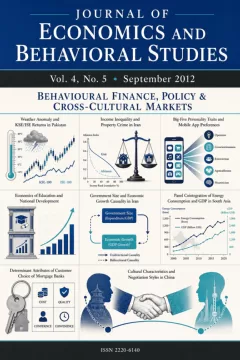 Vol. 4 No. 5 (2012)
Behavioural Finance, Policy & Cross-Cultural Markets
View issue contents
Published
Submissions
Have research to publish? Journal of Economics and Behavioral Studies welcomes submissions.
Make a Submission