Abstract
Understanding mobile phone users' preferences and behavior is essential for the commercial success of new application development. This study aims to enhance this understanding by identifying the personality traits associated with smart phone application use. Multiple regressions were used to analyze results from a sample of 233 participants. Consistent with recent personality research, we found that the "Big Five" personality dimensions are related to the application of smartphone technology. Extroverted individuals reported greater importance on gaming applications, but they viewed productivity applications as less important. Also, neurotics placed greater importance on travel applications, while less conscientious people indicated that communication, productivity, and utilities applications were less important to them.
Keywords
- Personality Traits Search this journal for Personality Traits (opens in a new tab)
- Mobile Phone Applications Search this journal for Mobile Phone Applications (opens in a new tab)
- Big Five Inventory Search this journal for Big Five Inventory (opens in a new tab)
- Extraversion Search this journal for Extraversion (opens in a new tab)
- Conscientiousness Search this journal for Conscientiousness (opens in a new tab)
References
- Barrick, M. R. & Mount, M. K. (1991). The big five personality dimensions and job performance: A metaanalysis. Personnel Psychology , 44(1), 1–26.
- Barrick, M. R., Mount, M. K. & Judge, T. A. (2001). Personality and performance at the beginning of the new millennium: What do we know and where do we go next? International Journal of Selection and Assessment, 9(1-2), 9–30.
- Bianchi, A. & Phillips, J. K. (2005). Psychological predictors of problem mobile phone use. Cyber Psychology & Behavior, 8, 39-51.
- Briggs, S. R. (1992). Assessing the five-factor model of personality description. Journal of Personality, 60(2), 253-293.
- Brownlow, M. (2011). Smartphone sales and statistics. Email Marketing Reports. Retrieved from http://www.email-marketing-reports.com/wireless-mobile/smartphone- statistics.htm.
- Costa, P. T. & McCrae, R. R. (1992). Revised neo personality inventory_neo pi-r_ and neo five-factor inventory neo-ffi professional manual. Odessa, FL: Psychological Assessment Resources.
- Devaraj, S., Easley, R. F. & Crant, J. M. (2008). How does personality matter? Relating the five factor model to technology acceptance and use. Information Systems Research, 19 (1), 93-105.
- Digman, J. M. (1990). Personality structure: emergence of the five- factor model. Annual Review of Psychology, 41 (1), 417-440.
- Ehrenberg, A. S., Juckes, K. M., White, H. & Walsh, S. P. (2008). Personality and self-esteem as predictors of young people’s technology use. Cyber Psychology and Behavior, 11(6), 739-741.
- Entner, R. (2010). Smartphones to overtake feature phones in U.S. by 2011. Retrieved from http://blog.nielsen.com/nielsenwire/consumer/smartphones-to-overtake-feature-phones- in-u-s by-2011.
- Greengard, S. (2010). The Pew Report on Mobile Apps. Communications of the ACM, 51(11), 17. Retrieved from http://www.webopedia.com/TERM/M/mobile_application.html
- John, O. P. (1990). The 'Big Five' factor taxonomy: Dimensions of personality in natural language and in questionnaires. In L. Pervin (Ed.), Handbook of Personality: Theory and Research. 56-100, New York: Guilford Press.
- Lane, W. & Manner, C. (2011). The impact of personality traits on smartphone ownership and use. International Journal of Business and Social Science , 2(17), 22-28.
- McCrae, R. R. & Costa P. T. (1997). Conceptions and correlates of openness to experience. In R. Hogan, J. Johnson, & S. Briggs, Handbook of personality psychology (825-847). San Diego: Academic Press.
- McElroy, J. C., Hendrickson, A. R., Townsend, A. M. & DeMarie, S. M. (2007). Dispositional factors in internet use: personality versus cognitive style. MIS Quarterly, 31(4), 809-820.
- Mobile Applications. (2008). Mobile Marketing Association. Retrieved from http://www.google.com/url?sa=t&rct=j&q=&esrc=s&source=web&cd=1&ved=0CFUQFjAA&url=http %3A%2F% 2Fwww.mmaglobal.com%2Ffiles%2Fmobileapplications.pdf.
- Mobile Social Gamers. (2011). The-New-Mass-Market-Powerhouse. Mobile Social Gamers. Retrieved from http://blog.flurry.com/bid/57219/Mobile-Social-Gamers
- Phillips, J. G., Butt, S. & Blaszczynski, A. (2006). Personality and self-reported use of mobile phones for games. Cyber Psychology & Behavior, 9(6), 753-758.
- Phillips, S. (2010). An app for everything. License! Global , 13(4), 140,142.
- Tabachnick, B. G. & Fidell, L. S. (2000). Using multivariate statistics, 4th ed. Boston: Allyn & Bacon.
- U.S. mobile local ad revenue to grow from $404 million in 2010 to $2.8 billion in 2015. (2011). BIA/Kelsey. Retrieved from http://www.biakelsey.com/Advisory-Services/Social-Local-Media.
- Watson, D. & Clark, L. A. (1997). Extraversion and its positive emotional core. R. Hogan, J. Johnson, S. Briggs, eds. Handbook of Personality Psychology. Academic Press, San Diego, 767–793.
- Weintraub, S. (2010). 2011 will be the year android explodes. Retrieved from http://tech.fortune.cnn.com/2010/12/22/2011-will-be-the-year-android-explodes.
- Whitney, L. (2011). Smartphones to dominate PCs in Gartner Forecast. Retrieved from http://news.cnet.com/8301-1001_3-10434760-92.html.
Downloads
No downloads have been recorded for this article yet. Figures appear here once readers begin downloading the full text.
How to Cite
Share this article
License
Copyright (c) 2012 Wilburn Lane, Chris Manner (Author)

This work is licensed under a Creative Commons Attribution 4.0 International License.
Author (s) should affirm that the material has not been published previously. It has not been submitted and it is not under consideration by any other journal. At the same time author (s) need to execute a publication permission agreement to assume the responsibility of the submitted content and any omissions and errors therein. After submission of revised paper in the light of suggestions of the reviewers, the editorial team edits and formats manuscripts to bring uniformity and standardization in published material.
This work will be licensed under Creative Commons Attribution 4.0 International (CC BY 4.0) and under condition of the license, users are free to read, copy, remix, transform, redistribute, download, print, search or link to the full texts of articles and even build upon their work as long as they credit the author for the original work. Moreover, as per journal policy author (s) hold and retain copyrights without any restrictions.
Keywords
- Personality Traits Search this journal for Personality Traits (opens in a new tab)
- Mobile Phone Applications Search this journal for Mobile Phone Applications (opens in a new tab)
- Big Five Inventory Search this journal for Big Five Inventory (opens in a new tab)
- Extraversion Search this journal for Extraversion (opens in a new tab)
- Conscientiousness Search this journal for Conscientiousness (opens in a new tab)
Section
Published in
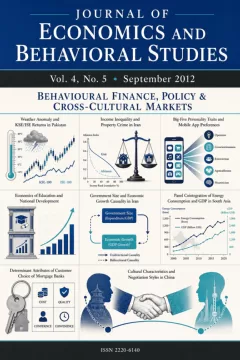 Vol. 4 No. 5 (2012)
Behavioural Finance, Policy & Cross-Cultural Markets
View issue contents
Published
Submissions
Have research to publish? Journal of Economics and Behavioral Studies welcomes submissions.
Make a Submission