Abstract
The aim of this study is to demonstrate the relationship between government size and economic growth in Iran within bivariate and trivariate causality framework. For this purpose, Vector Auto Regressive Model, Johansen Test and Auto Regressive Distributed Lag Model were used for analyzing the long run relationship, whereas Error Correction Model was considered for the short run. Moreover Wald Coefficient was used for bivariate and trivariate causality test. The results show that the relationship between government size and economic growth in Iran is negative. Furthermore there is a one-way causality relationship for the long run and the short run-from government size to economic growth. Inclusion of unemployment and oil revenue (separately) as the third variable causes the relationship to remain negative. However the direction of causality depends on the choice of the third variable. If unemployment rate is considered as the third variable instead, there will be no causality between the two variables in the long run. Although in the short run government size is still the cause of economic growth. However, consideration of oil revenue as the third variable results in a two-way causality relationship between the government size and the economic growth in the long run and the short run.
Keywords
- Government Size Search this journal for Government Size (opens in a new tab)
- Economic Growth Search this journal for Economic Growth (opens in a new tab)
- Unemployment Rate Search this journal for Unemployment Rate (opens in a new tab)
- Oil Income Search this journal for Oil Income (opens in a new tab)
References
- Bairam, E. (1990). Government Size and Economic Growth: The African Experience, 1960-85. Applied Economics , 22, 1427-35.
- Barro, R. J. (1991). Economic Growth in a Cross Section of Countries. The Quarterly Journal of Economics , 106(2), 407-443.
- Cheung, Y. & Lai, K. (1993). Finite-Sample Sizes of Johansen’s Likelihood Ratio Tests for Cointegration. Oxford Bulletin of Economics and statistics , 55, 313-328.
- Dar, E. & Amir, k. (2002). Government Size, Factor Accumulation and Economic Growth: Evidence from OECD Countries. Journal of Policy Modeling , 24, 679-692.
- Ghali, K. H. (1998). Government Size and Economics Growth; Evidence from a Multivariate Cointegration Analysis. Applied Economic , 31, 975-987.
- Johansen, S. (1991). Estimation and Hypothesis Testing of Cointegration Vectors in Gaussian Vector Autoregressive Models . Econometrica , 59, 1551-80.
- Johansen, S. (1995). Likelihood-Based Inference in Cointegrated Vector Autoregressive Models . New York Oxford University Press.
- Kolluri B. (2000).Government Expenditure and Economic Growth: Evidence from G7 Countries. Applied Economics , 32, 1059-1068.
- Landau, D. (1983). Government and Economic Growth in The Less Developed Countries: An Empirical Study for 1960-1980. The University of Chicago Press , 35(1), 35-75.
- Loizides, W. & Vamvoukas, Z. (2005). Government Expenditure and Economic Growth: Evidence from Trivariate Causality Testing. Journal of Applied Economics , 1, 125-152.
- Perron, P. (1989). The great crash, the oil price shock, and the unit root hypothesis. Econometrica , 99, 1361– 1401.
- Ram, R. (1986). Government Size and Economics Growth: A New Framework and Some Evidence from CrossSection and Time- Series Data. American Economic Review , 79, 191- 203.
- 4 - The “Law of increasing expansion of public and particularly state activities” (Wagner, 1893)- is one of the earliest attempts that emphasize economic growth as the fundamental determinant of public sector growth.
- Ram, R. (1986). Government Size and Economics Growth: A New Framework and Some Evidence from CrossSection and Time- Series Data: Reply. American Economic Review , 79, 281- 284.
- Romer, D. (2001). Advanced Macroeconomics, McGraw-Hill Wagner, A. (1893). Grundlegung der Politischen Okonomie, 3rd ed., Leipzig, C.F. Winter Vedder, T. & Gallaway, Y. (1998). Government Size and Economic Growth, Paper Prepared for The Joint Economic Committee of The US Congress, 1-15.
Downloads
No downloads have been recorded for this article yet. Figures appear here once readers begin downloading the full text.
How to Cite
Share this article
License
Copyright (c) 2012 Salma Keshtkaran, Khosrow Piraee, Farzane Bagheri (Author)

This work is licensed under a Creative Commons Attribution 4.0 International License.
Author (s) should affirm that the material has not been published previously. It has not been submitted and it is not under consideration by any other journal. At the same time author (s) need to execute a publication permission agreement to assume the responsibility of the submitted content and any omissions and errors therein. After submission of revised paper in the light of suggestions of the reviewers, the editorial team edits and formats manuscripts to bring uniformity and standardization in published material.
This work will be licensed under Creative Commons Attribution 4.0 International (CC BY 4.0) and under condition of the license, users are free to read, copy, remix, transform, redistribute, download, print, search or link to the full texts of articles and even build upon their work as long as they credit the author for the original work. Moreover, as per journal policy author (s) hold and retain copyrights without any restrictions.
Keywords
- Government Size Search this journal for Government Size (opens in a new tab)
- Economic Growth Search this journal for Economic Growth (opens in a new tab)
- Unemployment Rate Search this journal for Unemployment Rate (opens in a new tab)
- Oil Income Search this journal for Oil Income (opens in a new tab)
Section
Published in
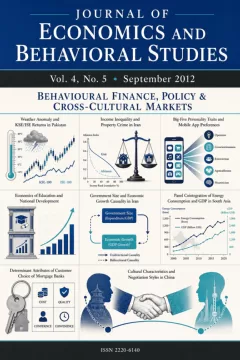 Vol. 4 No. 5 (2012)
Behavioural Finance, Policy & Cross-Cultural Markets
View issue contents
Published
Submissions
Have research to publish? Journal of Economics and Behavioral Studies welcomes submissions.
Make a Submission