Abstract
This study employs the panel cointegration and pooled mean group (PMG) techniques to examine the long run relationships between energy consumption and GDP for 5 South Asian countries from 1981 to 2009. Unit root and panel cointegration tests find a long run relationship between energy consumption and GDP after allowing for country-specific effect. Furthermore, we use the PMG technique to identify the magnitude of this relationship. Our results are consistent with the theory that suggests a role of energy use in GDP. On average, a 1% increase in energy consumption leads to a 0.61% increase in the long run GDP in South Asia from 1981 to 2009. Hence, it is apparent that energy is an important component to maintain the economic activities in these countries. These results have important implications for policy makers of South Asian countries which have experienced magnificent growth performance along with a sharp rise in consumption demand for energy in last few decades.
Keywords
- Energy Consumption Search this journal for Energy Consumption (opens in a new tab)
- Growth Search this journal for Growth (opens in a new tab)
- South Asia Search this journal for South Asia (opens in a new tab)
- Panel Cointegration Search this journal for Panel Cointegration (opens in a new tab)
- Pooled Mean Group Search this journal for Pooled Mean Group (opens in a new tab)
References
- Akarca, A. T. & Long, T. V. (1979). Energy and Employment: A Time Series Analysis of the Causal Relationship. Resources and Energy, 2(2-3), 151–162.
- Apergis, N. & Payne, J. E. (2009). Energy Consumption and Economic Growth in Central America: Evidence from a Panel Cointegration and Error Correction Model. Energy Economics, 31(2), 211-216.
- Apergis, N. & Payne, J. E. (2011). Renewable and Non-renewable Electricity Consumption-Growth Nexus: Evidence from Emerging Market Economies. Applied Energy, 88(12), 5226-5230.
- Apergis, N. & Payne, J. E. (2012). A Global Perspective on the Renewable Energy Consumption-Growth Nexus. Energy Sources, Part B, 7(3), 314-322.
- Aqeel, A. & Butt, M. S. (2001). The Relationship between Energy Consumption and Economic Growth in Pakistan. Asia Pacific Development Journal, 8(2), 101-110.
- Asafu-Adjaye, J. (2000). The Relationship between Energy Consumption, Energy Prices and Economic Growth; Time Series Evidence from Asian Developing Countries. Energy Economics, 22(6), 615–625.
- Asteriou, D. (2009). Foreign Aid and Economic Growth: New Evidence from a Panel Data Approach for Five South Asian Countries. Journal of Policy Modeling, 31(1), 155-161.
- Bartleet, M. & Gounder, R. (2010). Energy Consumption and Economic Growth in New Zealand: Results from Trivariate and Multivariate Models. Energy Policy, 38(7), 3508-3517.
- Bowden, N. & Payne, J. E. (2009). The Causal Relationship between US Energy Consumption and Real Output: A Disaggregated Analysis. Journal of Policy Modeling, 31(2), 180-188.
- Chen, S. T., Kuo, H. I. & Chen, C. C. (2007). The Relationship between GDP and Electricity Consumption in 10 Asian Countries. Energy Policy, 35(4), 2611-2621.
- Cheng, B. S. & Lai, T. W. (1997). An Investigation of Cointegration and Causality between Energy Consumption and Economic Activity in Taiwan. Energy Economics, 19(4), 435–444.
- Cheng, B. S. (1999). Causality between Energy Consumption and Economic Growth in India: An Application of Cointegration and Error-Correction Modeling. Indian Economic Review, 34(1), 39-49.
- Chiou-Wei, S. Z., Chen, C. & Zhu, Z. (2008). Economic Growth and Energy Consumption Revisited- Evidence from Linear and Nonlinear Granger Causality. Energy Economics, 30(6), 3063-3076.
- Das, A. (2011). External Resources and Savings Rate: A Pooled Mean Group Analysis for Developing Countries. Journal of Economics and Behavioral Studies, 3(1), 51-62.
- Fatai, K., Oxley, L. & Scrimgeour, F. (2002). Energy Consumption and Employment in New Zealand: Searching for Causality. Paper presented at NZAE Conference, Wellington, 26-28 June.
- Fuinhas, J. A. & Marques, A. C. (2012). An ARDL Approach to the Oil and Growth Nexus: Portuguese Evidence. Energy Sources, Part B, 7(3), 282-291.
- Ghali, K. H. & El-Sakka, M. I. T. (2004). Energy Use and Output Growth in Canada: A Multivariate Cointegration Analysis. Energy Economics, 26(2), 225-238.
- Glasure, Y. U. (2002). Energy and National Income in Korea: Further Evidence on the Role of Omitted Variables. Energy Economics, 24(4), 355–365.
- Heo, J. Y., Yoo, S. H. & Kwak, S. J. (2011). The Causal Relationship between Nuclear Energy Consumption and Economic Growth in India. Energy Sources, Part B, 6(2), 111-117.
- Hondroyiannis, G., Lolos, S. & Papapetrou, E. (2002). Energy Consumption and Economic Growth: Assessing the Evidence from Greece. Energy Economics, 24(4), 319-336.
- Huang, B., Hwang, M. J. & Yang, C. W. (2008). Causal Relationship between Energy Consumption and GDP Growth Revisited: A Dynamic Panel Data Approach. Ecological Economics , 67(1), 41-54.
- Hwang, D.& Gum, B. (1992). The Causal Relationship between Energy and GNP: the Case of Taiwan. Journal of Energy and Development, 3, 219-226.
- Im, K.S., Pesearan, M. H. & Shin, Y. (2003). Testing for Unit Roots in Heterogeneous Panels. Journal of Econometrics, 115(1), 53-74.
- Karanfil, F. (2008). Energy Consumption and Economic Growth Revisited: Does the Size of Unrecorded Economy Matter? Energy Policy, 36(8), 3029-3035.
- Kouakou, A. K. (2011). Economic Growth and Electricity Consumption in Cote D’Ivoire: Evidence from Time Series Analysis. Energy Policy, 39(6), 3638-3644.
- Kraft, J. & Kraft, A. (1978). On the Relationship between Energy and GNP. Journal of Energy and Development, 3, 401-403.
- Lee, C. (2005). Energy Consumption and GDP in Developing Countries: A Cointegrated Panel Analysis. Energy Economics, 27(3), 415-427.
- Lee, C. & Chang, C. P. (2005). Structural Breaks, Energy Consumption, and Economic Growth Revisited: Evidence from Taiwan. Energy Economics, 27(6), 857-872.
- Lee, C. & Chang, C. P. (2007). Energy Consumption and GDP Revisited: A Panel Analysis of Developed and Developing Countries. Energy Economics, 29(6), 1206-1223.
- Levin, A., Lin, C. & Chu, C. J. (2002). Unit Root Tests in Panel Data: Asymptotic and Finite-Sample Properties. Journal of Econometrics, 108(1), 1-24.
- Lim, H. J. & Yoo, S. H. (2012). Natural Gas Consumption and Economic Growth in Korea: A Causality Analysis. Energy Sources, Part B, 7(2), 169-176.
- Maddala, G. S. & Wu, S. (1999). A Comparative Study of Unit Root Tests with Panel Data and a New Simple Test. Oxford Bulletin of Economics and Statistics, Special Issue, 631-652.
- Martínez-Zarzoso, I. & Bengochea-Morancho, A. (2004). Pooled Mean Group Estimation of an Environmental Kuznets Curve for CO2. Economics Letters, 82(1), 121-126.
- Masih, A. M. M. & Masih, R. (1996). Energy Consumption, Real Income and Temporal Causality; Results from a Multi-country Study Based on Cointegration and Error Correction Modeling Techniques. Energy Economics, 18(3), 165–183.
- Morimoto, R. & Hope, C. (2004). The Impact of Electricity Supply on Economic Growth in Sri Lanka. Energy Economics, 26(1), 77-85.
- Mozumder, P. & Marathe, A. (2007). Causality Relationship between Electricity Consumption and GDP in Bangladesh. Energy Policy, 35(1), 395-402.
- Murray, D. A. & Nan, G.D. (1992). The Energy and Employment Relationship: A Clarification. Journal of Energy and Development, 16(1), 121–131.
- Murthy, N. R. V. (2007). Panel Cointegration Analysis: An Empirical Example, in Cointegration for the Applied Economist. In Rao, B. (ed.) Cointegration for the Applied Economics, 2, 222-256.
- Noor, S. & Siddiqi, M. W. (2010). Energy Consumption and Economic Growth in South Asian Countries: A CoIntegrated Panel Analysis. International Journal of Human and Social Sciences, 5(14), 921-926.
- Ouedraogo, I. M. (2010). Electricity Consumption and Economic Growth in Burkina Faso: A Cointegration Analysis. Energy Economics, 32(3), 524-531.
- Ozturk, I. (2010). A Literature Survey on Energy-Growth Nexus. Energy Policy, 38(1), 340-349.
- Paul, B. P. & Uddin, G. S. (2011). Energy and Output Dynamics in Bangladesh. Energy Economics, 33(3), 480487.
- Paul, S. & Bhattacharya, R. N. (2004). Causality between Energy Consumption and Economic Growth in India: A Note on Conflicting Results. Energy Economics, 26(6), 977 983.
- Payne, J. E. & Taylor, J. P. (2010). Nuclear Energy Consumption and Economic Growth in the U.S.: An Empirical Note. Energy Sources, Part B, 5(3), 301-307.
- Payne, J. E. (2011a). On Biomass Energy Consumption and Real Output in the US. Energy Sources, Part B, 6(1), 47-52.
- Payne, J. E. (2011b). US Disaggregate Fossil Fuel Consumption and Real GDP: An Empirical Note. Energy Sources, Part B, 6(1), 63-68.
- Pedroni, P. (2000). Fully-Modified OLS for Heterogeneous Cointegrated Panels. In Advances in Econometrics: Nonstationary Panels, Panel Cointegration and Dynamic Panels, 15, 93-150.
- Pedroni, P. (2004). Panel Cointegration; Asymptotic and Finite Sample Properties of Pooled Time Series Tests, with an Application to the PPP Hypothesis: New Results. Econometric Theory, 20(3), 597-625.
- Pesaran, M. H., Shin, Y. & Smith, R. (1999). Pooled Mean Group Estimation of Dynamic Heterogeneous Panels. Journal of the American Statistical Association, 94(446), 621-634.
- Roudet, S., Saxegaard, M. & Tsangarides, C. G. (2007). Estimation of Equilibrium Exchange Rates in the WAEMU: A Robustness Approach. IMF Working Paper, WP/07/194. Available at: http://cid.bcrp.gob.pe/biblio/Papers/IMF/2007/agosto/wp07194.pdf.
- Shiu, A. & Lam, L. P. (2004). Electricity Consumption and Economic Growth in China. Energy Policy, 32(1), 47– 54.
- Soytas, U. & Sari, R. (2003). Energy Consumption and GDP: Causality Relationship in G-7 Countries and Emerging Markets. Energy Economics, 25(1), 33–37.
- Suleiman, S. (2010). Energy Consumption and Economic Growth: Causality Relationship for Nigeria. OPEC Energy Policy, 34(1), 15-24.
- Tsani, S. Z. (2010). Energy Consumption and Economic Growth: A Causality Analysis from Greece. Energy Economics, 32(3), 582-590.
- Vacchione, G. (2011). Economic Growth, Electricity Consumption and Foreign Dependence in Italy between 1963-200. Energy Sources, Part B, 6(3), 304-313.
- Wang, Y., Wang, Y., Zhou, J., Zhu, X. & Lu, G. (2011). Energy Consumption and Economic Growth in China: A Multivariate Causality Test. Energy Policy, 39(7), 4399-4406.
- Wolde-Raufael, Y. (2012). Nuclear Energy Consumption and Economic Growth in Taiwan. Energy Sources, Part B , (1), 21-27.
- World Bank (2011). World Development Indicators, World Bank: Washington DC.
- Yoo, S. H. (2006). Oil Consumption and Economic Growth: Evidence from Korea. Energy Sources, Part B, 1(3), 235-243.
- Yu, E. S. H. & Hwang, B.K. (1984). The Relationship between Energy and GNP: Further Results. Energy Economics, 6(3), 186-190.
- Yu, E. S. H. & Choi, J. Y. (1985). Causal Relationship between Energy and GNP: An International Comparison. Journal of Energy and Development, 10(2), 249–272.
- Zhang, X. P. & Cheng, X. M. (2009). Energy Consumption, Carbon Emissions, and Economic Growth in China. Ecological Economics, 68(10), 2706-2712.
Downloads
No downloads have been recorded for this article yet. Figures appear here once readers begin downloading the full text.
How to Cite
Share this article
License
Copyright (c) 2012 Anupam Das, Murshed Chowdhury, Muhammad Akhtaruzzaman (Author)

This work is licensed under a Creative Commons Attribution 4.0 International License.
Author (s) should affirm that the material has not been published previously. It has not been submitted and it is not under consideration by any other journal. At the same time author (s) need to execute a publication permission agreement to assume the responsibility of the submitted content and any omissions and errors therein. After submission of revised paper in the light of suggestions of the reviewers, the editorial team edits and formats manuscripts to bring uniformity and standardization in published material.
This work will be licensed under Creative Commons Attribution 4.0 International (CC BY 4.0) and under condition of the license, users are free to read, copy, remix, transform, redistribute, download, print, search or link to the full texts of articles and even build upon their work as long as they credit the author for the original work. Moreover, as per journal policy author (s) hold and retain copyrights without any restrictions.
Keywords
- Energy Consumption Search this journal for Energy Consumption (opens in a new tab)
- Growth Search this journal for Growth (opens in a new tab)
- South Asia Search this journal for South Asia (opens in a new tab)
- Panel Cointegration Search this journal for Panel Cointegration (opens in a new tab)
- Pooled Mean Group Search this journal for Pooled Mean Group (opens in a new tab)
Section
Published in
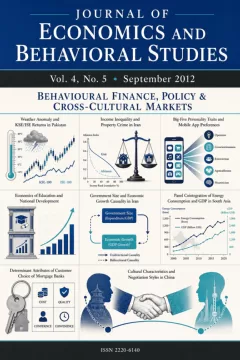 Vol. 4 No. 5 (2012)
Behavioural Finance, Policy & Cross-Cultural Markets
View issue contents
Published
Submissions
Have research to publish? Journal of Economics and Behavioral Studies welcomes submissions.
Make a Submission