Abstract
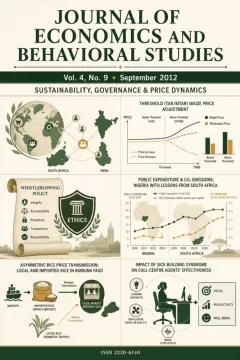
This paper examines the role of public expenditure in enhancing climate change adaptation and mitigation in Nigeria. It examines the trend of carbon dioxide (CO2) in Nigeria alongside those of South Africa and Sub Saharan Africa and investigates the statistical relationship between public expenditure and climate change in Nigeria. The paper hinges on the Climate Public Expenditure and Institutional framework of the Oversee Development Institute (ODI), which argues that climate change, has fiscal implications and can be addressed using national plans and annual budgets. Time series data were then collected for emission, public expenditure, human development index and economic growth from the World Bank and the Central Bank of Nigeria for 1970-2008, while trend analysis and lag regression model were used for data analysis. It was found that public expenditure towards economic services could be used to enhance Nigeria’s climate change mitigation and adaptation strategies. Though economic growth and human development index were found to be positively related to emission, results imply that economic growth in Nigeria is not pursued in a sustainable manner that accounts for the future generation. The paper recommends that economic growth that is driven by investment in renewable energy, developing human capacity to adapt to climate change and coordinating public expenditure to economic and community services to develop rural communities and vulnerable sectors like agriculture, would be useful for addressing climate change in Nigeria and ensuring sustainable development. A lesson Nigeria can learn from climate change mitigation and adaptation measures in South Africa is to identify and prioritize short term and medium term adaptation interventions to be addressed in sector plans such as water, agriculture and forestry, health, biodiversity and human settlements.
Keywords
- Climate Change Search this journal for Climate Change (opens in a new tab)
- Adaptation Search this journal for Adaptation (opens in a new tab)
- Mitigation Search this journal for Mitigation (opens in a new tab)
- National Plan Search this journal for National Plan (opens in a new tab)
- Budget Search this journal for Budget (opens in a new tab)
References
- Abraham, T. W. (2011). Climate Change and Food Supply in Nigeria’, Nigerian Economic Society (NES) 52nd Conference on Planning and the Transformation of the Nigerian Economy, Covenant University, Nigeria, 13-15 September
- CDDE (2011). Climate Fiscal Frameworks: Improving the Effectiveness of Climate Finance at the Country Level. Draft guidance note of the Capacity Development for Development Effectiveness (CDDE) 29th August, Bangkok.
- CEPS & ZEW (2010). The Fiscal Implications of Climate Change Adaptation’ Final Report (August 12) of the Centre for European Policy Studies (CEPS) and the Centre for European Economic Research (ZEW).
- GCCA (2011). Mainstreaming Climate Change in the Budgetary Process’ A Publication of the Global Climate Change Alliance (GCCA).
- IIED (2007). Adaptation to Climate Change: How we are set to cope with the impacts- An International Institute for Environment and Development (IIED) Briefing.
- IPCC (2007). Climate Change 2007: Impacts, Adaptation and Vulnerability. Summary for Policymakers. Working Group II Contribution to the IPCC Fourth Assessment Report.
- Ministry of Finance. (2009). Ministry of Finance Green Paper: Economic and Fiscal Policy Strategies for Climate Change Mitigation in Indonesia, Ministry of Finance and Australia Indonesia Partnership, Jakarta.
- NPC (2009). Nigeria Vision 20:2020 Economic Transformation Blueprint’ A Publication of the National Planning Commission (NPC) of the Federal Republic of Nigeria (FGN), October
- NPC (2011). The Transformation Agenda of the Federal Republic of Nigeria (2011-2015)’ A Publication of the National Planning Commission (NPC) of the Federal Republic of Nigeria (FGN).
- ODI & CDDE (2011). Climate Public Expenditure and Institutional Review: A Methodology to Review Climate Policy, Institutions and Expenditure’ Working Paper of the Over Development Institute (ODI) and the Capacity Development for Development Effectiveness (CDDE).
- Reid, H. & Huq, S. (2007). Adaptation to Climate Change: How we cope with the impacts An International Institute for Environment and Development (IIED) Briefing.
- The Government of the Republic of South Africa. (2011). National Climate Change Response White Paper October.
- UNDP (2003). Human Development Report 2003: Millennium Development Goals - A compact among Nations to End Human Poverty. New York: Oxford University Press for the United Nations Development Programme.
- WCED (1987). our common future Oxford, UK: World Commission on Environment and Development (WCED), Oxford University Press.
Downloads
No downloads have been recorded for this article yet. Figures appear here once readers begin downloading the full text.
How to Cite
Share this article
License
Copyright (c) 2012 Ogujiuba Kanayo, Stiegler Nancy, Terfa W. Abraham (Author)

This work is licensed under a Creative Commons Attribution 4.0 International License.
Author (s) should affirm that the material has not been published previously. It has not been submitted and it is not under consideration by any other journal. At the same time author (s) need to execute a publication permission agreement to assume the responsibility of the submitted content and any omissions and errors therein. After submission of revised paper in the light of suggestions of the reviewers, the editorial team edits and formats manuscripts to bring uniformity and standardization in published material.
This work will be licensed under Creative Commons Attribution 4.0 International (CC BY 4.0) and under condition of the license, users are free to read, copy, remix, transform, redistribute, download, print, search or link to the full texts of articles and even build upon their work as long as they credit the author for the original work. Moreover, as per journal policy author (s) hold and retain copyrights without any restrictions.
Keywords
- Climate Change Search this journal for Climate Change (opens in a new tab)
- Adaptation Search this journal for Adaptation (opens in a new tab)
- Mitigation Search this journal for Mitigation (opens in a new tab)
- National Plan Search this journal for National Plan (opens in a new tab)
- Budget Search this journal for Budget (opens in a new tab)
Section
Published
Submissions
Have research to publish? Journal of Economics and Behavioral Studies welcomes submissions.
Make a Submission