Articles

  • Article 1 in this issue

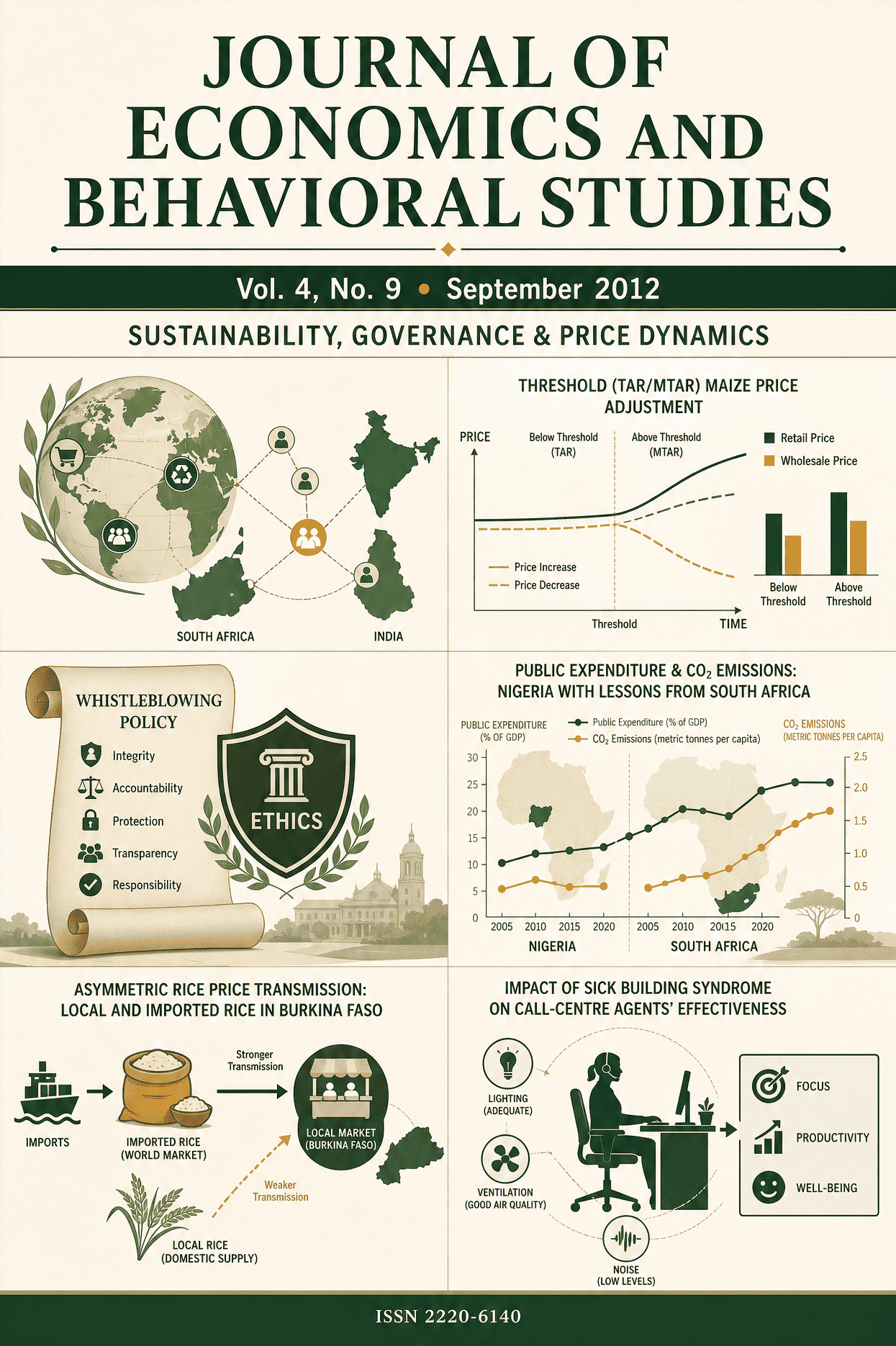
    Sustainable Development in Developing Countries: Case Studies of Sustainable Consumption and Production in South Africa and India

    • Author: Ogujiuba Kanayo, Stiegler Nancy, Fadila Jumare

    The pursuit of development has had a major impact on the environment and on existing social structures. During the 1950s and 1960s, most nations were preoccupied with economic growth and energy consumption, which led to social and environmental issues being overlooked. Thus, traditional societies have been devastated and extreme environmental damage occurring such as pollution and inadequate water supply, transportation and sewer infrastructure problems amongst others. If environmental damage remains unchecked, the achievements of development and even essential ecosystems would be undermined. This paper reviewed the link between growth trends and sustainable development in Sub-Saharan Africa. Thereafter, the impact of environmental degradation was discussed including strategies for sustainable energy production and consumption. These were based on evidence from South Africa and India and provided the benchmark for discussing ways in which energy production and consumption can take place sustainably. The paper notes that in developing and implementing strategies, emerging countries do not necessarily have to be western in their sustainable development policies. Rather, each country has to have sustainable development policies that are peculiar to its own circumstance. The paper recommends community participation and accountability of institutions as necessary for ensuring that social development is integrated into the economic and environmental elements of sustainable development.

    Pages 489-496

    PDF - Sustainable Development in Developing Countries: Case Studies of Sustainable Consumption and Production in South Africa and India (opens in a new tab)
  • Article 2 in this issue

    Threshold Effects and Asymmetric Price Adjustments within the Ghanaian Maize Market

    • Author: Henry de-Graft Acquah

    This study investigated co integration and asymmetric adjustments in the end equilibrium between Ghanaian retail and wholesale maize markets using the Enders and Siklos technique. Two competing models, namely Consistent Threshold Autoregressive (C-TAR) and Consistent Momentum Threshold Autoregressive (C-MTAR) models were estimated. Following the application of a standard model selection technique, C- MTAR model is selected as most appropriate. The results of the C-MTAR model confirm that the retail and wholesale prices of maize in Ghana are co integrated with threshold adjustment. Furthermore, it suggests that the process is asymmetric when the retail and wholesale prices of Ghanaian maize adjust to achieve the longterm equilibrium. Additionally, the adjustment is relatively faster when the price differential is increasing than when it is decreasing.

    Pages 497-504

    PDF - Threshold Effects and Asymmetric Price Adjustments within the Ghanaian Maize Market (opens in a new tab)
  • Article 3 in this issue

    Institutionalising a Whistle blowing Culture within Higher Education Institutions: Policy and Procedure Underpinning Good Governance at the Durban University of Technology

    • Author: N Dorasamy

    The article proposes to explore the importance of policy and procedure as an impetus for establishing a whistle blowing culture. It can be suggested that the institutionalization of a whistle blowing culture through established and practiced policies and procedures can lead to lower levels of perceived retaliation, which is frequently a deterrent in blowing the whistle. The quantitative research method was employed to determine the extent to which higher education institutions implement policies and procedures to institutionalize whistle blowing as an imperative for an ethical organizational culture, which encourages potential whistleblowers to report on wrongdoing. A conceptual framework informed by legislation, policy and procedures was used to determine employee perceptions relating to the role of whistle blowing policies and procedures within the Durban University of Technology as an impetus for establishing a whistle blowing culture. The investigation was based on empirical research conducted at the Durban University of Technology, South Africa and literature on whistle blowing. In the light of the research, recommendations are made relating to institutional whistle blowing policies and procedures. The empirical findings reveal that whistle blowing legislation is inadequate to encourage whistle blowing. The article provides a comprehensive framework for the institutionalization of whistle blowing within the organizational culture as an imperative to encourage disclosure of unethical practices.

    Pages 505-514

    PDF - Institutionalising a Whistle blowing Culture within Higher Education Institutions: Policy and Procedure Underpinning Good Governance at the Durban University of Technology (opens in a new tab)
  • Article 4 in this issue

    Impact of Public Expenditure on Climate Change in Nigeria: Lessons from South Africa

    • Author: Ogujiuba Kanayo, Stiegler Nancy, Terfa W. Abraham

    This paper examines the role of public expenditure in enhancing climate change adaptation and mitigation in Nigeria. It examines the trend of carbon dioxide (CO2) in Nigeria alongside those of South Africa and Sub Saharan Africa and investigates the statistical relationship between public expenditure and climate change in Nigeria. The paper hinges on the Climate Public Expenditure and Institutional framework of the Oversee Development Institute (ODI), which argues that climate change, has fiscal implications and can be addressed using national plans and annual budgets. Time series data were then collected for emission, public expenditure, human development index and economic growth from the World Bank and the Central Bank of Nigeria for 1970-2008, while trend analysis and lag regression model were used for data analysis. It was found that public expenditure towards economic services could be used to enhance Nigeria’s climate change mitigation and adaptation strategies. Though economic growth and human development index were found to be positively related to emission, results imply that economic growth in Nigeria is not pursued in a sustainable manner that accounts for the future generation. The paper recommends that economic growth that is driven by investment in renewable energy, developing human capacity to adapt to climate change and coordinating public expenditure to economic and community services to develop rural communities and vulnerable sectors like agriculture, would be useful for addressing climate change in Nigeria and ensuring sustainable development. A lesson Nigeria can learn from climate change mitigation and adaptation measures in South Africa is to identify and prioritize short term and medium term adaptation interventions to be addressed in sector plans such as water, agriculture and forestry, health, biodiversity and human settlements.

    Pages 515-522

    PDF - Impact of Public Expenditure on Climate Change in Nigeria: Lessons from South Africa (opens in a new tab)
  • Article 5 in this issue

    Asymmetric Price Transmission between Local and Imported Rice Prices in Burkina Faso

    • Author: Emmanuel Asane Otoo

    The study of how price signals in imported rice market influences prices in the local rice market is essential in understanding the inter-relationship between these prices and how soaring global food prices affect prices of locally produced agricultural commodities. This study uses a set of cointegration and error correction models with symmetric and asymmetric adjustment towards the long-run equilibrium to investigate the long-run relationship between local and imported rice prices and the extent to which imported rice prices are transmitted to local rice prices in Burkina Faso. Using national average consumer prices from January 2000 to June 2011, empirical results from the Engle-Granger and Johansen cointegration tests show that consumer price of local rice is significantly integrated with the imported rice market prices. Both threshold cointegration and asymmetric error correction models indicate that consumer prices of local rice respond asymmetrically to shocks from the imported rice price. Specifically, local rice prices respond rapidly to negative shocks while positive shocks take substantial amount of time to be transmitted. These findings provide clear empirical evidence with respect to the impact of imported rice prices on local rice prices and the role of profit-seeking traders in maintaining or increasing the price wedge between the two prices in Burkina Faso.

    Pages 523-531

    PDF - Asymmetric Price Transmission between Local and Imported Rice Prices in Burkina Faso (opens in a new tab)
  • Article 6 in this issue

    The Impact of Sick Building Syndrome on Call Centre Agents’ Effectiveness

    • Author: Devina Oodith, Sanjana Brijball Parumasur

    This study assessed the impact of Sick Building Syndrome (layout, ergonomic design of workstation, lighting/ventilation, health and performance, noise and aesthetics) on the effectiveness of Call Centre agents in managing customers and their needs. The study was undertaken in Durban, South Africa, and was conducted within a Public Sector service environment, which comprised of four major call centers employing 240 call centre agents. A sample of 151 call centre agents was drawn across using a simple random sampling technique and a 63% response rate was achieved. These call centre agents were responsible for inbound calls only. Data was collected using a self-developed, precoded questionnaire whose validity and reliability were statistically determined using Factor Analysis and Cronbach’s Coefficient Alpha respectively. Data was analyzed using descriptive and inferential statistics. The results indicate that the dimensions of Sick building Syndrome have the potential to impact on agents’ performance. Based on the results of the study a graphical representation has been designed and presents recommendations that, when implemented in call centre environments, have the potential to enhance agents’ effectiveness in managing customers and their needs.

    Pages 532-547

    PDF - The Impact of Sick Building Syndrome on Call Centre Agents’ Effectiveness (opens in a new tab)