Abstract
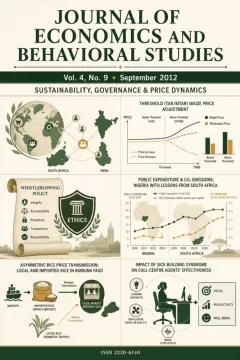
This study assessed the impact of Sick Building Syndrome (layout, ergonomic design of workstation, lighting/ventilation, health and performance, noise and aesthetics) on the effectiveness of Call Centre agents in managing customers and their needs. The study was undertaken in Durban, South Africa, and was conducted within a Public Sector service environment, which comprised of four major call centers employing 240 call centre agents. A sample of 151 call centre agents was drawn across using a simple random sampling technique and a 63% response rate was achieved. These call centre agents were responsible for inbound calls only. Data was collected using a self-developed, precoded questionnaire whose validity and reliability were statistically determined using Factor Analysis and Cronbach’s Coefficient Alpha respectively. Data was analyzed using descriptive and inferential statistics. The results indicate that the dimensions of Sick building Syndrome have the potential to impact on agents’ performance. Based on the results of the study a graphical representation has been designed and presents recommendations that, when implemented in call centre environments, have the potential to enhance agents’ effectiveness in managing customers and their needs.
Keywords
- Sick Building Syndrome Search this journal for Sick Building Syndrome (opens in a new tab)
- Ergonomic Design of Workstation Search this journal for Ergonomic Design of Workstation (opens in a new tab)
- Lighting Search this journal for Lighting (opens in a new tab)
- Noise Search this journal for Noise (opens in a new tab)
- Health Search this journal for Health (opens in a new tab)
- Performance Search this journal for Performance (opens in a new tab)
References
- Aerias Air Quality Sciences. (2010). Building Related Symptoms. Available at http://www.aerias.org/DesktopModules/ArticleDetail.aspx?articleId=106.
- Al-Anzi, N. M. (2009). Workplace Environment and its impact on Employee Performance. MBA Dissertation, Open University of Malaysia, 1-95.
- All Business Consulting. (2010). The impact of office design on business performance. Available at http://www.allbusiness.com/human-resources/careers/1119008-1html.
- Bachmann, M. O. & Myers, J. E. (1995). Influences of Sick Building Syndrome in Buildings. Available at http://www.ncbi.nlm.nih.gov/pubmed/ 7899936.
- Bachmann, M. O., Turck, W. A. V. & Myers, J. E. (1995). Sick Building Syndrome in office workers: a follow-up study before and one year after changing buildings. Journal of Occupational Medicine , 45(1), 11-15.
- Bakó-Biró, Z., Wargocki, P., Weschler, C. J. & Fanger, P. O. (2004). Effects of pollution from personal computers on perceived air quality, SBS symptoms and productivity in offices. Indoor Air , 14(3), 178-187.
- Banbury, S. P. & Berry, D. C. (2005). Office noise and employee concentration: Identifying causes of disruption and potential improvements. Ergonomics , 48, 25-37.
- Boykin, J. H. & Sauer, R. L. (1996). Sick Building Syndrome and the modern office Building. Real Estates Issues , 21(1), 21-27.
- Brand, J. L. (2008). Office Ergonomics: A Review of Pertinent Research and Research Developments. Chapter 7. In Reviews of Human Factors and Ergonomics , 4, 245-282.
- Brennan, A., Chugh, J. S. & Kline, T. (2002). Traditional versus open office design: A longitudinal field study. Journal of Environment and Behavior , 34(3), 279-299.
- Brown, D. (2004). Sick buildings lower productivity. Available at http://proquest.umi.com/ pqdweb?index=5&did=590031461&SrchMode=1&sid=2Fmt=6&VInst=PROD&VTypePQD&RQT=309 &VName=PQD&TS=1275552524&clientId=30060.
- Buildings and Workplace Design Guide. (2006). Crown Office and Procurator Fiscal Service, Estate Management Services. 1-105.
- Carnevale, D. G. (1992). Physical settings of work: a Theory of the effects of Environmental Firms. Public Productivity and Management Review , 15(4), 423-36.
- City of Cape Town. (2012). Green building Guidelines. Available at http://www.steadfast greening.co.za/docs/CCT_Green_Building_Guidelines. pdf.
- Clements-Croome, D. J. (2008). Work performance, productivity and indoor air. Scandinavian Journal of Work, Environment and Health (SJWEH) Supplements , 4, 69-78.
- Edwards, P. & Edwards, S. (1991). How to improve your indoor work environment. Available at http://proquest.umi.com/pqdweb?index=21&did=1642899&SrchMode=1&sid=1&Fmt =6&VInst=PROD&VType=PQD&RQT=309&VName=PQD&TS=1275557228&clientId=30060.
- Epstein, Y. (2008). Sick building syndrome. Harefuah , 147(7), 607-608.
- Evans, G. W. & Johnson, D. (2000). Stress and open-office noise. Journal of Applied Psychology , 85, 779-783.
- Fang, L, Wyon, D. P., Clausen, G. & Fanger, P. O. (2004). Impact of indoor air temperature and humidity in an office on perceived air quality, SBS symptoms and performance. Indoor Air , 14(7), 74-81.
- Fernberg, P. M. (1989). Taming your office environment. Available at http://proquest.umi.com/ pqdweb?index=27&did=632989&SrchMode=1&sid=1&Fmt=6&VInst=PROD&VType=PQD&RQT=309 &VName=PQD&TS=1275557817&clientId=30060.
- Global Healing Centre (GHC). (2012). Are you suffering from Sick Building Syndrome? Available at http://www.globalhealingcenter.com/health-hazards-to-know-about/industrial -chemical-toxins.
- Haka, M., Haapakangas, A., Keränen, J., Hakala, J., Keskinen, E. & Hongisto, V. (2009). Performance effects and subjective disturbance of speech in acoustically different office types – a laboratory experiment. Indoor Air , 19(6), 454-467.
- Holman, D. (2003). Phoning in sick? An overview of Employee stress in Call Centers. Leadership and Organization Development Journal , 24(3), 123-130.
- Heslop, K. (2003). The influence of Sick Building Syndrome on self reported productivity and work disruption amongst office employees in 2 buildings in South Africa. Available at http://www.inive.org/Ibase_search/search-detail-airbase-001.asp?ID=15663.
- Ilozor, B. D., Treloar, G. F., Olomolaiye, P. O. & Okoroh, M. I. (2001). FM Puzzle: Sick Building and Sydney’s open-plan offices. Facilities , 19(13/14), 484-493.
- Joshi, S. M. (2008). The Sick Building Syndrome. Indian Journal of Occupational and Environmental Medicine, 12(2), 61-64.
- Kaarlela-Tuomaala, A., Helenius, R., Keskinen, E. & Hongisto, V. (2009). Effects of acoustic environment on work in private office rooms and open-plan offices – longitudinal study during relocation. Ergonomics , 52(11), 1423-1444.
- Lan, L., Lian, Z. & Pan, L. (2010). The effects of air temperature on office workers’ well-being, workload and productivity-evaluated with subjective rating. Applied Ergonomics , 42(1), 29-36.
- Lan, L., Wargocki, P., Wyon, D. P. & Lian, Z. (2011). Effects of thermal discomfort in an office on perceived air quality, SBS symptoms, physiological responses, and human performance. Indoor Air , 21(5), 376390.
- Langston, C., Song, Y. & Purdey, B. (2008). Perceived conditions of workers in different organizational settings. Facilities , 1(2), 54-67.
- Leaman, A. (1992). Open-plan offices: Kill or Cure. Facilities , 10(6), 10-14.
- Leather, P., Beale, D. & Sullivan, L. (2003). Noise, psychosocial stress and their interaction in the workplace. Journal of Environmental Psychology , 23(2), 213-222.
- Magyar, S. V. Jr. (1999). Occupational Health Management. Professional Safety , 44(9), 23-27.
- Maher, A. & von-Hippel, C. (2005). Individual differences in employee reactions to open-plan offices. Journal of Environmental Psychology , 25(3), 219-229.
- Matthes, K. (1992). A prescription for healthier offices. Available at http://proquest.umi.com/ pqdweb?index=19&did=719713&SrchMode=1&sid=3&Fmt=6&VInst=PROD&VType=PQD&RQT=309 &VName=PQD& TS=1275554712 & client Id=30060.
- Mills, P. R., Tomkins, S. C. & Schlangen, L. J. M. (2007). The effect of high correlated color temperature office lighting on employee wellbeing and work performance. Journal of Circadian Rhythms , 5(2), 1-6.
- Milton, D. K., Glencross, P. M. & Walters, M. D. (2000). Risk of sick leave associated with outdoor air supply rate, humidication and occupant complaints. Indoor Air , 10(4), 212-221.
- Musser, G. (2009). The Origin of Cubicles and the Open-Plan Office. Scientific American, 17 August 2009, 1-2.
- Muzi, G., Abbritti, G., Accattoli, M. P. & dell’-Omo, M. (1997). Prevalence of irritative symptoms in a non problem air-conditioned office building. Available at http://www.springerlink.com/content/h5tdxkpky68h9pa6/fulltext.pdf.
- National Safety Council. (2010). Sick Building Syndrome. Available at http://downloads. nsc.org/pdf/factsheets/sick-building-syndrome.pdf.
- O’Neill, M. (2008). Open Plan and Enclosed Private Offices: Research Review and Recommendations. Knoll Workplace Research. Knoll, Inc.
- Passarelli. G. R. (2009). Sick Building Syndrome: An overview to raise Awareness. Journal of Building Appraisal , 5(1), 55-66.
- Pearson. (2012). What is the Best Office Chair for Call Centers. Available at http://www.247workspace.com/blog/what-is-the-best-office-chair-for-call-centers/
- Pejtersen, J. H., Feveile, H., Christensen, K. B. & Burr, H. (2022). Sickness absence associated with shared and open-plan offices – a national cross sectional questionnaire survey. Scandinavian Journal of Work, Environment & Health , 37(5), 376-382.
- Pitt, M. (2008). Editorial: Health and Safety and Health and Wellbeing. Available at http://proquest.umi.com/pqdweb?index=0&did=1596836511&SrchMode=1&sid=3&Fmt=6&VInst= PROD&VType=PQD&RQT=309&VName=PD&TS=1275476309&clientId=30060.
- Rooley, R. (1995). Sick Building Syndrome – the real facts . Structural Survey , 13(3), 5-8.
- Rooley, R. (1997). Sick Building Syndrome – the real facts: what is known, what can be done? Facilities , 15(1/2), 29-33.
- Rostron, J. (2008). Sick Building Syndrome: A review of causes, consequences and remedies. Journal of Retail and Leisure Property , 7(4), 291-303.
- Saunders, A. (1993). Upgrading acoustic privacy. Facilities , 11(10), 20-26.
- Sekaran, U. (2003). Research Methods for Business: A Skills Building Approach (4th ed), USA: John Wiley & Sons, Inc.
- Thomas-Mobley, L., Roper, K. O. & Oberle, R. (2005). A Proactive Assessment of Sick Building Syndrome. Facilities, 23(1/2), 6-15.
- Treasure, J. (2011). Sound News: More damaging evidence on open plan offices. The Sound Agency, 16 November 2011, Available at http://www.thesoundagency.com.
- US Environmental Protection Agency. (2012). Indoor Air Facts No. 4 (revised) Sick Building Syndrome. Available at http://www.epa.gov/iaq/ pubs/sbs.html.
- Wallenius, M. (2004). The interaction of noise stress and personal project stress on subjective health. Journal of Environmental Psychology , 24(2), 167-177.
- Witterseh, T., Wyon, D. P. & Clausen, G. (2004). The effects of moderate heat stress and open-plan office noise distraction on SBS symptoms and on the performance of office work. Indoor Air , 14(8), 30-40.
- Yao, M., Zhang, Q., Hand, D. W. & Perram, D. L. (2009). Investigation of the Treatability of the Primary Indoor Volatile Organic Compounds on Activated Carbon Fiber Cloths at Typical Indoor Concentrations. Journal of Air and Waste Management Association, 59(7), 882-890.
- Yildirim, K., Akalin-Baskaya, A. & Celebi, M. (2007). The effects of window proximity, partition height, and gender on perceptions of open-plan offices. Journal of Environmental Psychology , 27(2), 154-165.
- Yu, B. F., Hu, Z. B., Liu, M., Yang, H. L., Kong, Q. X. & Liu, Y. H. (2009). Review of research on air-conditioning systems and indoor air quality control for human health . International Journal of Refrigeration , 32, 3- 20.
Downloads
No downloads have been recorded for this article yet. Figures appear here once readers begin downloading the full text.
How to Cite
Share this article
License
Copyright (c) 2012 Devina Oodith, Sanjana Brijball Parumasur (Author)

This work is licensed under a Creative Commons Attribution 4.0 International License.
Author (s) should affirm that the material has not been published previously. It has not been submitted and it is not under consideration by any other journal. At the same time author (s) need to execute a publication permission agreement to assume the responsibility of the submitted content and any omissions and errors therein. After submission of revised paper in the light of suggestions of the reviewers, the editorial team edits and formats manuscripts to bring uniformity and standardization in published material.
This work will be licensed under Creative Commons Attribution 4.0 International (CC BY 4.0) and under condition of the license, users are free to read, copy, remix, transform, redistribute, download, print, search or link to the full texts of articles and even build upon their work as long as they credit the author for the original work. Moreover, as per journal policy author (s) hold and retain copyrights without any restrictions.
Keywords
- Sick Building Syndrome Search this journal for Sick Building Syndrome (opens in a new tab)
- Ergonomic Design of Workstation Search this journal for Ergonomic Design of Workstation (opens in a new tab)
- Lighting Search this journal for Lighting (opens in a new tab)
- Noise Search this journal for Noise (opens in a new tab)
- Health Search this journal for Health (opens in a new tab)
- Performance Search this journal for Performance (opens in a new tab)
Section
Published
Submissions
Have research to publish? Journal of Economics and Behavioral Studies welcomes submissions.
Make a Submission