Abstract
The purpose of this study is to examine gender differences on the effect of individual attributes on working capital management amongst small business owners. Based on a sample of 360 owner-managers of small businesses in the central business district of Kampala, the results show as follows. There are significant gender differences in perceived usefulness and attitude. Secondly, males and females do not statistically differ in terms of impulsivity. Thirdly, perceived usefulness significantly influences working capital management for females but not males. Fourthly, attitude significantly influences working capital management for males but not females. Lastly, the effect of impulsivity on working capital management is stronger for females than males. However, paucity of studies on the input perspective of working capital management limited crossvalidation of the findings with previous research. Future studies should be conducted to confirm the results. At policy level, understanding gender differences on the effect of the identified driving forces should be of interest to practitioners and policy makers in their effort to enhance small business management through developing appropriate gendered policies. This study contributes to the dearth of evidence of working capital management literature by investigating the effect of individual attributes as opposed to the conventional financial ratios.
Keywords
- Working Capital Management Search this journal for Working Capital Management (opens in a new tab)
- Gender Differences Search this journal for Gender Differences (opens in a new tab)
- Perceived Usefulness Search this journal for Perceived Usefulness (opens in a new tab)
- Attitude Search this journal for Attitude (opens in a new tab)
- Impulsivity Search this journal for Impulsivity (opens in a new tab)
References
- Afza, T. & Nazir, M. S. (2007). Working Capital Management policies of firms: Empirical evidence from Pakistan. In the proceedings of the 9th South Asian Management Forum (SAMF) on February 24- 25. North South University, Dhaka. Bangladesh.
- Ajzen, I. (1991). The theory of planned behavior. Organizational Behavior and Human Decision Processes, 50(2), 179-211.
- Briggs, B. R. (2009). Issues affecting Ugandan indigenous entrepreneurship trade. African Journal of Business Management , 3(10), 786-797.
- Chau, A., Chan, F. & Chan, Y. K. (2004). Study on financial management practices on University students in Hong Kong.
- Cheong, J. H. & Park, M. C. (2005). Mobile internet acceptance in Korea. Internet Research , 15(2), 125-140.
- Childers, T., Carr, C., Peck, J. & Carson, S. (2001). Hedonic and utilitarian motivations for online retail shopping behavior. Journal of Retailing, 77(4), 511-538.
- Chiu, Y. B., Lin, C. P. & Tang, L. L. (2005). Gender differs: Assessing a model of online purchase intentions in e- tail service. International Journal of Service Industry Management , 16(5) , 416-435.
- Chowdhury, S. & Endres, M. (2005). Gender difference and the formation of entrepreneurial self-efficacy. Presented at the United States Association of Small Business (USASBE) Annual Conference, Indian Wells, CA.
- Crawford, M. & Marecek, J. (1989). Psychology Reconstructs the Female: 1968-1988. Psychology of Women Quarterly , 13, 47-165.
- Davis, F. D. (1989). Perceived Usefulness, perceived ease of use, and user acceptance of information technology. MIS Quarterly , 13, 319-340.
- Davis, F. D. Bagozzi, R. P. & Warshaw, P. R. (1989). User acceptance of computer technology: A comparison of two theoretical models. Management Science , 35(8), 982-1003.
- Deakins, D., Morrison, A. & Galloway, L. (2002). Evolution, financial management and learning in the small firm. Journal of small Business and Enterprise development , 9(1), 7-16.
- Deloof, M. (2003). Does working capital management affect profitability of Belgian firms? Journal of Business Finance & Accounting, 30(3/4), 573-588.
- Dickman, S. J. (1990). Functional and dysfunctional impulsivity: personality and cognitive correlates. Journal of Personality and Social Psychology, 58, 95-102.
- Dittmar, H., Beattie, J. & Friese, S. (1995). Gender identity and material symbols: Objects and decision considerations in impulse purchases. Journal of Economic Psychology , 16(3), 491-511.
- Dowling, N. A., Corney, T. & Hoiles, L. (2009). Financial Management Practices and Money Attitudes as Determinants of Financial Problems and Dissatisfaction in Young Male Australian Workers. Journal of Financial Counseling and Planning, 20(2), 5-13.
- Ekanem, I. (2010). Liquidity management in small firms: a learning perspective. Journal of Small Business and Enterprise development, 17(1), 123-138.
- Ernst, L. & Young, K. (2011). 2010 Baseline survey of Small and Medium Enterprises in Uganda. Draft Final Report 2011, Print. Uganda Investment Authority.
- Fahati, L. & Paim, L. H. (2011). Gender differences in financial wellbeing among college students. Australian Journal of Basic and Applied Sciences, 5(9), 1765-1776.
- Filbeck, G. & Krueger, T. M. (2005). An analysis of working capital management results across industries. Mid American Journal of Business, 20(2), 11-18.
- Gatewood, E. J., Carter, N. M., Brush, C. G., Greene, P. G. & Hart, M. M. (2003). Women Entrepreneurs, Their Ventures, and the Venture Capital Industry: An Annotated Bibliography, Stockholm: ESBRI (a publication of the Diana project).
- Gefen, D. & Straub, D. W. (1997). Gender differences in the perception and use of e-mail: An extension to the Technology Acceptance Model. MIS Quarterly, 21(4), 389-400.
- Gutter, M. S., Copur, Z. & Garrison, S. (2009). Which Students Are More Likely to Experience Financial Socialization Opportunities? Exploring the Relationship between Financial Behaviors and Financial Well-Being of College Students (pp. 1-31). Indiana: Networks Financial Institute, Indiana University.
- Hayhoe, C. R., Leach, L. J., Turner, P. R., Bruin, M. J. & Lawrence, F. C. (2000). Differences in spending habits and credit use of college students. The Journal of Consumer Affairs, 34(1), 113-133.
- Hira, T. K. & Mugenda, O. M. (2000). Gender Differences in Financial Perceptions, Behaviors and Satisfaction. Journal of Financial Counseling and Planning , 13(2), 86-92.
- Ing-Long, W. & Jian-Liang, C. (2005). An extension of trust and TAM model with TPB in the initial adoption of on-line tax: an empirical study. International Journal of Human-Computer Studies, 62(6), 784-808.
- Jarvis, R., Kitching, J., Curran, J. & Lightfoot, G. (1996). Financial Management of Small Firms. Association of Chartered Certified Accountants, London.
- Kazooba, C. T. (2006). Causes of business failure in Uganda: a case study of Mbarara and Bushenyi towns. African studies quarterly , 8(4).
- Kidwell, B., Brinberg, D. & Turris, R. (2003). Determinants of Money management behavior. Journal of Applied Social Psychology, 33(6), 1244-1260
- Lazaridis, I. & Tryfonidis, D. (2006). Relationship between working capital management and profitability of listed companies in the Athens Stock Exchange. Journal of financial management and analysis, 19(1), 26-35.
- Lea, S. E. G., Webley, P. & Walker, C. M. (1995). Psychological factors in consumer debt: Money management, economic socialization, and credit use. Journal of Economic Psychology, 16, 681-701.
- Lim, V. K. G., Teo, T. S. H. & Loo, G. L. (2003). Sex, financial hardship and locus of control: An empirical study of attitudes towards money among Singaporean Chinese. Personality and Individual Differences , 34, 411429.
- Luarn, P. & Lin, H. H. (2005). Toward an understanding of the behavioral intention to use mobile banking. Computers in Human Behavior , 21, 873-891.
- Mathwick, C., Rigdon, E. & Malhotra, N. (2001). Experiential value: conceptualization, measurement and application in the catalog and Internet shopping environment. Journal of Retailing, 77(1), 39-53.
- May, O. S. (2005). User acceptance of internet banking in Penang: a model comparison approach. MBA thesis, School of Management, University Sains Malaysia, Penang.
- Menon, S. & Kahn, B. (2002). Cross-category effects of induced arousal and pleasure on the Internet shopping experience. Journal of Retailing, 78(1), 31-42.
- Mischel, W. & Ayduk, O. (2004). Willpower in a cognitive-affective processing system: The dynamics of delay of gratification. In K.D. Vohs & R.F. Baumeister (Eds.), Handbook of self-regulation: Research, theory, and applications (99–129). New York: Guilford Press
- Moutinho, L. & Smith, A. (2000). Modeling bank customers' satisfaction through mediation of attitudes towards human and automated banking. International Journal of Retail & Distribution Management, 18(3), 124-134.
- Munene, J. C. (1991). Organizational environments in Africa: a factor analysis of critical incidents. Human Relations , 44, 439–458
- Namatovu, R., Waswa, B., Kyejjusa, S. & Dawa, S. (2010). Global Entrepreneurship Monitor (GEM Uganda) Executive report.
- Newcomb, M. D. & Rabow, J. (1999). Gender, Socialization, and Money. Journal of Applied Social Psychology , 29(4), 852-869.
- Nunnally, J. (1978). Psychometric Theory. New York: McGraw-Hill.
- Orobia, L., Sserwanga, A. & Rooks, G. (2011). Risk taking and start-up capital: Exploring gender differences in Uganda, through an international comparison. Journal of Economics and Behavioral Studies , 3(2), 83-93.
- Padachi, K. (2006). Trends in working capital management and its impact on firms’ performance: an analysis of Mauritian small manufacturing firms. International Review of Business Research Papers, 2(2), 45 -58.
- Patton, J. H., Stanford, M. S. & Barratt, E. S. (1995). Factor structure of the Barratt impulsiveness scale, Journal of Clinical Psychology, 51 (6), 768–774.
- Raheman, A. & Nasr, M. (2007). Working capital management and profitability–case of Pakistani Firms. International Review of Business Research Papers, 3(1), 279-300.
- Ramayah, T., Ling, C. Y., Norazah, M. S. & Ibrahim, M. (2005). Determinants of intention to use an online bill payment system among MBA students. E-Business , 9, 80-91.
- Reynolds, B., Ortengren, A., Richards, J. B. & de Wit, H. (2006). Dimensions of impulsive behavior: Personality and behavioral measures. Personality and Individual Differences, 40(2), 305.
- Rhodes, R. E. & Courneya, K. S. (2003). Investigating multiple components of attitude, subjective norm, and perceived control: an examination of the theory of planned behavior in the exercise domain. The British Journal of Social Psychology , 1(42), 129-46.
- Rhodes, R. E. & Courneya, K. S. (2003). Modeling the theory of planned behavior and past behavior. Psychology, health and medicine, 8(1), 57-59.
- Rook, D. W. (1987). The buying impulse. Journal of Consumer Research, 14, 189-199.
- Rosa, P., Kodithuwakku, S. & Balunywa, W. (2006). Reassessing Necessity Entrepreneurship in Developing Countries. Institute for Small Business & Entrepreneurship , 1-13.
- Shashaani, L. & Khalili, A. (2001). Gender and computers: similarities and differences in Iranian College Students’ attitudes toward computers. Computers and Education, 37(3), 363–375.
- Stevenson, L. & Annette, S. O. (2005). Support for Growth-oriented Women Entrepreneurs in Uganda. African Development Bank (AfDB) · Tunis, 2005
- Sserwanga, A. (2011). Entrepreneurial quality in Uganda. Unpublished PhD thesis. Makerere University, Uganda.
- Tang, T. L. P. (1995). The development of a short money ethic scale: Attitudes toward money and pay satisfaction revisited. Personality and Individual Differences, 19, 809-816.
- Tokunaga, H. (1993). The use and abuse of consumer credit: Application of psychological theory and research. Journal of Economic Psychology, 14, 285-316.
- Teruel, P. J. G. & Solano, P. M. (2007). Effects of working capital management on SME profitability. International Journal of Managerial Finance, 3(2), 164-186.
- UBOS. (2012). Uganda Bureau of Statistics (UBOS), Statistical Abstract 2012.
- Venkatesh, V. & Davis, F. D. (1996). A model of the antecedents of perceived ease of use: Development and test. Decision Sciences, 27(10), 451-481.
- Venkatesh, V. (2000). Determinants of perceived ease of use: integrating control, intrinsic motivation, and emotion into the technology acceptance model. Information Systems Research, 4(4), 342-365.
- Venkatesh, V. & Morris, M. G. (2000). Why don’t men ever stop to ask for directions: Gender, social influence and their role in technology acceptance and usage behavior? MIS Quarterly , 24(1), 115-139.
- Verheul, I., van-Stel, A. & Thurik, R. (2006). Explaining female and male entrepreneurship at the country level. EIM Business and Policy Research. SCALES Paper N200510.
- Wang, Y., Wang, Y., Lin, H. & Tang, T. (2003). Determinants of user acceptance of internet banking: an empirical study. International Journal of Service Industry Management, 14(5), 501-519.
- Walter, T., Balunywa, W., Rosa, P., Sserwanga, A., Barabas, S., Namatovu, R. & Kyejjusa, S. (2004). Global Enterprenuership Monitor: GEM Uganda 2004 Executive Report.
- Weir, D. R. & Willis, R. J. (2000). Prospects for Widow Poverty in the Finances of Married Couples in the HRS. In Forecasting Retirement Needs and Retirement Wealth, edited by O. Mitchell, P.B. Hammond, and A. Rappaport (208–234). Philadelphia: University of Pennsylvania Press.
- Wilhelm, M. S., Varcoe, K. & Fridrich, A. H. (1993). Financial satisfaction and assessment of financial progress: Importance of money attitudes. Financial Counseling and Planning, 4, 181-199.
- Youn, S. H. (2000). The Dimensional Structure of Consumer Buying Impulsivity: Measurement and Validation. Unpublished doctoral dissertation, University of Minnesota, Minneapolis.
- Zuckerman, M., Kuhlman, D. M., Joireman, J., Teta, P. & Kraft, M. (1993). A comparison of three structural models of personality: the big three, the big five, and the alternative five. Journal of Personality and Social Psychology , 65, 757-768.
Downloads
No downloads have been recorded for this article yet. Figures appear here once readers begin downloading the full text.
How to Cite
Share this article
License
Copyright (c) 2013 Laura A. Orobia (Author)

This work is licensed under a Creative Commons Attribution 4.0 International License.
Author (s) should affirm that the material has not been published previously. It has not been submitted and it is not under consideration by any other journal. At the same time author (s) need to execute a publication permission agreement to assume the responsibility of the submitted content and any omissions and errors therein. After submission of revised paper in the light of suggestions of the reviewers, the editorial team edits and formats manuscripts to bring uniformity and standardization in published material.
This work will be licensed under Creative Commons Attribution 4.0 International (CC BY 4.0) and under condition of the license, users are free to read, copy, remix, transform, redistribute, download, print, search or link to the full texts of articles and even build upon their work as long as they credit the author for the original work. Moreover, as per journal policy author (s) hold and retain copyrights without any restrictions.
Keywords
- Working Capital Management Search this journal for Working Capital Management (opens in a new tab)
- Gender Differences Search this journal for Gender Differences (opens in a new tab)
- Perceived Usefulness Search this journal for Perceived Usefulness (opens in a new tab)
- Attitude Search this journal for Attitude (opens in a new tab)
- Impulsivity Search this journal for Impulsivity (opens in a new tab)
Section
Published in
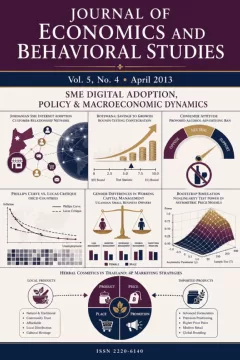 Vol. 5 No. 4 (2013)
SME Digital Adoption, Policy & Macroeconomic Dynamics
View issue contents
Published
Submissions
Have research to publish? Journal of Economics and Behavioral Studies welcomes submissions.
Make a Submission