Articles

  • Article 1 in this issue

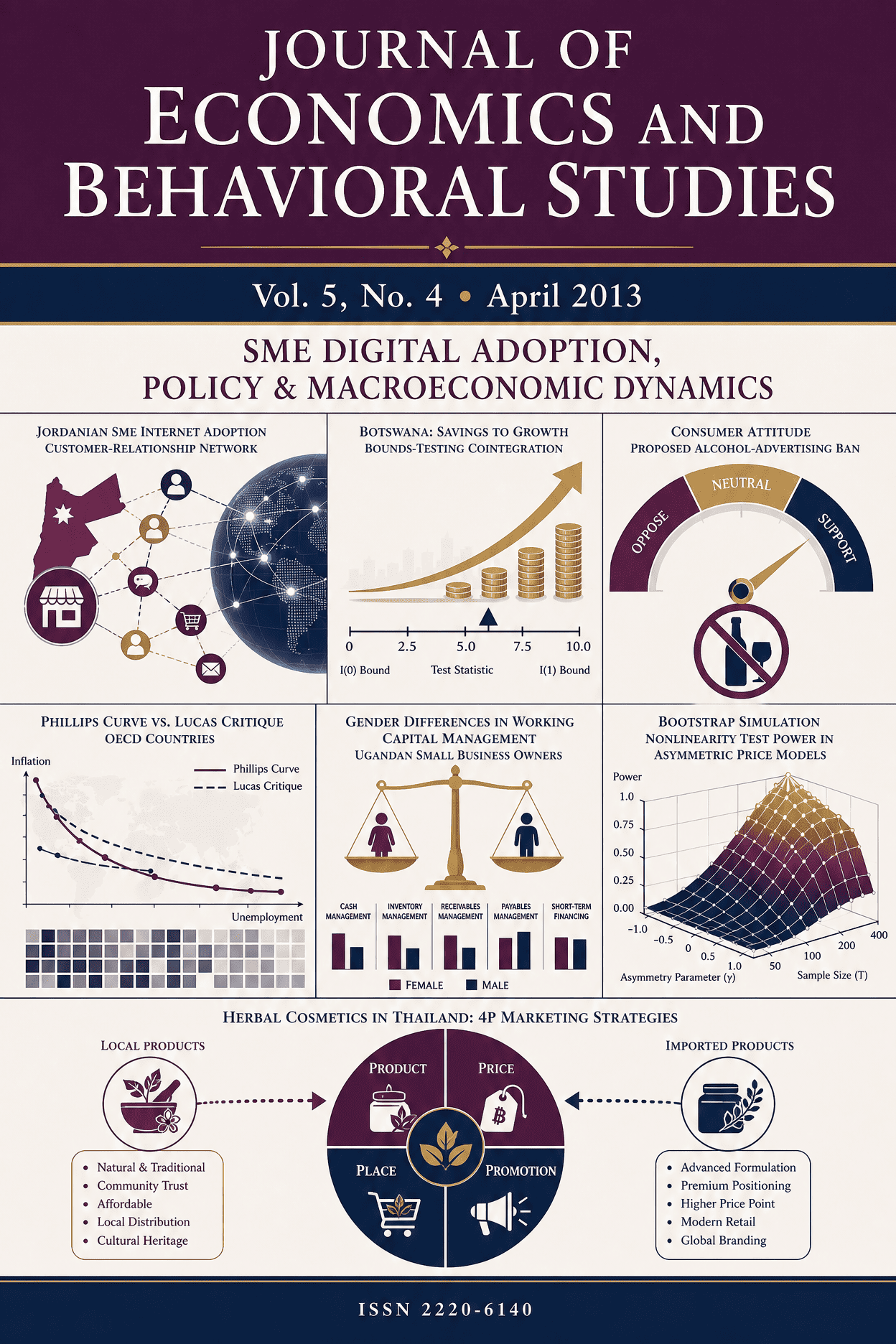
    The Effect of Customer-Company Relationship on Internet Adoption in Jordanian Small and Medium Enterprises

    • Author: Ghaith Mustafa Al-Abdallah

    Internet is a new effective way to conduct business and marketing. It is used widely in the developed countries because of its unquestionable benefits especially for small and medium enterprises (SMEs) where internet provides great potential for such firms to compete world wild. SMEs are very important component of the national economies and are estimated to account for 80 percent of global economic growth. In developing countries, such as Jordan, internet adoption for marketing activities can be very helpful to SMEs. The main objective of this research is to examine the customer-company relationship effect on internet adoption in Jordanian SMEs, and highlight the actual use of internet in SMEs that adopted internet for marketing activities. One main and three sub- hypotheses were formed based on the literature review and previous studies. A restricted research methodology was used and the hypothesis was tested over a proportional systematic random sample obtained from the official records of Amman Chamber of Commerce. Data was collected through questionnaires, 270 personally submitted questionnaires were distributed to the decisions makers in Jordanian SMEs. Statistical Package for the Social Science (SPSS) was chosen to describe and analyze the data of 253 filtered and screened questionnaires. Results and discussion, conclusion, and recommendations were provided.

    Pages 192-199

    PDF - The Effect of Customer-Company Relationship on Internet Adoption in Jordanian Small and Medium Enterprises (opens in a new tab)
  • Article 2 in this issue

    Savings and Economic Growth in Botswana: An Analysis Using Bounds Testing Approach to Cointegration

    • Author: Kafayat Amusa, Moyo Busani

    Economic growth boosted by high domestic savings has been advocated for by numerous economists throughout the years. For a country like Botswana where the savings- GDP ratio is relatively high, it becomes important to determine whether savings is indeed important for the economy. This paper reexamines the savings-growth debate for the Botswana economy by applying the Bounds testing approach to cointegration analysis to establish the relationship between domestic savings and economic growth in Botswana. The results indicate that domestic savings is significantly positively related to growth in Botswana. The study recommends the need for development of financial instruments to encourage domestic savings.

    Pages 200-209

    PDF - Savings and Economic Growth in Botswana: An Analysis Using Bounds Testing Approach to Cointegration (opens in a new tab)
  • Article 3 in this issue

    The Proposed Banning of Alcohol Advertising in a Developing Economy

    • Author: Jeevarathnam Parthasarathy Govender

    The growing problem of alcohol misuse and its social consequences have been attributed to the advertising of alcohol, by some parties. Alcohol companies and the advertising industry have refuted this claim. It is against this background that this paper seeks to assess consumer attitudes towards alcohol advertising in South Africa. A survey was conducted amongst a sample of 400 respondents. Respondent demographics and attitudes towards the advertising of alcohol were ascertained. The results indicate no significant relationship between the selected demographic variables (viz. gender, age, income, education level and race) and attitude towards the advertising of alcohol. Some perspectives on the implications for policy and practice are presented.

    Pages 210-220

    PDF - The Proposed Banning of Alcohol Advertising in a Developing Economy (opens in a new tab)
  • Article 4 in this issue

    Revisiting the Phillips Curve and the Lucas Critique

    • Author: Md. Sharif Hossain, Rajarshi Mitra

    Many OECD countries are facing problems of high government debt and high unemployment. Consequently, a monetary stimulus is being increasingly viewed as a solution to curb the rising debt burden and stimulate economic growth. Some OECD countries are setting inflation target at 2% or even higher. In this paper we investigate the likely impact of inflation on unemployment for a panel of 10 highincome OECD countries, namely, Australia, Denmark, Iceland, Japan, Korea, New Zealand, Norway, Sweden, Switzerland and the United States. The period of study is 1970-2012. Results indicate a significantly positive long-run impact of inflation on unemployment. Granger causality indicates long-run bi-directional causality between inflation and unemployment. For the 10 OECD countries and the period of this study, the empirical findings support the Lucas critique: inflation and unemployment are positively correlated. A monetary stimulus, therefore, will most likely aggravate the unemployment scenario in the 10 OCED countries under study.

    Pages 221-225

    PDF - Revisiting the Phillips Curve and the Lucas Critique (opens in a new tab)
  • Article 5 in this issue

    Gender differences in Working Capital Management amongst Small Business Owners in Uganda

    • Author: Laura A. Orobia

    The purpose of this study is to examine gender differences on the effect of individual attributes on working capital management amongst small business owners. Based on a sample of 360 owner-managers of small businesses in the central business district of Kampala, the results show as follows. There are significant gender differences in perceived usefulness and attitude. Secondly, males and females do not statistically differ in terms of impulsivity. Thirdly, perceived usefulness significantly influences working capital management for females but not males. Fourthly, attitude significantly influences working capital management for males but not females. Lastly, the effect of impulsivity on working capital management is stronger for females than males. However, paucity of studies on the input perspective of working capital management limited crossvalidation of the findings with previous research. Future studies should be conducted to confirm the results. At policy level, understanding gender differences on the effect of the identified driving forces should be of interest to practitioners and policy makers in their effort to enhance small business management through developing appropriate gendered policies. This study contributes to the dearth of evidence of working capital management literature by investigating the effect of individual attributes as opposed to the conventional financial ratios.

    Pages 226-236

    PDF - Gender differences in Working Capital Management amongst Small Business Owners in Uganda (opens in a new tab)
  • Article 6 in this issue

    Using Bootstrap Method to Evaluate the Power of Tests for Non-Linearity in Asymmetric Price Relationship

    • Author: Henry De-Graft Acquah

    This paper introduces and applies the bootstrap method to compare the power of the test for asymmetry in the Granger and Lee (1989) and Von Cramon-Taubadel and Loy (1996) models. The results of the bootstrap simulations indicate that the power of the test for asymmetry depends on various conditions such as the bootstrap sample size, model complexity, difference in adjustment speeds and the amount of noise in the data generating process used in the application. The true model achieves greater power when compared with the complex model. With small bootstrap sample size or large noise, both models display low power in rejecting the (false) null hypothesis of symmetry.

    Pages 237-241

    PDF - Using Bootstrap Method to Evaluate the Power of Tests for Non-Linearity in Asymmetric Price Relationship (opens in a new tab)
  • Article 7 in this issue

    Marketing Strategies of Herbal Cosmetic Products: Thai and Imported Products
    • Author: Rojanadilok Thanisorn, Nanagara Byaporn

    This research investigated the factors that influence the marketing strategies of herbal cosmetic products in Thailand by comparison between Thai and imported product where the imported products are manufactured from Australia and U.S.A. This study is both quantitative and qualitative research. The facial herbal cosmetics products in this study were moisturizer, whitening lotion, cream, power, toner, make up cleansing mask, cleansing oil, soap bar, and anti-aging lotions. Finding from the study found that the marketing strategy of Thai herbal cosmetic products have the 4Ps;Product strategy by improving the quality of products, research and development for launching the new products to the market, creating beauty packaging and new product launch attracts the market’s attention. Price strategy using cash discount to increase consumer’s purchase motive. Place strategy using department stores as the main distribution channels, distribution channels are direct sales with catalogs, counter sales in department store and beauty showrooms. Promotion strategy using integrated marketing communication for maintaining brand image, television advertisement, radio advertisement, cabal advertisement, booth exhibition, beauty school, website, face to face marketing and male beauty instructor to attract the women customers. Marketing strategy of imported products; Products strategies are concerned with the odor, color, physical appearance of products and the penetration characteristic of products. The strategies promote the imported products by introducing the product e.g. the product is a blend of herbs, the most effective skin care for healthy, revitalized skin and natural extract that contains active ingredients with high technology to manufacture the cosmetic product that performs a specific action to penetrate deep into the skin. The smooth odor and color of the imported products are the important purchasing decision factor. Physical appearance of products; non greasy, non oily helps absorbs quickly into skin and help smooth the skin surface texture and packaging design, color, size and shape, play a role in purchasing decisions. Packaging has to possess the strength to make eye-catching packaging that helps make the most window of opportunity in pristine conditions, brand, logo/slogan as a way to facilitate their purchasing decision; the image of the brand has all the criteria value, quality reliability trust, intangible and delivers benefits to the consumers. Price strategy is heavily differentiated due to the branding then imported herbal cosmetic products offering lower priced luxury products. The lower prices could also boost sales e.g. smaller sizes of some products, such as 50 ml and 30 ml bottles of products, which is normally sold in 100 ml bottles then smaller bottles are selling better than regular size ones, Place strategy; purchasing convenience from the Internet to virtual presence e.g. Website, direct mail, social media enhancing the brand’s image. The site also uses Face book page by constantly updating content photos, videos, information about events, YouTube, twitter as platforms to keep customers up to date on new episodes and development. Promotion strategies using advertisement, television advertisement

    Pages 242-251

    PDF - Marketing Strategies of Herbal Cosmetic Products: Thai and Imported Products (opens in a new tab)