Abstract
This paper adopts the Toda-Yamamoto technique of causality in order to examine the direction of causality between employment and economic growth. This is to investigate whether the increase in the Gross Domestic Product (GDP) translates into increased employment or not and vice versa, in South Africa, using quarterly data from 2000Q1 to 2012Q3. South Africa has been experiencing high and increased growth for the past decade, yet the rate of employment is not significantly high. Meanwhile, the objective of the government, since the first democratic election in 1994, was to increase economic growth along with a reduction in the unemployment rate (BMR, 2011). Although the economy has been experiencing significant success of increased economic growth, it performed poorly in the area of increased employment (BMR, 2011). This study thus seeks to answer the following questions: (1) does it mean that the increase in growth does not translate to the creation of more jobs and (2) is increased economic growth not as a result of increase in employment in South Africa? The results obtained shows that causality does not run from employment to economic growth in South Africa, as the null hypothesis was not rejected at all significant levels. However, Keynes General Theory holds for South Africa, where the empirical result showed that economic growth leads employment. These results support the criticism of ‘jobless growth’ against South Africa (Kumo, 2012). The paper suggests some policy recommendations for the improvement of employment.
Keywords
- Causality Search this journal for Causality (opens in a new tab)
- Employment Search this journal for Employment (opens in a new tab)
- GDP Search this journal for GDP (opens in a new tab)
- Toda-Yamamoto Search this journal for Toda-Yamamoto (opens in a new tab)
- Unemployment Rate Search this journal for Unemployment Rate (opens in a new tab)
References
- Adebayo, A. & Ogunrinola, I. O. (2006). Contemporary Dimensions of Unemployment Problem in Nigeria: A Special Challenge under the National Economic Empowerment and Development Strategy. The Nigerian Economic Society.
- Ajilore, T. & Yinusa, O. (2011). An analysis of employment intensity of sectoral output growth in Botswana. Southern African Business Review , 15(2), 26 – 42.
- Akcay, S. (2011). The Causal Relationship between Producer Price Index and Consumer Price Index: Empirical Evidence from Selected European Countries. International Journal of Economics and Finance, 3(6), 227 – 232.
- Altman, M. (2003). Jobless or Job Creating Growth? Some preliminary thoughts. Employment and Economic Policy Research Program, Human Sciences Research Council. Paper Presented at the TIPS/ DPRU Annual Forum
- Asari, F. F., Mohamad, Z., Alias, T. S., Shamsudin, N., Baharuddin, N. S. & Kamaruzaman, J. (2011). Multivariate Time Series Analysis on Correlation between Inflation rate and Employment rate with Gross Domestic Product. World Applied Sciences Journal, (Special Issue on Bolstering Economic Sustainability), 61 – 66.
- Ball, L. M. & Moffitt, R. A. (2001). Productivity growth and the Phillips curve. National Bureau of Economic Research, Cambridge, Mass, USA.
- Biyase, M. & Bonga-Bonga, L. (2007). South Africa’s growth paradox. DEGIT Conference Papers. www.degit.ifw-kiel.de/papers/degit_12/C012_043.pdf Accessed 3 February 2013.
- Bureau of Market Research (BMR). (2011). A broad review of the new growth path framework with a specific emphasis on the feasibility of its proposed targets. http://www.unisa.ac.za/contents/faculties/ems/docs/Press413.pdf Accessed 1 February 2013.
- Caporale, G.M. & Škare, M. (2011). Short- and Long-Run Linkages between Employment Growth, Inflation and Output Growth: Evidence from a Large Panel. Economics and Finance Working Paper Series, No. 11-17.
- Eita, J. H. & Ashipala, J. M. (2010). Determinants of Unemployment in Namibia. International Journal of Business and Management , 5(10), 92–104.
- Ewing, B. T. (1999). Employment and economic performance: Jobs, inflation, and growth. Journal of Labor Research , 20(4), 622-624.
- Fourie, F. C. N. & Burger, P. (2009). How to Think and Reason in Macroeconomics. 3rd ed. Juta & Co. Ltd. Cape Town.
- Granger, C. W. J. (1969). Investigating Causal Relationships by Econometric Models and Cross-Spectral Models. Econometrica, 37(3), 424 – 438.
- Hansen, S. (2013). Weekly Review: Does Employment Really Lag Economic Growth? http://www.nasdaq.com/article/weekly-review-does-employment-really-lag-economic-growthcm171052 Accessed 1 February 2013.
- He, Z. & Maekawa, K. (1999). On spurious Granger causality. Economic letters , 73(3), 307–313.
- International Labor Organization (ILO). (2013). Key Indicators of labor market database, The World Bank.
- International Monetary Fund (IMF). (2012). Sub-Saharan Africa, Maintaining Growth in an Uncertain World. World Economics and Financial Surveys, Regional Economic Outlook.
- Keynes, J. M. (1936). The General Theory of Employment, Interest and Money. London: Macmillan (Reprinted 2007).
- Kumo, W. L. (2012). Infrastructure Investment and Economic Growth in South Africa: A Granger Causality Analysis. African Development Bank, Working Paper Series N° 160, Tunis, Tunisia.
- Landmann, O. (2002). Employment, productivity and output growth. ILO, mimeographed.
- Marelli, E. & Signorelli, M. (2010). Employment, productivity and models of growth in the EU. International Journal of Manpower , 31 (7), 732-754.
- Oladeji, S. I. (1994). Absorption of Educated Manpower into Nigeria's Informal Sector. National Manpower Board.
- Omotor, D. G. & Gbosi, A. N. (2006). The Dynamics of Productivity and Unemployment Nexus: Implications for Employment Generation in Nigeria. Nigerian Economic Society , 2, 177 – 197.
- Osmani, S. R. (2006). Employment intensity of Asian manufacturing: An examination of recent trends. United Nations Development Programme (UNDP), New York.
- Pandalino, S. & Vivarelli, M. (1997). The Employment Intensity of Economic Growth in the G-7 Countries. International Labor Review, 136 (2), 191 – 213.
- Phelps, E. S. (1994). Structural slumps: The modern equilibrium theory of unemployment, interest, and assets: Harvard University Press.
- Pini, P. (1997). Occupazione, tecnologia e crescita: modelli interpretativi ed eevidenze empiriche a livello macroeconomico’. Paper presented at Conference of Accademia Nazionale dei Lincei on ‘Sviluppo tecnologico e disoccupazione: trasformazione della societa’, Rome, 16–18 January 1997.
- Rad, S. T. (2011). Jordan’s Paradox of Growth without Employment: A Microcosm of the Middle East? Centre for development policy and research, Development Viewpoint, Number 65.
- Sawtelle, B. (2007). Analyzing the Link between Real GDP and Employment: An Industry Sector Approach. Business Economics, 1, 46-54.
- Sodipe, O. A. & Ogunrinola, I. O. (2011). Employment and Economic Growth Nexus in Nigeria. International Journal of Business and Social Science, 2(11) , 232 – 239.
- Swane, A. & Vistrand, H. (2006). Jobless Growth in Sweden? A Descriptive Study. Master's Thesis in International Economics and Business, Stockholm School of Economics.
- Toda, H. Y. & Yamamoto, T. (1995). Statistical inference in vector auto regressions with possibly integrated processes. Journal of Econometrics , 66, 225 – 250.
- Walterskirchen, E. (1999). The Relationship between Growth, Employment and Unemployment in the EU. European Economist for an Alternative Economic Policy Workshop, Barcelona, Spain. http://www.memoeurope.unibremen.de/tser/Walterskirchen_24months.PDF Accessed 12 February 2013.
- World Trade Organisation (WTO) (2013). Growth and jobs. http://www.wto.org/english/thewto_e/whatis_e/10ben_e/10b07_e.htm Accessed 1 February 2013
- World Bank, World Development Indicators, (2011). http://www.indexmundi.com /facts/indicators/SL.UEM.TOTL.ZS/compare?country=bw#country=za:sz
- Yogo, T. (2008). Growth and Employment in Sub Saharan Africa: Theoretical Evidence and Empirical Facts. Munich Personal RePEc Archive, Paper No 10474, http://mpra.ub.uni-muenchen.de/10474/ Accessed 11 February 2013
Downloads
No downloads have been recorded for this article yet. Figures appear here once readers begin downloading the full text.
How to Cite
Share this article
License
Copyright (c) 2013 Temitope L. A. Leshoro (Author)

This work is licensed under a Creative Commons Attribution 4.0 International License.
Author (s) should affirm that the material has not been published previously. It has not been submitted and it is not under consideration by any other journal. At the same time author (s) need to execute a publication permission agreement to assume the responsibility of the submitted content and any omissions and errors therein. After submission of revised paper in the light of suggestions of the reviewers, the editorial team edits and formats manuscripts to bring uniformity and standardization in published material.
This work will be licensed under Creative Commons Attribution 4.0 International (CC BY 4.0) and under condition of the license, users are free to read, copy, remix, transform, redistribute, download, print, search or link to the full texts of articles and even build upon their work as long as they credit the author for the original work. Moreover, as per journal policy author (s) hold and retain copyrights without any restrictions.
Keywords
- Causality Search this journal for Causality (opens in a new tab)
- Employment Search this journal for Employment (opens in a new tab)
- GDP Search this journal for GDP (opens in a new tab)
- Toda-Yamamoto Search this journal for Toda-Yamamoto (opens in a new tab)
- Unemployment Rate Search this journal for Unemployment Rate (opens in a new tab)
Section
Published in
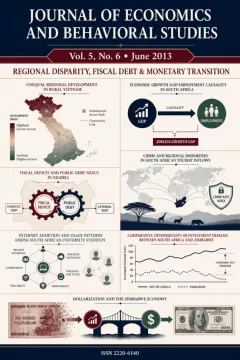 Vol. 5 No. 6 (2013)
Regional Disparity, Fiscal Debt & Monetary Transition
View issue contents
Published
Submissions
Have research to publish? Journal of Economics and Behavioral Studies welcomes submissions.
Make a Submission