Articles

  • Article 1 in this issue

    Unequal Regional Development in Rural Vietnam: Sources of Spatial Disparities and Policy Considerations

    • Author: Hoang Van Long, Mitsuyasu Yabe

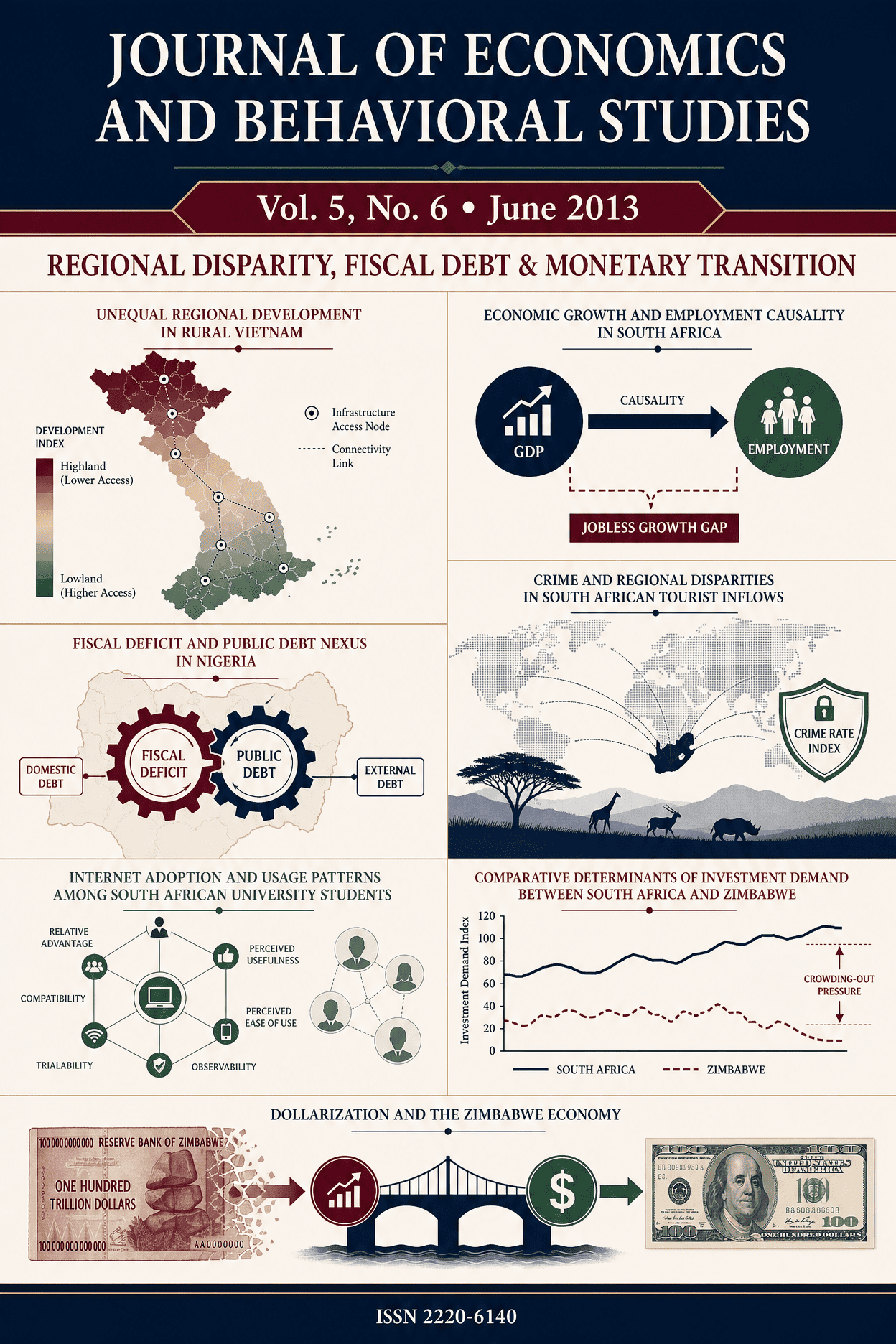
    In Vietnam, the poor have long been assumed to be the ethnic minorities mostly living in the highlands. After more than two decades of introducing _Doi moi_1 policy into the economy, along with having enjoyed various improvements in social and economic aspects, the disparities between the majority and ethnic majorities, the lowlands and the highlands, and between regions, still have been widened. This paper aims at examining sources of spatial disparities in rural areas, and exploring the current situation of regional economic development using both development policy review and econometrics approaches. Data from Vietnam Household Living Standard Survey (VHLSS) 2008 was used in the study. The expenditure per capita was employed as the dependent variable to regress with household characteristics and resources in order to obtain the effecting factors. In addition, the regional dummy variables were employed to show the effects from different geographic locations. The results showed that the household characteristics and resources such as education level, perennial land area, water surface area, and the accessibility to infrastructure facilities such as road, electricity and local market had positive effect on the expenditure. Furthermore, the North Central Coastal region showed negative impact on household expenditure. Interestingly, this finding does not absolutely follow the hypothesis and indicates that the economic development strategy and polices should be adjusted to decrease the gap among regions based on their economic advantages for balancing the economic situation of the whole country in the future.

    Pages 325-335

    PDF - Unequal Regional Development in Rural Vietnam: Sources of Spatial Disparities and Policy Considerations (opens in a new tab)
  • Article 2 in this issue

    Does Economic Growth Lead Employment in South Africa?

    • Author: Temitope L. A. Leshoro

    This paper adopts the Toda-Yamamoto technique of causality in order to examine the direction of causality between employment and economic growth. This is to investigate whether the increase in the Gross Domestic Product (GDP) translates into increased employment or not and vice versa, in South Africa, using quarterly data from 2000Q1 to 2012Q3. South Africa has been experiencing high and increased growth for the past decade, yet the rate of employment is not significantly high. Meanwhile, the objective of the government, since the first democratic election in 1994, was to increase economic growth along with a reduction in the unemployment rate (BMR, 2011). Although the economy has been experiencing significant success of increased economic growth, it performed poorly in the area of increased employment (BMR, 2011). This study thus seeks to answer the following questions: (1) does it mean that the increase in growth does not translate to the creation of more jobs and (2) is increased economic growth not as a result of increase in employment in South Africa? The results obtained shows that causality does not run from employment to economic growth in South Africa, as the null hypothesis was not rejected at all significant levels. However, Keynes General Theory holds for South Africa, where the empirical result showed that economic growth leads employment. These results support the criticism of ‘jobless growth’ against South Africa (Kumo, 2012). The paper suggests some policy recommendations for the improvement of employment.

    Pages 336-345

    PDF - Does Economic Growth Lead Employment in South Africa? (opens in a new tab)
  • Article 3 in this issue

    Relationship between Fiscal Deficit and Public Debt in Nigeria: an Error Correction Approach

    • Author: Benjamin Ayodele Folorunso, Olanipekun Emmanuel Falade

    The paper examined the nexus between fiscal deficit and public debt in Nigeria. Public debt was disaggregated into domestic and external debt with a view to analyzing the causal relationship and relative effect of both categories of debt on fiscal deficit. Time series data were collected from Statistical Bulletins published by the Central Bank of Nigeria from 1970 to 2011. Except for inflation rate that was I(0), the unit root test results revealed stationarity of fiscal balance, public debt and its components, income, exchange rate and rate of interest series at their first difference; they are I(1) series. Pair-wise Granger causality results support bi-directional relationship between fiscal balance and public debt as well as its domestic component while causality run only from external debt to fiscal deficit. Johansen cointegration results also confirmed the existence of cointegrating relationships at 5 per cent level of significance. In addition, error correction estimates revealed that fiscal balance had significant positive relationship with debt in Nigeria in both the short and long run. The results showed that 1 per cent increase in public debt resulted in an increase of 1.85 per cent in fiscal deficit. In addition, 1 per cent increase in fiscal deficit resulted into 0.08 per cent increase in public debt. The paper further confirmed that domestic debt has greater impact on fiscal deficit than external debt. The paper concluded that the Nigerian government should consider appropriate mix of domestic debt and external debt as a mean of financing budget deficit.

    Pages 346-355

    PDF - Relationship between Fiscal Deficit and Public Debt in Nigeria: an Error Correction Approach (opens in a new tab)
  • Article 4 in this issue

    Crime and the Regional Disparities in Tourist Inflows: A Case Study of South Africa

    • Author: Busani Moyo, Olusegun. A. Akanbi

    The aim of this study is to investigate the impact of crime proxied by different indicators on regional tourist inflows to South Africa. The estimations are carried out using the Johansen estimation techniques. Monthly data gathered from March 2003 to April 2011 is employed and the results from the estimations found that total crime has a negative effect on tourists from Africa, North America, Central and Southern America, West and Southern Europe. However, the level of crime in the country appears to have no influence at all to tourist from the Middle East whilst those from Asia are more sensitive to the level of sexual crime. At the different categories of crime investigated, tourists react differently. In line with the findings of the existing literature, the real exchange rate and world income remain to have a significant effect on tourist inflows from most of the regions.

    Pages 356-376

    PDF - Crime and the Regional Disparities in Tourist Inflows: A Case Study of South Africa (opens in a new tab)
  • Article 5 in this issue

    Internet adoption and usage patterns among Students in selected South African Universities

    • Author: Wilfred Kassangoye, Johan W de Jager, Robert Rugimbana

    This study examines the case of student adoption and usage patterns of the Internet as an innovation in delivering important services that include financial services. The quantitative approach employed in this study utilizes an extended version of Rogers’ model of perceived innovation attributes. Consistent with previous studies, the perceived innovation attributes were found to be important determinants of students’ adoption decisions. However, two dimensions, namely relative advantage and perceived usefulness were found to influence this consumer groups’ adoption decisions more prominently, thus highlighting the complex nature of the innovation and adoption decisions for Internet services users.

    Pages 377-385

    PDF - Internet adoption and usage patterns among Students in selected South African Universities (opens in a new tab)
  • Article 6 in this issue

    Comparative Analysis of the Determinants and Behaviour of Investment Demand between South Africa and Zimbabwe

    • Author: Sambulo Malumisa

    The study investigates the determinants of private investment in South Africa and Zimbabwe employing annual data over the 1980-2010 periods. The influence of gross domestic product (GDP), government debt, inflation, and interest rate policies are considered. Applied vector autoregressive and error correction models are used to estimate long- and short-run relationships among variables. The results suggest that GDP has a positive effect on private investment. Government debt has a crowding out effect on private investment, and inflation is shown to negatively affect investment. Increases in interest rates discourage private investment in South Africa

    Pages 386-398

    PDF - Comparative Analysis of the Determinants and Behaviour of Investment Demand between South Africa and Zimbabwe (opens in a new tab)
  • Article 7 in this issue

    Dollarization and the Zimbabwe’s Economy

    • Author: Mike Nyamazana Sikwila

    This paper examines the economic impact of the inception of the full dollarization1 in Zimbabwe’s economy after the effects of hyperinflation and an unprecedented depreciation of an exchange rate between 2000 and 2008. Dollarization is a generic word implying the use of any foreign currency as legal tender instead of the domestic currency. An analytical qualitative approach was adopted for this study. The analysis of the benefits and costs of dollarization to Zimbabwe’s economy revealed how dollarization has impacted on the stabilization of Zimbabwe’s economy. This article also highlights the fact that Zimbabwe is not the only country in Africa that has had to resort to adopting foreign currency as legal tender in an effort to remedy macroeconomic imbalances. To our knowledge, there is scant literature on dollarization in Africa and this is the reason why we have chosen to examine the impact of dollarization on Zimbabwe’s economy. In addition, we add to Kurt Schuler’s work (2005) by indicating the other African countries that had adopted dollarization over the years. Furthermore, the study offers support to recent literature that asserts that economic stabilization in these countries resulted from the impact of dollarization. The results of the study revealed that dollarization positively impacts on the country’s economy. In particular, this study is important to policymakers in that it sheds some insight into the importance of a strong currency and stable exchange rate for the stabilization of economies that experienced hyperinflation.

    Pages 399-406

    PDF - Dollarization and the Zimbabwe’s Economy (opens in a new tab)