Abstract
The paper examined the nexus between fiscal deficit and public debt in Nigeria. Public debt was disaggregated into domestic and external debt with a view to analyzing the causal relationship and relative effect of both categories of debt on fiscal deficit. Time series data were collected from Statistical Bulletins published by the Central Bank of Nigeria from 1970 to 2011. Except for inflation rate that was I(0), the unit root test results revealed stationarity of fiscal balance, public debt and its components, income, exchange rate and rate of interest series at their first difference; they are I(1) series. Pair-wise Granger causality results support bi-directional relationship between fiscal balance and public debt as well as its domestic component while causality run only from external debt to fiscal deficit. Johansen cointegration results also confirmed the existence of cointegrating relationships at 5 per cent level of significance. In addition, error correction estimates revealed that fiscal balance had significant positive relationship with debt in Nigeria in both the short and long run. The results showed that 1 per cent increase in public debt resulted in an increase of 1.85 per cent in fiscal deficit. In addition, 1 per cent increase in fiscal deficit resulted into 0.08 per cent increase in public debt. The paper further confirmed that domestic debt has greater impact on fiscal deficit than external debt. The paper concluded that the Nigerian government should consider appropriate mix of domestic debt and external debt as a mean of financing budget deficit.
Keywords
- Fiscal Deficit Financing Search this journal for Fiscal Deficit Financing (opens in a new tab)
- Public Debt Search this journal for Public Debt (opens in a new tab)
- Public Finance Search this journal for Public Finance (opens in a new tab)
- Causal Relationship Search this journal for Causal Relationship (opens in a new tab)
- Time Series Analysis Search this journal for Time Series Analysis (opens in a new tab)
References
- Abrego, L. & Ross, D. C. (2001). Debt Relief under HIPC Initiative: Context and Outlook for Debt Sustainability and Resource Flows. IMF Working Paper 01/144.
- Adedotun, P. O. (1997). Nigeria’s Fiscal Policy: 1998-2010. American Economic Review , 38(3), 245-264.
- Anyanwu, J. C. (1998). Do Large Fiscal Deficits Produce High Interest Rate?: The Case of Nigeria, Ghana and the Gambia, 1987:3 – 1995:4. Central Bank of Nigeria Financial and Economic Review , 36(1), 51-84.
- Ariyo, A. (1993). An assessment of the sustainability of Nigeria fiscal deficit: 1970 – 1990. Journal of African Economics , 2(2), 263-282.
- Ariyo, A. & Raheem, M. I. (1993). Deficit Financing and Economic Development: Empirical Perspective from Nigeria. Project report presented to the African Economic Research Consortium. Abidjan, (December)
- Bandiera, L. (2008). Public Debt and its Determinants in Low Income Countries: Results from 7 Country Case Studies. World Bank Working Paper Series.
- Beaugrand, P., Loko, B. & Mlachila, M. (2002). The Choice between External and Domestic Debt in Financing Budget Deficit: The Case of Central and West African Countries. IMF Working Paper WP/02/79.
- Boariu, A. & Bilan, I. (2007). Inflationary effects if budget deficit financing in contemporary economies. Analele Stiintifice ale Universitatii Alexandru Ioan Cuza din Iasi, 54 (November), 77-82.
- Brooks, R., Cortes, M., Fornasari, F., Ketchekmen, B., Metzgen, Y. A., Powell, R., Rizavi, S., Ross, D. C. & Ross, K. (1998). External Debt Histories of Ten Low-Income Developing Countries: Lessons from Their Experience. IMF Working Paper No 98/72.
- Central Bank of Nigeria. (2011). Central Bank of Nigeria: Statistical Bulletin. 22 (December)
- Chimobi, O. P. & Igwe, O. L. (2010). Budget Deficit, Money Supply, and Inflation in Nigeria. European Journal of Economics, Finance and Administration Sciences, 19, 52-60.
- De Fontenay, P. B., Milesi-Ferretti, G. M. & Pill, H. (1995). The Role of Foreign Currency Debt in Public Debt Management. IMF Working Paper 95/21.
- Easterly, W. & Schmidt-Hebbel, K. (1993). Fiscal Deficits and Macroeconomic Performance in Developing Countries. World Bank Research Observer , 8(2), 211-237.
- Easterly, W. & Schmidt-Hebbel, K. (2003). The Macroeconomics of Public Sector Deficits: A Synthesis. In William Easterly, Carlos Rodriguez, and Klaus Schmidt- Hebbel, eds., Public Sector Deficits and Macroeconomic Performance. New York: Oxford University Press.
- Egwaikhide, F. O. (1991). Determinants of Fiscal Deficits in a Developing Economy: Evidence from Nigerian. Journal of Economic and Social Studies , 33(3), 177-189.
- Fischer, S. & Easterly, W. (1990). The Economic of Government Budget Constraints. World Bank Research Observer , 5, 127-142.
- Gray, S. (1996). The Management of Government Debt. Handbook in Central Banking: NO.5, Center for Central Banking Studies, Bank of England, London.
- Gray, S. & David, W. (2000). Reconsidering External Financing of Domestic Budget Deficits: Debunking Some Received Wisdom. IMF Policy Discussion Paper 00/8, Washington, International Monetary Fund.
- Ikhide S. I. (1995). Must a Fiscal Deficit Be Inflationary in a Developing Africa country? Journal of Economic Management , 2(1), 20-34.
- Keynes, J. M. (1936). The General Theory of Employment, Interest and Money. Cambridge University Press.
- Klein, T. M. (1994). External Debt Management: An Introduction. World Bank Technical Paper No. 245, The World Bank, Washington, D.C. (June).
- Kruger, A. (1987). Origins of the Developing Countries Debt Crisis, 1970-82. Journal of Development Economics , 27, 165-187.
- Lad, D. (1984). Government Deficits, the Real Interest Rate and LDC Debts: On Global Crowding Out. World Bank Discussion Paper No. DRD 104.
- Michael S. O. (2011). Does fiscal deficit determine the size of external debt in Nigeria? Journal of Economics and International Finance , 3(10), 580-585.
- Noll, F. (2004). The United States Public Debt, 1861 to 1975. EH. Net Encyclopedia, Edited by Robert Whaples.
- Ogunmuyiwa, M. S. (2008). Fiscal Deficit-Inflation Nexus in Nigeria. Indian Journal of Economics , 89(II), 353, 167-175.
- Ogunmuyiwa, M. S. (2011). Does fiscal deficit determine the size of external debt in Nigeria? Journal of Economics and International Finance , 3(10), 580–585.
- Onwioduokit E. A. (1999). Fiscal Deficits and Inflation Dynamics in Nigeria: An Empirical Investigation of Causal Relationships. Central Bank of Nigeria Economic and Financial Review , 37(2), 1-16.
- Ojo, M. O. & Okunrounmu, T. O. (1992). Why Fiscal Policies Matter in African Countries. Central Bank of Nigeria Economic and Financial Review , 30(4), 220-225.
- Okunrounmu, T. O. (1993). Fiscal Operations of the Federal Government : Policies and Strategies since 1986. Central Bank of Nigeria Economic and Financial Review , 31(4), 145-161.
- Oladipo, S. O. & Akinbobola, T. O. (2011). Budget Deficit and Inflation in Nigeria: A Causal Relationship. Journal of Emerging Trends in Economics and Management Sciences , 2(1), 1-8.
- Sinha, P., Arora, V. & Bansal, V. (2011). Determinants of Public Debt for middle income and high income group countries using Panel Data regression. MPRA Paper No. 32079.
- Summer, L. (1986). Debt Problems and Macroeconomic Policies. Symposium sponsored by the FED, Kansas City, August.
- World Bank. (2005). Public Debt and Its Determinants in Market Access Countries Results from 15 Country Case Studies. World Bank Research Report, (March)
Downloads
No downloads have been recorded for this article yet. Figures appear here once readers begin downloading the full text.
How to Cite
Share this article
License
Copyright (c) 2013 Benjamin Ayodele Folorunso, Olanipekun Emmanuel Falade (Author)

This work is licensed under a Creative Commons Attribution 4.0 International License.
Author (s) should affirm that the material has not been published previously. It has not been submitted and it is not under consideration by any other journal. At the same time author (s) need to execute a publication permission agreement to assume the responsibility of the submitted content and any omissions and errors therein. After submission of revised paper in the light of suggestions of the reviewers, the editorial team edits and formats manuscripts to bring uniformity and standardization in published material.
This work will be licensed under Creative Commons Attribution 4.0 International (CC BY 4.0) and under condition of the license, users are free to read, copy, remix, transform, redistribute, download, print, search or link to the full texts of articles and even build upon their work as long as they credit the author for the original work. Moreover, as per journal policy author (s) hold and retain copyrights without any restrictions.
Keywords
- Fiscal Deficit Financing Search this journal for Fiscal Deficit Financing (opens in a new tab)
- Public Debt Search this journal for Public Debt (opens in a new tab)
- Public Finance Search this journal for Public Finance (opens in a new tab)
- Causal Relationship Search this journal for Causal Relationship (opens in a new tab)
- Time Series Analysis Search this journal for Time Series Analysis (opens in a new tab)
Section
Published in
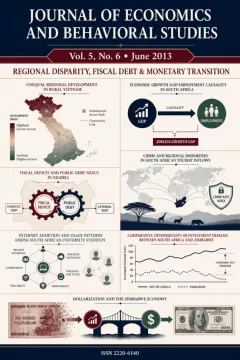 Vol. 5 No. 6 (2013)
Regional Disparity, Fiscal Debt & Monetary Transition
View issue contents
Published
Submissions
Have research to publish? Journal of Economics and Behavioral Studies welcomes submissions.
Make a Submission