Abstract
This study examines the case of student adoption and usage patterns of the Internet as an innovation in delivering important services that include financial services. The quantitative approach employed in this study utilizes an extended version of Rogers’ model of perceived innovation attributes. Consistent with previous studies, the perceived innovation attributes were found to be important determinants of students’ adoption decisions. However, two dimensions, namely relative advantage and perceived usefulness were found to influence this consumer groups’ adoption decisions more prominently, thus highlighting the complex nature of the innovation and adoption decisions for Internet services users.
Keywords
References
- Baumol, W. J. (1967). Calculation of optimal product and retailer characteristics: The abstract product approach. Journal of Political Economy , 75(5) 52-59.
- Black, N., Lockett, A., Winkelhofer, H. & Ennew, C. (2001). The adoption of Internet financial services: a qualitative study. International Journal of Retail & Distribution Management, 29(8), 390-398
- Dickerson, M. D. & Gentry, J. W. (1983). Characteristics of adopters and non adopters of home computers. Journal of Consumer Research , 10, 225-35.
- Foxall, G. R. (1994). Consumer initiators: both innovators and adaptors, in Kirton, M.J. (Eds), Adaptors and Innovators. Styles of Creativity and Problem Solving, 2nd ed., Routledge, London, 114-36.
- Fusilier, M. & Durlabhji, S. (2005). An exploration of student internet use in India. The technology acceptance model and the theory of planned behaviour , 22(4) 233 - 246.
- Hinson, R. (2005). The internet for academics: towards a holistic adoption model. Online Information Review , 30(5), 542 – 554.
- Hinson, R. & Amidu, M. (2006). Internet adoption among final year students in Ghana’s oldest business school, 55 (5), 314 – 323.
- Holak, S. L. (1988). Determinants of durable adoption: an empirical study with implications for early product screening. Journal of Product Innovation Management , 5, 50-69.
- De Jager, J. W. & Du Plooy, A. T. (2010). Information sources used to select a higher education institution: evidence from South African students. Business Education and Accreditation (BEA) , 2(I), 61-76.
- LaBay, D. G. & Kinnear, T. C. (1981). Exploring the consumer decision process in the adoption of solar energy systems. Journal of Consumer Research , 8, 271-8.
- Lancaster, K. (1966). A new approach to consumer theory. Journal of Political Economy , 74(1), 132-157.
- Lockett, A. & Littler, D. (1997). The adoption of direct banking services. Journal of Marketing Management , 13, 791-811.
- Malhotra, N., Hall, J., Shaw, J. & Oppenheim, P. (2006). Marketing Research: An Applied Orientation (5thd ed.) Frenchs Forest: NSW, Pearson Education Australia Pty Ltd.
- Myers, J. H. & Shocker, A. D. (1981). The nature of product related attributes. Research in Marketing, 2, 211236.
- Ostlund, L. E. (1974). Perceived innovation attributes as predictors of innovativeness. Journal of Consumer Research , 1, 23-29.
- Park, E. & Del Pobil, A. P. (2013). Users' attitudes toward service robots in South Korea. Industrial Robot: An International Journal, 40(1), 77 – 87
- Ratchford, B. T. (1975).The new economic theory of consumer behaviour: An interpretive essay. Journal of consumer Research , 2(2), 65-85.
- Rogers, E. M. (1962). The Diffusion of Innovations, Free Press, New York, NY.
- Rogers, E. M. (1983). The Diffusion of Innovations, Free Press, New York, NY. Rogers, E. M. (2003). The Diffusion of Innovations, Free Press, New York, NY.
- Rugimbana, R. & Iversen, P. (1994). Perceived attributes of ATMs and their marketing implications. International Journal of Bank Marketing , 12(2), 30-35.
- Rugimbana, R. (1998). Values, Perceptions and Consumer Preference Patterns for Personal Banking Technologies in Australia and Malaysia. PhD Dissertation, Published by Macquarie University.
- Rugimbana, R. O. (2007). Segmenting Generation Y: The Use of Cultural Variables as Predictors of Personal Banking Product Preferences. Journal of Financial Services Marketing, 11(4).
- Shambare, R. (2013). Predicting Consumer Preference for Remote Banking Services in South Africa and Zimbabwe: The Role of Consumer Perceptions versus Personality variables. Doctoral Dissertation, Published by Tshwane University of Technology.
- Singh, R. M. (1966). Characteristics of farm innovations associated with the rate of adoption, Guelph, Ontario Agricultural Extension Education Report, 14.
- Szymigin, I. T. D. & Bourne, H. (1999). Electronic cash: a qualitative assessment of its adoption. International Journal of Bank Marketing , 17(4), 192-203.
- Teo, T. S. H. (2001). Demographic and motivation variables associated with internet usage activities. Internet Research: Electronic Networking Applications and Policy , 11(2), 125-37.
- Teo, T. S. H. & Noyes, J. (2011). An assessment of the influence of perceived enjoyment and attitude on the intention to use technology among pre-service teachers: A structural equation modeling approach. Journal of Computers & Education , 57, 1645–1653.
- Zeithaml, V. A. & Gilly, M. C. (1987). Characteristics affecting the acceptance of retailing technologies: a comparison of elderly and non-elderly consumers. Journal of Retail Banking , 63(1), 49-68.
Downloads
No downloads have been recorded for this article yet. Figures appear here once readers begin downloading the full text.
How to Cite
Share this article
License
Copyright (c) 2013 Wilfred Kassangoye, Johan W de Jager, Robert Rugimbana (Author)

This work is licensed under a Creative Commons Attribution 4.0 International License.
Author (s) should affirm that the material has not been published previously. It has not been submitted and it is not under consideration by any other journal. At the same time author (s) need to execute a publication permission agreement to assume the responsibility of the submitted content and any omissions and errors therein. After submission of revised paper in the light of suggestions of the reviewers, the editorial team edits and formats manuscripts to bring uniformity and standardization in published material.
This work will be licensed under Creative Commons Attribution 4.0 International (CC BY 4.0) and under condition of the license, users are free to read, copy, remix, transform, redistribute, download, print, search or link to the full texts of articles and even build upon their work as long as they credit the author for the original work. Moreover, as per journal policy author (s) hold and retain copyrights without any restrictions.
Keywords
Section
Published in
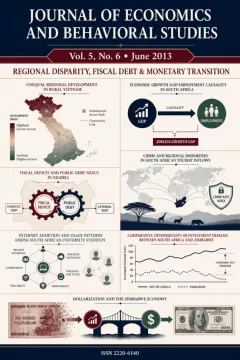 Vol. 5 No. 6 (2013)
Regional Disparity, Fiscal Debt & Monetary Transition
View issue contents
Published
Submissions
Have research to publish? Journal of Economics and Behavioral Studies welcomes submissions.
Make a Submission