Abstract
This paper examines the economic impact of the inception of the full dollarization1 in Zimbabwe’s economy after the effects of hyperinflation and an unprecedented depreciation of an exchange rate between 2000 and 2008. Dollarization is a generic word implying the use of any foreign currency as legal tender instead of the domestic currency. An analytical qualitative approach was adopted for this study. The analysis of the benefits and costs of dollarization to Zimbabwe’s economy revealed how dollarization has impacted on the stabilization of Zimbabwe’s economy. This article also highlights the fact that Zimbabwe is not the only country in Africa that has had to resort to adopting foreign currency as legal tender in an effort to remedy macroeconomic imbalances. To our knowledge, there is scant literature on dollarization in Africa and this is the reason why we have chosen to examine the impact of dollarization on Zimbabwe’s economy. In addition, we add to Kurt Schuler’s work (2005) by indicating the other African countries that had adopted dollarization over the years. Furthermore, the study offers support to recent literature that asserts that economic stabilization in these countries resulted from the impact of dollarization. The results of the study revealed that dollarization positively impacts on the country’s economy. In particular, this study is important to policymakers in that it sheds some insight into the importance of a strong currency and stable exchange rate for the stabilization of economies that experienced hyperinflation.
Keywords
- Exchange Rate Search this journal for Exchange Rate (opens in a new tab)
- Dollarization Search this journal for Dollarization (opens in a new tab)
- Hyperinflation Search this journal for Hyperinflation (opens in a new tab)
- Legal Tender Search this journal for Legal Tender (opens in a new tab)
- Sterilization Search this journal for Sterilization (opens in a new tab)
References
- Agnoli, M. Q. & Whisler, E. (2006). Official Dollarization and the Banking System in Ecuador and El Salvador: Federal Reserve Bank of Atlanta. Economic Review Third Quarter , (2), 55 -71.
- Alesina, A. & Barro, J. J. (2001). Dollarization. The American Economic Review , 91(2), 381-385.
- Berrios, R. (2006). Cost and Benefit of Ecuador’s Dollarization Experience. Perspectives on Global Development and Technology , 5(1-2), 55-68.
- Biti, T. (2013). Minister of Finance: The 2013 National Budget Statement, Government of Zimbabwe.
- Bogetic, Z. (2000). Official Dollarization: Current Experiences and Issues. Cato Journal , 20(2), 179-211.
- Bruno, M. & Easterly, W. (1998). Inflation Crises and Long-Run Growth. Journal of Monetary Economics , 41, 3-26.
- Central Statistics. (2005 – 2010). Various issues. Government of Zimbabwe.
- Edwards, S. (1995). Crisis and Reform in Latin America: From Despair to Hope. Washing ton, D.C.: World Bank.
- Fischer, S. (1982). Seigniorage and the Case for National Money. Journal of Political Economy , 90, 295-313.
- Fischer, S. (1993b). The Role of Macroeconomic Factors in Growth. Journal of Monetary Economics , 32, 485-512.
- Gust, C., Leduc, S. & Sheets, N. (2009). The Adjustment of Global External Balances: Does Partial Exchange rate Pass-through to Trade Prices Matter? Journal of International Economics , 79, 173-185.
- Gust, C., Leduc, S. &Vigfusson, R. (2010). Trade Integration, Competition, and the Decline in Exchange rate Pass-through. Journal of Monetary Economics , 57, 309-324.
- Hanke, S. (2002). On Dollarization and Currency Boards: Error and Deception. Journal of Economic Policy Reform , 5(4), 203-222.
- Hanke, S. H. & Kwok, A. K. F. (2009). On the Management of Zimbabwe’s Hyperinflation. Cato Journal , 29(2), 353-363.
- Linzmayer, O. (2012). Zimbabwe. The Banknote Book. San Francisco, CA: wwww. BanknoteNews.com. Makuyana, G., Manongo, S. & Zivanomoyo, J. (2011). Does the Zimbabwean Exchange Rate Follow a Random Walk: January 2000-December 2008? Journal of Economics and International Finance , 3(2), 121-124.
- Melvin, M. (1988). The Dollarization of Latin America as market- enforced Monetary Reform: Evidence and Implications. Economic Development and Cultural Change , 36(3), 543-558.
- Minda, A. (2005). Full Dollarization: A Last Resort Solution to Financial Instability in Emerging Countries. The European Journal of Development Research , 17(2), 289-316.
- Ministry of Finance. (2010). Budget 2011. The Herald, Harare, Zimbabwe, Friday 26 November.
- Ministry of Finance. (2010-2012). National Budget Statement, Government of Zimbabwe.
- Moreno-Villalaz, J. L. (2005). Financial integration and Dollarization: The case of Panama. Cato Journal , 25(1), 17-14.
- Mundell, R. A. (1961). A Theory of Optimum Currency Areas. American Economic Review , 51(4), 657-665.
- Mutambara, A. (2009). Press Conference: On the Zimbabwe Political Crisis. htt://www.theZimbabwean.co.uk
- Neiman, B. (2010). Stickiness, Synchronization, and Pass-through in intra-firm Trade Prices. Journal of Monetary Economics , 57, 295-308.
- Noko, J. (2011). Dollarization: The Case of Zimbabwe. Cato Journal , 31(2), 339-365.
- Quispe-Agnoli, M. &Whisler, E. (2006). Official Dollarization and the Banking System in Ecuador and El Salvador. Economic Review Third Quarter, Federal Reserve Bank of Atlanta.
- Raath, J. (2007). Devaluation is too little, too late to save Zimbabwe. Times Online. 7 September 2007.
- Reserve Bank of Zimbabwe. (2009). Unveils $100 trillion note. The Herald, 16 January 2009. Reserve Bank of Zimbabwe. (2009). Unveils ZW$100 trillion note. The Herald. 16 January 2009. Reserve Bank of Zimbabwe. (2013). ‘Monetary Policy Statement’ issued in terms of Reserve Bank of Zimbabwe Act, Chapter 22:15, Section 46.
- Richardson, C. J. (2005). The Loss of Property Rights and the Collapse of Zimbabwe. Cato Journal , 25(3), 541-553.
- Schuler, K. (2005). Some Theory and History of Dollarization. Cato Journal , 25(1), 115-125.
- Selgin, G. (2005). Currency Privatization as a Substitute for Currency Boards and Dollarization. Cato Journal , 25(1), 144-151.
- Sikwila, M. N. (2011). Inflation Impact of an Exchange Rate. Interdisciplinary Journal for the study of the Arts and Humanities in Southern Africa , 4, 166-180.
- The Daily Telegraph. (27 October 2008). Zimbabwe shops stop accepting local currency. UNIDO (2011). Report: Fostering Industrial Development in Africa in the new global environment. Zimbabwe National Statistic Agency (2012). Quarterly Digest of Statistics, Government of Zimbabwe.
Downloads
No downloads have been recorded for this article yet. Figures appear here once readers begin downloading the full text.
How to Cite
Share this article
License
Copyright (c) 2013 Mike Nyamazana Sikwila (Author)

This work is licensed under a Creative Commons Attribution 4.0 International License.
Author (s) should affirm that the material has not been published previously. It has not been submitted and it is not under consideration by any other journal. At the same time author (s) need to execute a publication permission agreement to assume the responsibility of the submitted content and any omissions and errors therein. After submission of revised paper in the light of suggestions of the reviewers, the editorial team edits and formats manuscripts to bring uniformity and standardization in published material.
This work will be licensed under Creative Commons Attribution 4.0 International (CC BY 4.0) and under condition of the license, users are free to read, copy, remix, transform, redistribute, download, print, search or link to the full texts of articles and even build upon their work as long as they credit the author for the original work. Moreover, as per journal policy author (s) hold and retain copyrights without any restrictions.
Keywords
- Exchange Rate Search this journal for Exchange Rate (opens in a new tab)
- Dollarization Search this journal for Dollarization (opens in a new tab)
- Hyperinflation Search this journal for Hyperinflation (opens in a new tab)
- Legal Tender Search this journal for Legal Tender (opens in a new tab)
- Sterilization Search this journal for Sterilization (opens in a new tab)
Section
Published in
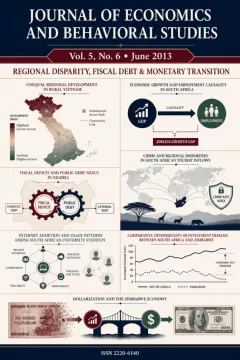 Vol. 5 No. 6 (2013)
Regional Disparity, Fiscal Debt & Monetary Transition
View issue contents
Published
Submissions
Have research to publish? Journal of Economics and Behavioral Studies welcomes submissions.
Make a Submission