Abstract
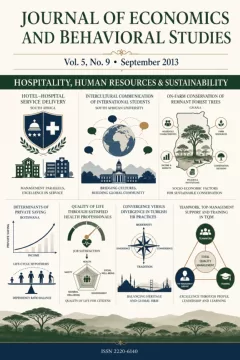
The contribution of remnant trees in traditional agro forestry systems in recent times has attracted significant attention from policy makers, stakeholders, and academicians due to their important role in conserving biodiversity within agricultural systems, reserves of genetic resources and provision of other important environmental services. The study seeks to determine socioeconomic factors influencing farmers’ decision to maintain remnant trees in agricultural landscape. Data was solicited from 220 households in three rural communities through structured interviews and on farm visitations. We employed Poison and Negative Binomial Regressions to determine factors influencing rural farm households’ decision to retain remnants forest tree species in agro ecosystem. The regression results indicated that the key factors strongly affecting farmers’ on-farm conservation decision to retain remnant forest trees in agricultural landscape were age, gender, years of schooling, religion, land tenure, farmers’ perceptions to current environmental problems, distance to farm land, erosion and the size of the landholdings. The study recommends that forest governance with focus on collaborative forest resource management and equitable distribution of benefits generated from extraction of forest resources should be given high impetus in policy formulation. The needs and concerns of forest fringe communities should feature paramount in this regard.
Keywords
References
- Acharya, K. P. (2006). Linking trees on farms with biodiversity conservation in subsistence farming systems in Nepal. Biodiversity and Conservation , 15, 631-646.
- Acheampong, E. & Marfo, E. (2011).The impact of tree tenure and access on chainsaw milling in Ghana. Ghana Journal of Forestry , 27, 68-86.
- Adesina, A. A. & Baidu-Forson, J. (1995). Farmers’ perception and adoption of new agricultural technology: evidence from analysis in Burkina Faso and Guinea, West Africa. Agricultural Economics , 13, 1-9.
- Adesina, A. A. & Zinnah, M. M. (1993).Technology characteristics, farmer perceptions and adoption decisions: a Tobit model application in Sierra Leone. Agricultural Economics , 9, 297-311.
- Afikorah-Danquah, S. (1997). Local Resource management in the forest-savannah transitional zone: The Case of Wenchi District, Ghana. IDS Bulletin , 28(4), 36-46.
- Agidee, Y. (2011). Forest Carbon in Ghana: Spotlight on Community Resource Management Areas. Katoomba Group’s Legal Initiative Country Study Series. Forest Trends: Washington, DC.
- Agyenim-Boateng, J., Koomson, F., Tenkorang, E. Y. & Ntiri-Oppong, R. (2002). Effective stakeholder’s collaboration in forest policy and management in Southern Ghana. Accra (Ghana): Tropenbos Ghana.
- Ahn, P. M. (1970). West African Soils. Oxford University Press, London.
- Ansong, M. & Roskaft, M. (2011). Determinants of attitudes of primary stakeholders towards forest conservation management: a case study of Subri Forest Reserve, Ghana. International Journal of Biodiversity Science, Ecosystem Services and Management , 7(2), 98-107.
- Anyonge, C. H. & Roshetko, J. M. (2003). Farm-level timber production: orienting farmers towards the market. Unasylva , 212(54), 48-56.
- Asare, R., David, S. & Sonwa, D. (2009). Conservation and biodiversity in and around cocoa farms. Learning about sustainable cocoa production. A guide for participatory farmer training. Development and Environment Series 12-2009. Forest and Landscape Denmark.
- Asrat, S., Yesuf, M., Carlsson, F. & Wale, E. (2010). Farmers’ preferences for crop variety traits. Lessons for onfarm conservation and technology adoption. Ecological Economics , 69, 2394-2401.
- Ayine, D. (2008). Social responsibility agreements in Ghana’s forestry sector. Developing legal tools for citizen empowerment series, IIED, London.
- Boakye, K. A. & Baffoe, A. B. (2006). Trends in Forest Ownership, Forest Resource Tenure and Institutional Arrangements: a Case Study from Ghana. Forestry Policy and Institutions Working Paper No. 19, pp. 151-174 in Understanding Forest Tenure in Africa: Opportunities and Challenges for Forest Tenure Diversification. FAO, Rome, Italy.
- Birol, E. & Smale, M. (2007). Farmer preferences for Milpa diversity and genetically modified maize in Mexico. A latent class approach. International Food Policy Research Institute, IFPRI Discussion Paper 00726.
- Brammer, H. (1962). Soils. Agriculture and land use in Ghana(Ed. By J.B. Wills), University Press, London, 88-87.
- Cameron, A. C. & Trivedi, P. K. (1998). Regression analysis of count data. New York: Cambridge University Press.
- Colfer, C. J. P. (2005). The complex forest: communities, uncertainty, and adaptive collaborative management. Washington (DC): RFF Press.
- Dadebo, M. A. & Shinohara, T. (1999). Forest resources and timber production of Ghana: Current Instruments for sustainable development. Journal of Forest Research , 4(1), 1-12.
- Damnyag, L., Saastamoinen, O., Appiah, M. & Pappinen, A. (2012). Role of tenure insecurity in deforestation in Ghana’s high forest zone. Forest Policy and Economics , 14, 90-98.
- Degrande, A., Shreckenberg, K., Mbosso, C., Anegbeh, P., Okafor, V. & Kanmegne, J. (2006). Farmers’ fruit tree-growing strategies in the humid forest zone of Cameroon and Nigeria. Agro forestry Systems , 67, 159-175.
- Deressa, T., Hassan, R. M., Alemu, T., Yesuf, M. & Ringer, C. (2008). Analyzing the determinants of farmers’ choice of adaptation methods and perceptions of climate change in the Nile Basin of Ethiopia. International Food Policy Research Institute. IFPRI Discussion paper 00798.
- Dorm-Adzobu, C., Ampadu-Agyei, O. & Veit, P. G. (1991). Religious beliefs and environmental protection: the Malshegu sacred grove in northern Ghana., World Resource Institute, Washington, DC, USA and Acts Press, African Centre for Technology Studies, Nairobi Kenya.
- Dumenu, W. K. (2010). Management of timber resources in areas outside forest reserves in Ghana: The role of stakeholders. M Sc. Dissertation, Albert-Ludwigs-University.
- Eneji, C. V. O., Ntamu, G. U., Ajor, J. O., Ben, C. B., Bassey, J. E. & Williams, J. J. (2012). Ethical basis of African traditional religion and socio-cultural practices in natural resource conservation and management in Cross river State, Nigeria. Journal of Research in Peace, Gender and Development , 2(2), 034-043.
- Estrada, A., Coates-Estrada, R. & Meritt-Jr., D. (1993). Bat species richness and abundance in tropical rain forest fragments and in agricultural habitats at Los Tuxtlas, Mexico. Ecography , 16, 309-318.
- FAO. (2001). Country report-Ghana, Forestry sector outlook studies. FOSA, Working Paper / WP12.
- FAO. (2003). State of forest and tree genetic resources in dry zone Southern Africa Development Community Countries. Document prepared by B.I. Nyoka. Forest Genetic Resources Working Papers, Working Paper FGR/41E, Forest Resources Development Services, Forest Resources Division. FAO, Rome.
- Gauchan, D., Smale, M., Maxted, N., Cole, M., Sthapit, B. R., Jarvis, D. & Upadhyay, M. P. (2005). Socioeconomic and agro ecological determinants of conserving diversity on-farm: The case of rice genetic resources in Nepal. Nepal Agricultural Research Journal , 6, 89-98.
- Ghana Forestry Commission. (2009). FLEGT Voluntary Partnership Agreement between Ghana and the European Union. Briefing Note November 2009.
- Ghana Statistical Service. (2005). 2000 population and housing census of Ghana. Brong Ahafo Region. Analysis of District Data and Implication for planning. Ghana Statistical Service.
- Gebreegziabher, Z., Melkonen, A., Kassie, M. & Kohlin, G. (2010). Household tree planting in Tigrai, northern Ethiopia: Tree species, purposes and determinants. University of Gothenburg, School of Business, Economics and Law. Working papers in economics, 432.
- GoG (Government of Ghana). (1962). Concessions Act. The Government Printing Department, Accra.
- Green, W. H. (2000). Econometric analysis , 4th ed. Prentice Hall, Upper Saddle River, New Jersey: PrenticeHall.
- Greenberg, R. (1989). Forest migrants in non-forest habitats on the Yucatan Peninsula. In: Hagan JM and Johnston DW (eds) Ecology and Conservation of Neotropical Migrant Ladybirds, 273286.Smithsonian Institute Press, Washington DC.
- Guevara, S. & Laborde, L. (1993). Monitoring seed dispersal at isolated standing trees in tropical pastures: consequences for local species availability. Vegetation , 107(108), 319-338.
- Guevara, S., Purata, S. E. & Van de Maarel, E. (1986).The role of remnant forest trees in tropical secondary succession. Vegetation , 66, 77-84.
- Hall, J. B. & Swaine, M. D. (1981). Distribution and ecology of vascular plants in a tropical rain forest. Junk, The Hague.
- Hansen, C. P. (2011). Forest law compliance and enforcement: The case of on-farm timber extraction in Ghana. Journal of Environmental Management , 92, 575-586.
- Hawthorne, W. D. & Abu-Juam, M. (1995). Forest protection in Ghana. Forest conservation series no. 14, IUCN, Gland.
- Heitz-Seifert, U., Heitz, P. & Guevara, S. (1996). Epiphyte vegetation and diversity on remnant trees after forest clearance in southern Veracruz, Mexico. Biological Conservation , 75, 103-111.
- IDS. (1979). Rural development: whose knowledge counts? IDS Bulletin 10(2). Institute of Development Studies, University of Sussex, UK.
- Jackson, N. V. (2007). Knowledge and use of native trees by local forest users: Implication for a Philippine protected area. M.Sc. thesis, University Montana, Missoula, MT.
- Kassaga, K. & Kotey, N. A. (2001). Land management in Ghana: Building on traditional and modernity. International Institute for Environment and Development, London. pp34.
- Kotey, N. A., Francois, J., Owusu, J. G. K., Yeboah, R., Amanor, K. S. & Antwi, L. (1998). Falling into place. Policy that works for forests and people. Series number 4. International Institute for Environment and Development, London, pp 138.
- Lancaster, K. J. (1966). A new approach to consumer theory. Journal of Political Economy , 74(2), 132-157.
- Long, J., Cromwell, E. & Gold, K., (2000). On-farm management of crop diversity: an introductory bibliography. London: Overseas Development Institute for ITGG, pp 42.
- Lourmas, M., Kjellberg, F., Dessard, H., Joly, H. I. & Chevallier, M. H. (2007). Reduce density due to logging and its consequences on mating system and pollen flow in African mahogany Entandrophragma cylindricum. Heredity , 99,151-160.
- McClanahan, T. R. & Wolfe, R. W. (1993). Accelerating forest succession in fragmented landscape: the role of birds and perches. Conservation Biology , 7(2), 279-288.
- McFadden, D. L. (1974).The measurement of urban travel demand. Journal of Public Economics , 3, 303-328.
- Mekonnen, A. & Damte, A. (2011). Private trees as household assets and determinants of tree-growing behaviour in rural Ethiopia. Environmental for Development Discussion Paper Series , 11(14), 1-25.
- Merry, F. D. & Carter, D. R. (2001). Factors affecting Bolivian mahogany exports with policy implication for forest sector. Forest Policy and Economics , 2, 281-290.
- Micheal, R. T. & Becker, G. S. (1973). On the new theory of consumer behaviour. The Swedish Journal of Economics , 75(4), 378-396.
- Nadkarni, N. M. & Matelson, T. J. (1989). Bird use epiphyte resources in Neotropical trees. The Condor , 91, 891-907.
- Nepstad, D. C., Uhl, C. & Serrao, E. A. S. (1991). Recuperation of a degraded Amazonian landscape: forest recovery and agricultural restoration. Ambio , 20, 248-288.
- Nkamleu, G. B. (2005). Factors affecting the adoption of agro forestry practices by farmers in Cameroon. Small-scale Forest Economics, Management and Policy , 4(2), 135-148.
- Ntiamoa-Baidu, Y. (1995). Indigenous vs. introduced biodiversity conservation strategies: The case of protected area systems in Ghana.< http://WWW. World wildlife. org/bsp/publications /african/indigenous_vs_eng/yaaeng.htm>Assessed on 17th July, 2012.
- Odoom, F. K. (2005). Chainsawing in the natural forest of Ghana. An assessment of the socioeconomic impacts of this practice. FAO Forest Harvesting Case-Study 21. FAO, Rome.
- Opoku, K. (2006). Forest Governance in Ghana an NGO perspective. Recommendations for a Voluntary Partnership Agreement with EU. A report produced for FERN by Forest Watch Ghana, March 2006. Pp 31. FERN, Moreton in Marsh, UK.
- Pattanayak, S. K., Mercer, D. E., Sills, E. O., Yang, J. & Cassingham, K. (2003).Taking stock of agro forestry adoption studies. Agro forestry Systems , 57(3), 173-186.
- Rahm, M. R. & Huffman, W. E. (1984).The adoption of reduced tillage: the role of human capital and other variables. American Journal of Agricultural Economics , 66(4), 405-413.
- Richard, P. (1989). Agriculture as a performance. In: Farmer first (eds. Chamber, R. Pacey, A. and Thrupp, L.A.). Intermediate Technology Publications, London, 39-51.
- Robiglio, V., Minang, P. A. & Asare, R. (2011). On-farm timber production for emission reduction with sustainable benefits at the tropical forest margins.ASB Policy Brief No 23. ASB Partnership for the Tropical Forest Margins, Nairobi, Kenya.
- Sillitoe, P. (1998). The development of indigenous knowledge: a new applied anthropology. Current Anthropology , 39, 233-252
- Sinclairm, F. L. & Walker, D. H. (1998). Qualitative knowledge about complex agro ecosystems. Part 1: a natural language approach to representation. Agricultural systems , 56, 341-363.
- Sinclair, F. L. & Walker, D. H. (1999). A utilitarian approach to the incorporation of local knowledge in agro forestry research and extension. In: Agro forestry in sustainable agricultural systems (eds. Buck, L.E., Lassoie, J.P. and Fernandes, E.C.M.) Lewis Publisher, New York, pp245-275.
- Smale, M., Istvan, M. & Devra, I. J. (2002).The economics of conserving agricultural biodiversity on-farm: Research methods development from IPGRI’s Global Project Strengthening the Scientific Basis of InSitu Conservation of Agriculture Biodiversity. International Plant Genetic Resources Institute , Rome, Italy.
- Snook, L. K. (1996). Catastrophic disturbances, logging and the ecology of mahogany (Swietenia macrophylla King): grounds for listing a major tropical species in CITIES. Botanical Journal of the Linnean Society , 122(1), 35-46.
- Sokal, R. R. & Rohlf, F. J. (1981). Biometry. The principles and practice of statistics in biological research (2nd ed.), W.H Freeman and Company, New York.
- Swaine, M. D. (1992). Characteristics of dry forest in West Africa and the influence of fire. Journal of Vegetation Science , 3, 365-374.
- Swaine, M. D. (1996). Rainfall and soil fertility as factors limiting forest species distributions in Ghana. The Journal of Ecology , 84(3), 419-428.
- Tropenbos-International. (2005). Reconciling policy reforms with forest legislation. Proceeding of the Tropenbos International Ghana Workshop 5; 2005 July 4-5; Elmina, Ghana. Wageningen (The Netherlands).Tropenbos-International.
- Wale, E. (2010). How do farmers allocate land for coffee trees? Implication for on-farm conservation and seed technology adoption in Ethiopia. Journal of Sustainable Agriculture , 34(3), 270-291.
- Walters, G. D. (2007). Using poisson class regression to analyze count data in correctional and forensic psychology: A relatively old solution to relatively new problem. Criminal Justice and Behavior , 34, 1659-1674.
- Warriner, G. K. & Moul, T. M. (1992). Kinship and personal communication network influences on the adoption of agricultural conservation technology. Journal of Rural Studies , 8(3), 279-291.
Downloads
No downloads have been recorded for this article yet. Figures appear here once readers begin downloading the full text.
How to Cite
Share this article
License
Copyright (c) 2013 Jones Abrefa Danquah, John K.M. Kuwornu, Ari Pappinen (Author)

This work is licensed under a Creative Commons Attribution 4.0 International License.
Author (s) should affirm that the material has not been published previously. It has not been submitted and it is not under consideration by any other journal. At the same time author (s) need to execute a publication permission agreement to assume the responsibility of the submitted content and any omissions and errors therein. After submission of revised paper in the light of suggestions of the reviewers, the editorial team edits and formats manuscripts to bring uniformity and standardization in published material.
This work will be licensed under Creative Commons Attribution 4.0 International (CC BY 4.0) and under condition of the license, users are free to read, copy, remix, transform, redistribute, download, print, search or link to the full texts of articles and even build upon their work as long as they credit the author for the original work. Moreover, as per journal policy author (s) hold and retain copyrights without any restrictions.
Keywords
Section
Published
Submissions
Have research to publish? Journal of Economics and Behavioral Studies welcomes submissions.
Make a Submission