Articles

  • Article 1 in this issue

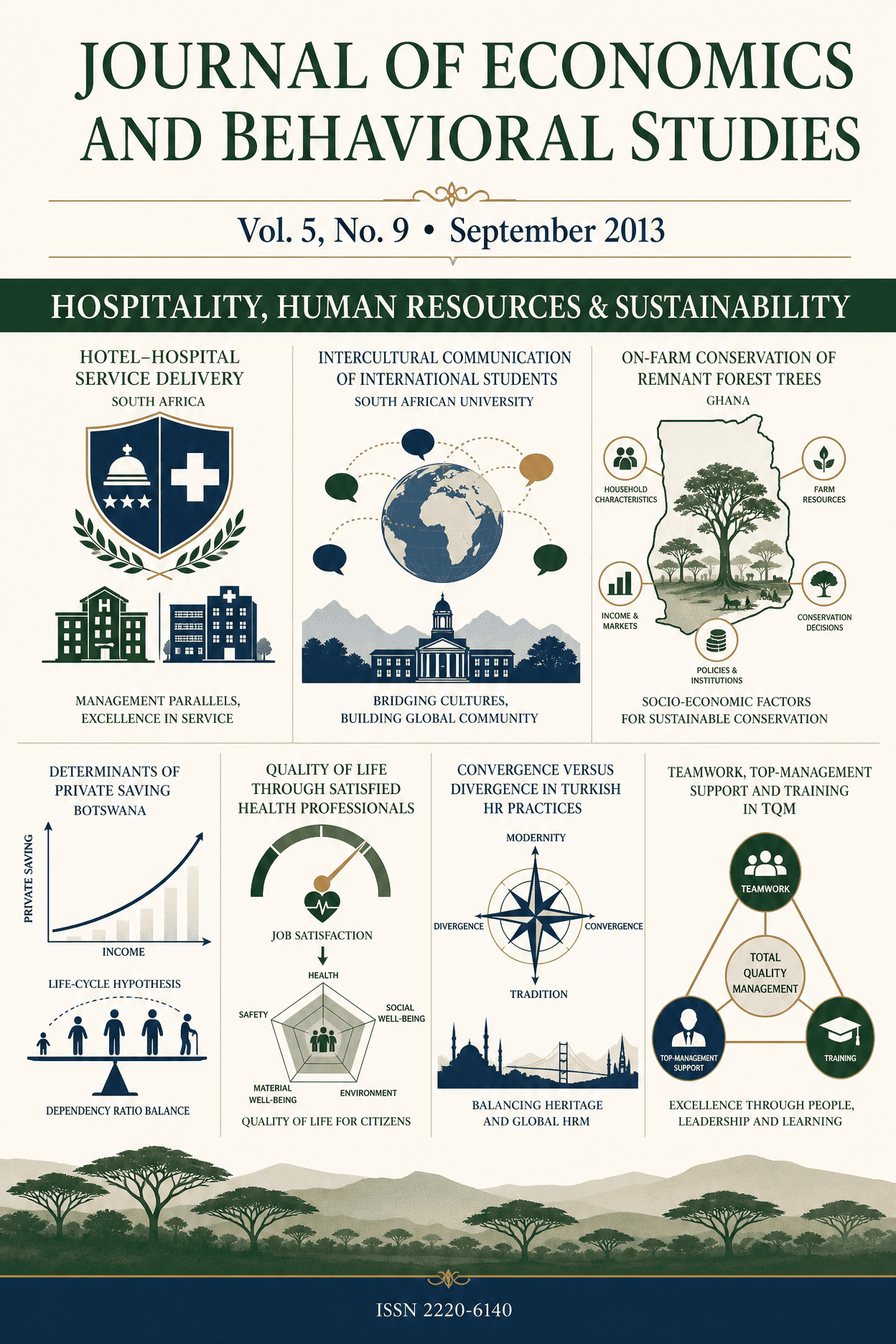
    An analysis of Hotels and its Similarities to the Management of Hospitals: A case study of a Provincial Hospital in South Africa

    • Author: A. Deen, R. Balkaran

    The South African concept of Provincial Hospitals in South Africa is characterised by the fact that it is managed by the state and its structure, operations and location were predominantly influenced by its historical record and to a large extent the challenges experienced with its management is directly linked to the problems of the past. This specifically has to do with the dire lack of essential resources from financial aligned resources to health care expertise. The stand- off here is against the desperate need for basic health care services from the many millions that have been previously disadvantaged. The ability to close this gap lies in the heart of efficient, effective and economical management of the provincial hospitals. The management of hotels and its link to the management of hospitals becomes significant within this context as essential elements such as hospitality and hospitality practice may be embraced within the management of health care services within South Africa. The paper explores the strong theoretical base of hospitality within hotels and its relevance to hospitals which is premised on service delivery the roots of which are fixed on the efficiencies of management practice. A theoretical model will be explored in respect of its application to the management of provincial hospitals in South Africa. This is further enhanced by a parallel study of a provincial hospital in South Africa which would incorporate amongst other an analysis of its socio-economic and legislative environments.

    Pages 573-579

    PDF - An analysis of Hotels and its Similarities to the Management of Hospitals: A case study of a Provincial Hospital in South Africa (opens in a new tab)
  • Article 2 in this issue

    A Matter of Intercultural Communication: Perspectives of International Students at a University in South Africa

    • Author: V.P. Rawjee, K. Reddy, M. Maharaj

    The end of apartheid in South Africa in 1994 saw many higher education institutions identifying opportunities to increase their intake of international students by introducing student exchange programmes. Based on South Africa’s ethnically diverse society, cultural differences pose various challenges for international students. This results in intercultural communication apprehension and therefore, a negative experience for international students. The aim of this research is to examine the cultural challenges faced by international exchange students studying at a university in South Africa. A quantitative descriptive methodology was employed for this study. Themes emanating from the literature review were used to develop a research questionnaire that consisted mostly of closed-ended questions followed by a few open-ended questions. The questionnaire was administered to ninety nine international students. The findings of the investigation indicate that the majority of international students experience culture as a challenge, which impacted on their ability to communicate and to be understood. To add credence to the international students’ experiences and the exchange programme, this paper therefore, suggests that issues around culture and intercultural communication is introduced as a core study module for all first-time international students before they arrive in South Africa.

    Pages 580-587

    PDF - A Matter of Intercultural Communication: Perspectives of International Students at a University in South Africa (opens in a new tab)
  • Article 3 in this issue

    Analyses of Socioeconomic Factors influencing on-farm Conservation of Remnant Forest Tree Species: Evidence from Ghana

    • Author: Jones Abrefa Danquah, John K.M. Kuwornu, Ari Pappinen

    The contribution of remnant trees in traditional agro forestry systems in recent times has attracted significant attention from policy makers, stakeholders, and academicians due to their important role in conserving biodiversity within agricultural systems, reserves of genetic resources and provision of other important environmental services. The study seeks to determine socioeconomic factors influencing farmers’ decision to maintain remnant trees in agricultural landscape. Data was solicited from 220 households in three rural communities through structured interviews and on farm visitations. We employed Poison and Negative Binomial Regressions to determine factors influencing rural farm households’ decision to retain remnants forest tree species in agro ecosystem. The regression results indicated that the key factors strongly affecting farmers’ on-farm conservation decision to retain remnant forest trees in agricultural landscape were age, gender, years of schooling, religion, land tenure, farmers’ perceptions to current environmental problems, distance to farm land, erosion and the size of the landholdings. The study recommends that forest governance with focus on collaborative forest resource management and equitable distribution of benefits generated from extraction of forest resources should be given high impetus in policy formulation. The needs and concerns of forest fringe communities should feature paramount in this regard.

    Pages 588-602

    PDF - Analyses of Socioeconomic Factors influencing on-farm Conservation of Remnant Forest Tree Species: Evidence from Ghana (opens in a new tab)
  • Article 4 in this issue

    What Drives Private Saving in Botswana?

    • Author: Naledi. C. Modisaatsone

    This study examines the determinants of private saving in Botswana for the period covering 19942009. We use quarterly time series data to evaluate the magnitude and direction of the effects of key policy and non-policy variables on private saving. The variables examined are inflation, real interest rates, real gross national disposable income, degree of financial depth and dependency ratio. The dependency ratio is included in order to capture the effect of demographic influence on private savings. The stated determinants of savings are articulated in the context of the life cycle hypothesis. We investigate the short and long run behavior of the variables using an ARDL-ECM. The results suggest that there is a positive relationship between household income and their savings. The dependency ratio exerts a negative impact on private savings which supports the Lifecycle Hypothesis. The results also suggest that financial sector development has induced a positive impact on private savings in Botswana. Interest rates have a positive relationship with private savings; and, lastly, inflation has a negative relationship with private savings. Financial depth and real interest rates are the core policy instruments that the government can use to encourage savings in Botswana.

    Pages 603-611

    PDF - What Drives Private Saving in Botswana? (opens in a new tab)
  • Article 5 in this issue

    Citizens’ Quality of Life: The Outcome of a Satisfied Health-Related Professional

    • Author: Chux Gervase Iwu

    This paper argues that the quality of life of citizens of a nation can also be amplified by the quality of life of health-related professionals who provide myriad necessary services across a wide range of care pathways and in various settings. The approach was both theoretical and empirical – review of literature and statistical analysis of the collated data. Thus, the study utilized factor analysis to determine the factors that bring about job satisfaction amongst health-related professionals. The findings point to a number of important job satisfaction as well as organizational climate dimensions, which combine to generate high levels of job satisfaction amongst health-related professionals. The paper concludes by serving some important directives for management of health establishments.

    Pages 612-624

    PDF - Citizens’ Quality of Life: The Outcome of a Satisfied Health-Related Professional (opens in a new tab)
  • Article 6 in this issue

    Convergence or Divergence? Evaluation of Human Resource Practices in Turkey

    • Author: Ozge Tayfur

    This study investigates human resource (HR) management (HRM) practices in Turkey vis-à-vis history, religion, culture, and economic systems. It hopes to contribute discussion on convergence and divergence by assessing traditional values’ impact on shaping HR practices. The study reviews the journal articles, thesis and conference proceedings addressing major human resource functions, namely job analysis, training, performance-management, recruitment and selection in Turkey. Review suggests directional convergence’s presence, meaning companies in Turkey follow the same trends prevailing in the USA or Europe, yet the patterns differ with respect to Turkish firms’ understanding and implementation of these trends. Collectivism, paternalism, and uncertainty avoidance seem to profoundly impact HRM practices in Turkey, decreasing the possibility of full convergence. HR literature is dominated by U.S. and European-oriented research. As this study provides a detailed, though not comprehensive literature review concerning HR practices in Turkey, its conclusions also may be extrapolated to countries with a similar socio-cultural dynamic, in addition to suggesting avenues for future research.

    Pages 625-638

    PDF - Convergence or Divergence? Evaluation of Human Resource Practices in Turkey (opens in a new tab)
  • Article 7 in this issue

    The Importance of Teamwork, Continuous Top Management Support and Training in Bringing About TQM

    • Author: Sanjana Brijball Parumasur, Patsy Govender

    As a result of increasing competition, organizations have realised the importance of its human capital in bringing about continuous improvement in quality in order to secure increased customer satisfaction and loyalty as well as sustainable development. Strategic approaches frequently, though not always successfully, adopted in a TQM environment include teamwork, management support and training. Hence, this study aims to assess managerial perceptions of the importance of teamwork, continuous top management support and training in bringing about TQM. Biographical influences on these managerial perceptions are also assessed. A sample of 202 managers (middle, senior, top) was drawn using a stratified random sampling technique. Data was collected using a pre-coded, selfdeveloped questionnaire whose psychometric properties were assessed using Factor Analysis and Cronbach’s Coefficient Alpha respectively. Data was analyzed using descriptive and inferential statistics. The findings reflect that in this organization, the focus in bringing about total quality management is on continuous top management support, followed by continuous training and learning and lastly, teams and teamwork. These dimensions also significantly inter-correlate with each other. Biographical influences were also noted in terms of position, qualifications and gender. Based on the results, recommendations are presented for enhancing team performance, managerial support and training in efforts to bring about TQM.

    Pages 639-651

    PDF - The Importance of Teamwork, Continuous Top Management Support and Training in Bringing About TQM (opens in a new tab)