Abstract
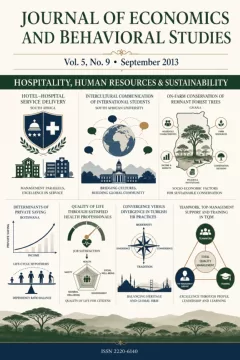
This study examines the determinants of private saving in Botswana for the period covering 19942009. We use quarterly time series data to evaluate the magnitude and direction of the effects of key policy and non-policy variables on private saving. The variables examined are inflation, real interest rates, real gross national disposable income, degree of financial depth and dependency ratio. The dependency ratio is included in order to capture the effect of demographic influence on private savings. The stated determinants of savings are articulated in the context of the life cycle hypothesis. We investigate the short and long run behavior of the variables using an ARDL-ECM. The results suggest that there is a positive relationship between household income and their savings. The dependency ratio exerts a negative impact on private savings which supports the Lifecycle Hypothesis. The results also suggest that financial sector development has induced a positive impact on private savings in Botswana. Interest rates have a positive relationship with private savings; and, lastly, inflation has a negative relationship with private savings. Financial depth and real interest rates are the core policy instruments that the government can use to encourage savings in Botswana.
Keywords
References
- African Development Bank. (2011). The Middle of the Pyramid: Dynamics of the Middle Class in Africa, Market Brief.
- Aghveli, B., Boughton, J., Montiel, P., Villanueva, D. & Woglom, G. (1990). The Role of National Saving in the World Economy. International Monetary Fund , Occasional Paper 67.
- Ahmed, A. (2007).Potential Impact of Financial Reforms on Private Savings in Botswana: An Empirical Analysis Using a VECM Approach. The Journal of Developing Areas , 41(1).
- Bank of Botswana. (2009). Annual Report.
- Chowdhury, A. (2001).The Impact of Financial Reform on Private Savings in Bangladesh. World Institute for Development Economics Research, Discussion Paper No.2001/78.
- Chowdhury, A. & Baliamoune, M. (2003). The long run behavior and short run dynamics of private savings in Morocco. Savings and Development , 27(2), 135-160
- Clarke, L. C. (1995). The Financial Emergence of Southern Africa, Bank of Botswana, Gaborone.
- Elbadawi, I. & Mwega, F. (2000). Can Africa’s Savings Collapse Be Reversed? The World Bank Economic Review, 14(3), 415-443.
- Gujarati, D. (2004). Basic Econometrics , Fourth Edition
- Hussein, K. & Thirlwall, A. P. (1999). Explaining differences in the domestic savings ratio across countries: A panel data study. The Journal of Development Studies , Taylor and Francis Journals , 36(1), 31-52.
- Loayza, N., Schmidt-Hebbel, K. & Steven, L. (2000). What drives Savings across the World? Review of Economics and Statistics , 82(2), 165-181.
- Masson, P. R., Bayoumi, T. & Samiei, H. (1998). International Evidence on the Determinants of Private Saving. The World Bank Economic Review , 12(3), 483-501.
- Modigliani, F. (1970). The life-cycle hypothesis and inter country differences in the saving ratio, in W. A. Eltis, M. FG. Scott, and J. N. Wolfe, eds., Induction, growth, and trade: essays in honor of Sir Roy Harrod, Oxford. Oxford University Press, 197–225.
- Modigliani, F. (1993). Recent declines in the savings rate: a life-cycle perspective. In M. Baldassari, L. Paganetto, and E. Phelps (Eds.) World saving, prosperity and growth (pp. 249-286). London: Macmillan.
- Nwachukwu, T. & Egwaikhide, F. (2009). An Error Correction Model of the Determinants of Private Saving in Nigeria, Paper presented at the African Economic Society, Capetown, South Africa
- Pesaran M. H., Shin Y. & Smith R. P. (1999). Pooled Mean Group estimation of dynamic Heterogeneous panels. Journal of the American Statistical Association , 94, 621-34.
- Ozcan, K., Gunay, A. & Ertac, S. (2003). Determinants of Private Savings Behavior in Turkey. Applied Economics , 35, 1405-1416
- Radipotsane, M. (2007). Determinants of Household Saving and Borrowing in Botswana.IFC Bulletin No 25
- Taye, H. K. (2013). Inflation Dynamics in Botswana and Bank of Botswana’s Medium-Term Objective Range. BIDPA Working Paper 36
Downloads
No downloads have been recorded for this article yet. Figures appear here once readers begin downloading the full text.
How to Cite
Share this article
License
Copyright (c) 2013 Naledi. C. Modisaatsone (Author)

This work is licensed under a Creative Commons Attribution 4.0 International License.
Author (s) should affirm that the material has not been published previously. It has not been submitted and it is not under consideration by any other journal. At the same time author (s) need to execute a publication permission agreement to assume the responsibility of the submitted content and any omissions and errors therein. After submission of revised paper in the light of suggestions of the reviewers, the editorial team edits and formats manuscripts to bring uniformity and standardization in published material.
This work will be licensed under Creative Commons Attribution 4.0 International (CC BY 4.0) and under condition of the license, users are free to read, copy, remix, transform, redistribute, download, print, search or link to the full texts of articles and even build upon their work as long as they credit the author for the original work. Moreover, as per journal policy author (s) hold and retain copyrights without any restrictions.
Keywords
Section
Published
Submissions
Have research to publish? Journal of Economics and Behavioral Studies welcomes submissions.
Make a Submission