Abstract
This paper adopted the Box-Jenkins methodology to estimate a univariate time series model. Quarterly data collected from the South African Reserve Bank covering the period 1994 to 2014 was used. The initial plot of the series revealed that household debt is explained by an irregular and non-seasonal component. Owing to the non stationarity of the series, first differencing was applied to induce stationarity. The ACFs and PACFs identified six models. Of the six identified models,???????????????????? 3, 1, 0 was selected according to the standard error estimates and the information criteria. The proposed model passed all the diagnostic tests and was further used for producing ten period forecasts of household debt. The forecasted household debt rates obtained were above 75% and within confidence bounds of 95%. Insample and out-of-sampling forecasts moved together confirming the reliability of the model in forecasting household debt and vigour in predictive ability. The proposed model exhibited the best performance in terms of Max APE and Max AE and ascertained the robustness and accuracy of the BoxJenkins ARIMA in forecasting. Both a trend of the data captured and non-seasonal peaks were predicted by the model. These forecasts were proven to be realistic and a true reflection of economic reality in the country. The paper recommended a non-seasonal???????????????????? 3, 1, 0 be used by researchers, policy makers and decision makers of different countries to make forecasts of household debt. The South African authorities were also encouraged to use this model to produce further forecasts of the series when making long term planning.
Keywords
- Autoregressive Integrated Moving Average Method Search this journal for Autoregressive Integrated Moving Average Method (opens in a new tab)
- Forecasting Search this journal for Forecasting (opens in a new tab)
- Household Debt Search this journal for Household Debt (opens in a new tab)
- Robustness and Accuracy Search this journal for Robustness and Accuracy (opens in a new tab)
- Stationary Series Search this journal for Stationary Series (opens in a new tab)
- Univariate Time Series Search this journal for Univariate Time Series (opens in a new tab)
References
- Abebe, A. & Foerch, G. (2008). Stochastic simulation of the severity of hydrological drought. Water Environmental Journal , 22, 2-10. DOI: 10.1111/j.1747- 6593.2007.00080.
- Boubaker, H. B. H. (2011). The forecasting performance of seasonal and nonlinear models. Asian Economic and Financial Review, 1(1), 26-39.
- Box, G. E. P. & Jenkins, G. M. (1976). Time series analysis: forecasting and control . 1st Ed., San Fransisco, Holden-Day. ISBN: 0816211043.
- Briet, O. J. T., Vounatsou, P. Gunawardena, D. M., Galappaththy, G. N. L. & Amerasinghe, P. H. (2008). Models for short term malaria prediction in Sri Lanka. Malaria Journal , 7, 76-76. DOI: 10.1186/1475-2875-7-76.
- Chang, C. L. , Sriboonchitta, S. & Wiboonpongse, A. (2009). Modelling and forecasting tourism from East Asia to Thailand under temporal and spatial aggregation. Mathematics and Computers in Simulation , 79, 1730–1744.
- Chu, F. (2008).A fractionally integrated autoregressive moving average approach to forecasting tourism demand. Tourism Management, 29, 79‐88.
- Chu, F. (2009). Forecasting tourism demand with ARMA‐based methods. Tourism Management , 30(5), 740‐751.
- Clark, A. E. & Daniel, T. (2006).Forecasting South African house prices. Investment Analysts Journal, 64, 27-33.
- Coshall, J.T. (2009). Combining volatility and smoothing forecasts of UK demand for international tourism. Tourism Management , 30(4), 495‐511.
- De Oliveira Santos, G. E. (2009). Forecasting tourism demand by disaggregated time series ‐ empirical evidence from Spain . Tourism Economics , 15(2), 467‐472.
- Dickey, D. A. & Fuller, W. A. (1979). Distribution of the estimators for autoregressive time series with a unit root. Journal of the American Statistical Association , 74, 427-431.
- Dickey, D. A. & Fuller, W. A. (1981). The likelihood ratio statistics for autoregressive time series with a unit root. Econometrica, 49, 1057-1072.
- Etuk, E. H., Igbudu, R. C. & Sarima, A. (2013). Fit to monthly Nigerian Naira-British pound exchange rates. Journal of Computations and Modelling , 3(1), 133-144.
- Faraway, J. & Chatfield, C. (1998). Time series forecasting with neural networks: A comparative study using the airline data. Applied Statistics , 47, 231- 250. DOI: 10.1111/1467-9876.00109
- Hamilton, J. (1994). Time series analysis. New Jersey, Princeton University Press.
- Haswell, C. C., Izawa, J., Dowell, R., Mostofsky, S. & Shadmehr, R. (2009).Representation of internal models of action in the autistic brain. Natural Neuroscience , 12, 970–972.
- Hipel, K. W. & McLeod, A. I. (1994).Time series modelling of water resources and environmental systems. Amsterdam, Elsevier.
- Hu, Q. V., Huang, X. J., Melek, W. & Kurian, C. J. (2010). A Time series based method for analyzing and predicting personalized medical data. Lecture notes in computer science , 6334, 288-298.
- Kihoro, J. M., Otieno, R. O. & Wafula, C. (2004). Seasonal time series forecasting: A comparative study of ARIMA and ANN Models. African Journal of Science and Technology , 5(2), 41-49.
- Litterman, R. (1986). Forecasting with Bayesian Vector Autoregressions - five years of experience. Journal of Business and Economic Statistics , 4(1), 25-38.
- Ljung, G. & Box, G. E. P. (1978). On a measure of a lack of fit in time series models. Biometrika , 65(2), 297303.
- Madsen, H. (2008). Time series analysis. London, Chapman & Hall/CRC.
- Modarres, R. (2007). Stream flow drought time series forecasting. Stochastic Environmental Research and Risk Assessment , 21, 223-233. DOI: 10.1007/s00477-006-0058-1.
- Momani, P. E. N. M. (2009). Time series analysis model for rainfall data in Jordan: Case study for using time series analysis. American Journal of Environmental Science , 5, 599-604. DOI: 10.3844/ajessp.599-604.
- Meyler, A., Kenny, G. & Quinn, T. (1998). Forecasting Irish inflation using ARIMA models. Technical paper, 3/RT/98.
- Song, H., Witt, S. F., Wong, K. F. & Wu, D. C. (2009). An Empirical Study of Forecast Combination in Tourism. Journal of Hospitality & Tourism Research , 33(1), 3‐39.
- Stockton, D. & Glassman, J. (1987). An Evaluation of the forecast performance of alternative models of inflation. Review of Economics and Statistics , 69(1), 108-117.
- Suhartono, S. (2011). Time series forecasting by using autoregressive integrated moving average: Subset, multiplicative or additive model. Journal of Mathematics and Statistics , 7(1), 20-27.
- Tsay, R. S. (2005). Analysis of financial time series . 2nd ed. New York, John Wiley & Sons.
- Tsay, R. S. (2010). Analysis of financial time series , 3rd ed., New York, John Wiley & Sons.
- Vogelvang, B. (2005). Econometrics: Theory and Applications with EViews. New York, Prentice-Hall.
- Vu, J. C. & Turner, L. (2005). Data disaggregation in demand forecasting. Tourism and Hospitality Research , 6(1), 38–52.
- Vu, C. J. & Turner, L. W. (2006). Regional data forecasting accuracy: The case of Thailand. Journal of Travel Research , 45, 186–193.
- Wagner, M. (2010). Forecasting daily demand in cash supply chains. American Journal of Economics and Business Administration , 2, 377-383. DOI: 10.3844/ajebasp.2010.377.383
- Wei, W. W. S. (2006). Time series analysis: univariate and multivariate analysis , 2nd ed. Edison, Wesley Pearson.
Downloads
No downloads have been recorded for this article yet. Figures appear here once readers begin downloading the full text.
How to Cite
Share this article
License
Copyright (c) 2014 Ntebogang Dinah Moroke (Author)

This work is licensed under a Creative Commons Attribution 4.0 International License.
Author (s) should affirm that the material has not been published previously. It has not been submitted and it is not under consideration by any other journal. At the same time author (s) need to execute a publication permission agreement to assume the responsibility of the submitted content and any omissions and errors therein. After submission of revised paper in the light of suggestions of the reviewers, the editorial team edits and formats manuscripts to bring uniformity and standardization in published material.
This work will be licensed under Creative Commons Attribution 4.0 International (CC BY 4.0) and under condition of the license, users are free to read, copy, remix, transform, redistribute, download, print, search or link to the full texts of articles and even build upon their work as long as they credit the author for the original work. Moreover, as per journal policy author (s) hold and retain copyrights without any restrictions.
Keywords
- Autoregressive Integrated Moving Average Method Search this journal for Autoregressive Integrated Moving Average Method (opens in a new tab)
- Forecasting Search this journal for Forecasting (opens in a new tab)
- Household Debt Search this journal for Household Debt (opens in a new tab)
- Robustness and Accuracy Search this journal for Robustness and Accuracy (opens in a new tab)
- Stationary Series Search this journal for Stationary Series (opens in a new tab)
- Univariate Time Series Search this journal for Univariate Time Series (opens in a new tab)
Section
Published in
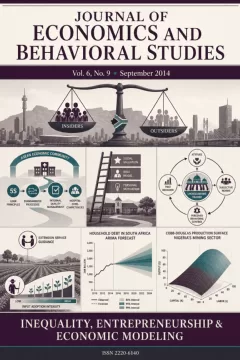 Vol. 6 No. 9 (2014)
Inequality, Entrepreneurship & Economic Modeling
View issue contents
Published
Submissions
Have research to publish? Journal of Economics and Behavioral Studies welcomes submissions.
Make a Submission