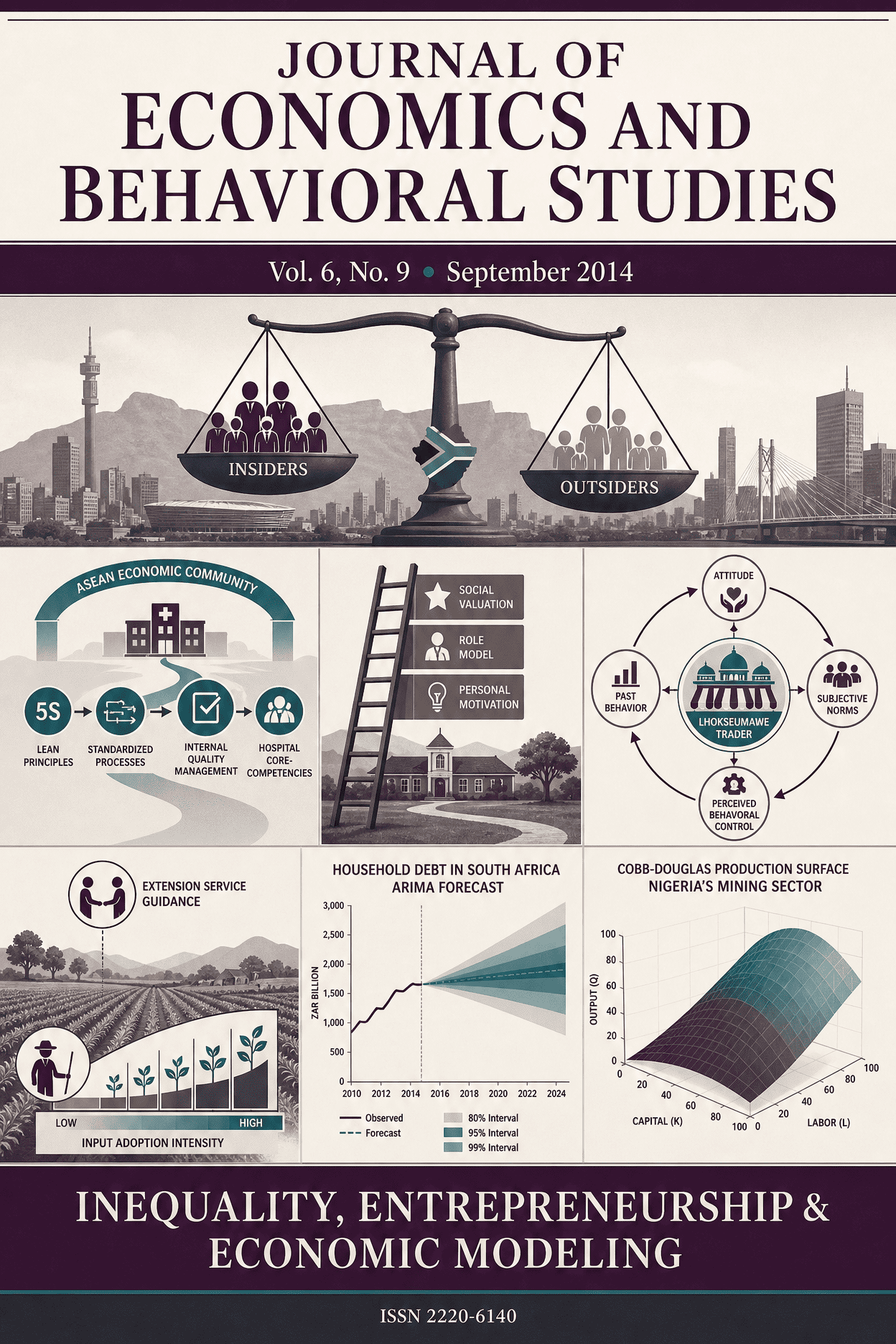
Articles

  • Article 1 in this issue

    The Economic and Political Ramifications of Inequality in Post-Apartheid South Africa

    • Author: Molefi Solomon Mohautse

    South Africa is regarded as one of the most unequal societies in the world. Apartheid engineered a population with vast inequalities across racial groups. The nature of this inequality was primarily racially based. The political and economic trajectory of the last twenty years has somewhat changed the nature and composition of this kind of inequality but fundamental continuity of deep inequality is still somehow maintained. The post-apartheid distributional regime continues to divide South Africans into insiders and outsiders. Although the political pattern is still largely racially based, a new political landscape is beginning to emerge which is based on the complexity of class and race entanglements. The rising inequality within the black community is becoming a cause for concern for the continuation of the present developmental trajectory. It has created a fertile ground for the rise of populist movements and demagogues that will seek to take advantage of those neglected by the state machinery. This paper will seek to explore the links between inequality and economic growth and political conflict by tracing the origins of income inequality in South Africa, its evolution after the democratic transition in 1994; and its economic and political implications.

    Pages 690-699

    PDF - The Economic and Political Ramifications of Inequality in Post-Apartheid South Africa (opens in a new tab)
  • Article 2 in this issue

    Creating Hospitals’ Core Competencies with Lean Healthcare Strategies Entering the ASEAN Economic Community

    • Author: Pareeyawadee Ponanake, Sunpasit Limnararat, Manat Pithuncharurnlap, Woranat Sangmanee

    This study aimed to evaluate the structural equation modeling of the influences between Lean healthcare strategies, internal quality management and hospitals’ core competencies as medical care centers entering the ASEAN Economic Community. The populations and sample groups in this study included 384 HA officers. The research was conducted from December 2012 to August 2013, and the research method involved purposive sampling through questionnaires. A statistical data analysis was performed using Structural Equation Modeling analysis. This study found that 1) Lean healthcare strategies indirectly influenced hospitals’ core competencies as medical centers entering the ASEAN Economic Community through internal quality management at the 0.01 significance level, 2) Lean healthcare strategies directly influenced hospitals’ core competencies as medical centers entering the ASEAN Economic Community at the 0.01 significance level; 3) Lean healthcare strategies directly influenced internal quality management at the 0.01 significance level; and 4) internal quality management directly influenced hospitals’ core competencies as medical centers entering the ASEAN Economic Community at the 0.01 significance level.

    Pages 700-708

    PDF - Creating Hospitals’ Core Competencies with Lean Healthcare Strategies Entering the ASEAN Economic Community (opens in a new tab)
  • Article 3 in this issue

    Entrepreneurial Intentions and Entrepreneurial Motivation of South African Rural University Students

    • Author: Mmakgabo Justice Malebana

    Entrepreneurial motivation is vital in translating entrepreneurial intention into action. This paper investigates whether entrepreneurial role models, social valuation of entrepreneurship, perceived knowledge of entrepreneurial support and barriers to starting a business, entrepreneurial intention and its determinants are related to entrepreneurial motivation. The study integrates the theory of planned behaviour with environmental factors to determine the factors influencing entrepreneurial motivation among final year rural university students in the Limpopo province, South Africa. The study was carried out by means of a survey and included 329 final year students who were registered for various commerce degrees. A structured questionnaire was used to collect the data. Data were analysed by means of descriptive statistics, Pearson correlation and hierarchical multiple regression analysis. The findings indicate that entrepreneurial motivation has a significant correlation with entrepreneurial intention and its three determinants, social valuation of entrepreneurship, having entrepreneurial role models, knowledge of entrepreneurial support and perceived barriers to starting a business. The respondents were motivated by both intrinsic and extrinsic rewards and the need for independence. The results revealed that entrepreneurial intention, the attitude towards becoming an entrepreneur, subjective norms, social valuation of entrepreneurship, knowledge of entrepreneurial role models and entrepreneurial support have a significant influence on entrepreneurial motivation. This study is the first in South Africa to use theory of planned behaviour to investigate the factors that influence entrepreneurial motivation. The study contributes to the body of knowledge by shedding light into the impact of the social environment on entrepreneurial motivation in South Africa.

    Pages 709-726

    PDF - Entrepreneurial Intentions and Entrepreneurial Motivation of South African Rural University Students (opens in a new tab)
  • Article 4 in this issue

    The Intention to Pay Zakat Commercial: An Application of Revised Theory of Planned Behavior

    • Author: Mohd Heikal, Muammar Khaddafi, Falahuddin

    Several researches have been carried out to predict the intention to pay zakat using the factors introduced by the Theory of Planned Behavior – developed by Ajzen & Fishbein (1980). Meanwhile, an addition of predicting past behavior factor on the intention to pay zakat has not been found in previous researches. The purpose of this research is to analyze the influence of attitude, subjective norms, perceived behavioral control and past behavior towards the intention of traders in the Lhokseumawe city to pay zakat commercial. The revised Theory of Planned Behavior was used in the research. This study aims to predict the intention of zakat payers. A total of 2,432 traders as the population of the research was identified and 150 of them were chosen as respondents determined using the purposive sampling technique. Using multiple linear regression models, it has found that the subjective norms, perceived behavioral control and past behavior partially have positive and significant influence towards the intention to pay zakat commercial. It also finds that past behavior variable has the most dominant impact towards the intention of zakat payers, while attitude has the least impact towards the intention. Finally, there is a simultaneously positive and significant influence towards the intention to pay zakat commercial.

    Pages 727-734

    PDF - The Intention to Pay Zakat Commercial: An Application of Revised Theory of Planned Behavior (opens in a new tab)
  • Article 5 in this issue

    Agricultural Extension Service and Input Application Intensity: Evidence from Ethiopia

    • Author: Kidane Mariam Gebregziabher

    This paper examines factors that influence agricultural input adoption in the northern part of Ethiopia. Using a 730 households survey data set, a Tobit model is estimated to explain the factors that influence farmers’ decision to adopt modern inputs or not. The factors found to significantly influence included: plot size, oxen ownership, gender, age and literacy status of the household head, adult labor force, total non-farm income, extension service and location variables. The results confirm the adoption theory.

    Pages 735-747

    PDF - Agricultural Extension Service and Input Application Intensity: Evidence from Ethiopia (opens in a new tab)
  • Article 6 in this issue

    The robustness and accuracy of Box-Jenkins ARIMA in modeling and forecasting household debt in South Africa

    • Author: Ntebogang Dinah Moroke

    This paper adopted the Box-Jenkins methodology to estimate a univariate time series model. Quarterly data collected from the South African Reserve Bank covering the period 1994 to 2014 was used. The initial plot of the series revealed that household debt is explained by an irregular and non-seasonal component. Owing to the non stationarity of the series, first differencing was applied to induce stationarity. The ACFs and PACFs identified six models. Of the six identified models,???????????????????? 3, 1, 0 was selected according to the standard error estimates and the information criteria. The proposed model passed all the diagnostic tests and was further used for producing ten period forecasts of household debt. The forecasted household debt rates obtained were above 75% and within confidence bounds of 95%. Insample and out-of-sampling forecasts moved together confirming the reliability of the model in forecasting household debt and vigour in predictive ability. The proposed model exhibited the best performance in terms of Max APE and Max AE and ascertained the robustness and accuracy of the BoxJenkins ARIMA in forecasting. Both a trend of the data captured and non-seasonal peaks were predicted by the model. These forecasts were proven to be realistic and a true reflection of economic reality in the country. The paper recommended a non-seasonal???????????????????? 3, 1, 0 be used by researchers, policy makers and decision makers of different countries to make forecasts of household debt. The South African authorities were also encouraged to use this model to produce further forecasts of the series when making long term planning.

    Pages 748-759

    PDF - The robustness and accuracy of Box-Jenkins ARIMA in modeling and forecasting household debt in South Africa (opens in a new tab)
  • Article 7 in this issue

    Efficiency of Capital-Labor in Nigeria’s Mining Sector: A Cobb-Douglas Framework

    • Author: Kanayo Ogujiuba, Francis Adebayo, Nancy Stiegler

    The productivity in the Nigeria’s mining sector presents significance challenges, especially in view of its prospect in diversifying the national economy. The need to uncover the efficiency by way of estimating two major production functions (i.e. capital and labor) cannot be minimized. However, this paper uses econometric technique to estimates the Cobb-Douglas production function of mining sector between 1980 and 2011 periods in Nigeria. To avoid a spurious series, unit root test was conducted based on Augmented Dickey-Fuller (ADF) to test for the stationarity or otherwise of the variables in the model. The outcome reveals that the substitution parameters α and β (substitution parameters for capital and labor) confirms the a priori expectation that the pair of α and β are positive values. Despite labor is the most significant factor of production, the study also found that other inputs such as innovations and technology are positively significant in this period of modern mining production processes in view of the global economic outlook. The study amongst others recommends strong political will of government, transparency and accountability to drive efficient and effective mining sector reform, increased capital investment in innovations, technology, and raw materials.

    Pages 760-770

    PDF - Efficiency of Capital-Labor in Nigeria’s Mining Sector: A Cobb-Douglas Framework (opens in a new tab)