Abstract
Microfinance is a well known terminology used for microcredit and financial services for financially deprived community. Through informal, semi-formal and formal ways different institutions has been providing these services. Expenditure of the industry is considered to be high because of its inherent structure, dealing with small loans and having high risk of recovery. Therefore, expected inefficiency is greater than its profit. There are several factors and reason. Through this study, we analyzed few factors which have a positive or negative relation with the inefficiency of Microfinance in Pakistan. Stochastic frontier analysis (SFA) is used for weighing up a relationship between inefficiency and its determinants. It is seen that the average efficiency of this sector is low, on average the highest technical efficiency score is 87 only. Age and number of clients have a negative relationship with inefficiency whereas for other variable's relationship is conditional on Microfinance Institutions (MFIs) working status. The number of women borrowers and average loan balance has been incorporated in the study to analyze the focus of MFIs, either on mission drift or achievement. We found that microfinance banks (MFBs) are drifting away, however, Non Government Organizations (NGOs) and Rural Support Programs (RSPs) are fulfilling their social mission efficiently. We did not find a strong evidence of mission drift in the industry because microfinance banks considered their social mission on second priority. Hence, if MFBs are drifting away from their social services, it is not unexpected.
Keywords
- Efficiency Search this journal for Efficiency (opens in a new tab)
- Micro Financing Search this journal for Micro Financing (opens in a new tab)
- Stochastic Frontier Analysis Search this journal for Stochastic Frontier Analysis (opens in a new tab)
- Technical Efficiency Search this journal for Technical Efficiency (opens in a new tab)
- Mission Drift Search this journal for Mission Drift (opens in a new tab)
- Women Borrowers Search this journal for Women Borrowers (opens in a new tab)
References
- Abayie, E., Amanor, K. & Frimpong, J. (2011). The Measurement and Determinants of Economic Efficiency of Microfinance Institutions in Ghana: A Stochastic Frontier Approach. African Review of Economics and Finance, 2, 149-166.
- Aigner, D., Lovell, K. & Schmidt, P. (1977). Formulation and Estimation of Stochastic Frontier Production Function Models. Journal of Econometrics , 6, 21-32.
- Baido, L. (2008). Women in Uganda benefit by freedom from hunger's microcredit/education program, Freedom from hunger. Bay Area International Development Organization.
- Bassem, S. B. (2008). Efficiency of Microfinance Institutions in the Mediterranean: An Application of DEA. Transit Stud Rev , 15, 343-354.
- Battese, G. E. & Coelli, T. J. (1995). A Model for Technical Inefficiency Effects in a Stochastic Frontier Production Function for Panel Data. Empirical Economics , 20, 325–332.
- Bhattacharyya, A., Lovell, C. A. K. & Sahay, P. (1997). The impact of liberalization on the productive efficiency of Indian commercial banks. European Journal of Operational Research , 98(2), 250-68.
- Canhoto, A. & Dermine, J. (2003). A note on banking efficiency in Portugal, New vs Old banks. Journal of Banking and Finance , 27, 2087-2098.
- CIA. (2011). Country Factsheet-Pakistan. The World Fact Book. https://www.cia.gov/library/publications/the-world-factbook/geos/pk.html
- Cull, R., Demirgüç-Kunt, A. & Morduch, J. ( 2007) . Financial performance and outreach: a global analysis of leading microbanks. Economic Journal , 117, F107 – F133.
- Daraio, C. & Simar, L. (2007). Advanced robust and nonparametric methods in efficiency analysis: Methodology and applications (Vol. 4). Springer Science+ Business Media.
- Debreu, G. (1951). The Coefficient of Resource Utilization. Econometrica , 19, 273-292 .
- Demirg'uc-Kunt, A. (1989). Deposit-institution failures: A review of empirical literature, Federal Reserve Bank of Cleveland. Economic Review , 25(4), 1-17.
- Desrochersa, M. & Lamberteb, M. (2003). Efficiency and expense preference in Philippines‘ cooperative rural banks', Discussion paper 2002-12, Philippine Institute of Development Studies, Philippine
- Drake, L. & Hall, M. J. B. (2003). Efficiency in Japanese banking: An empirical analysis. Journal of Banking and Finance , 27(05), 891–917.
- Eisenbeis, R. A., Ferrier, G. D. & Kwan, S. (1999). The informativeness of linear programming and econometric efficiency scores: An analysis using U.S. banking data. Working paper. Bureau of Business and Economic Research. University of Arkansas.
- Elyasiani, E. & Mehdian, S. M. (1990). A Nonparametric Approach to measurement of efficiency and technological change: The Case of large U.S. commercial banks. Journal of Financial Services Research , 4(2), 157-68.
- Farrell, M. (1957). The Measurement of Productive Efficiency. Journal of the Royal Statistical Society A, General , 120, 253-281.
- Greene, W. (1997). Frontier Production Functions,” in H. Pesaran and P. Schmidt, eds., Handbook of Applied Econometrics, Volume II, Microeconomics, Oxford University Press, Oxford.
- Greene, W. (2005b). The Econometric Approach to Efficiency Measurement, in K. Lovell, H. Fried and S. Schmidt, eds., The Measurement of Productive Efficiency, 2nd ed., Oxford, Oxford University Press.
- Gregoire, I. R. & Oswaldo, R. T. (2003). Cost Efficiency of Microfinance Institutions in Peru. A stochastic Frontier Approach. www.Jstore.co
- Guitierrez-Nieto, B., Serrano-Cinca, C. & Molinero, C. M. (2009). Microfinance institutions and efficiency . OMEGA, International Journal of Management Science , 35(2), 131–142.
- Hassan, M. K. & Tufte, D. R. (2001). The X-efficiency of a group based lending institution: the case of Grameen Bank. World Development , 29, 1071-1082.
- Hermes, N., Lensink, R. & Meesters, A. (2011). Outreach and efficiency of microfinance institutions. World Development , 39(6), 938-948.
- Hughes, J. P., Lang, W., Mester, L. J. & Moon, C. (1996). Efficient Banking under Interstate Branching. Journal of Money, Credit, and Banking , 28(4), 1045-71.
- Jayamaha, A. & Mula, J. M. (2010). Financial practices and efficiency of cooperative rural banks in Sri Lanka. In Proceedings of the 1st International Conference on Business and Information: Researching Realities of Management Phenomenon (ICBI 2010) (pp. 1-25). University of Kelaniya.
- Johansen, M. & Nilsson, C. (2007). Microfinance and poverty reduction: A case study of Grameen Bank and BRAC.
- Kabir, M. S. & Huo, X. (2011). Advancement of Rural Poor Women through Small Entrepreneurship Development: The Case of Bangladesh. International Journal of Business and Management , 6(9), 134.
- Khandker, S. R. (2005). Fighting poverty with microcredit: Experience in Bangladesh. New York, NY: Oxford University
- Koopmans, T. C. (1951). An analysis of production as an Efficient Combination of Activities, in T.C. Koopmans,ed., Activity Analysis of production and Allocation, Cowles Commission for Research in Economics, Monograph No.13. New York: Wiley.
- Kwan, S. & Eisenbeis, R. A. (1997). Bank risk, capitalization, and operating efficiency. Journal of Financial Services Research , 12(2/3), 117-31.
- Ledgerwood, J., Julie, E. & Candace, N. (2013). The New Microfinance Handbook: A Financial Market System Perspective. Washington, DC: World Bank. doi: 10.1596/978-0-8213-8927-0.
- Lang, G. & Welzel, P. (1996). Efficiency and technical progress in banking: Empirical results for a panel of German Cooperative Banks. Journal of Banking and Finance, 20, 1003-23.
- Masood, T. & Ahmad, M. (2010). Technical Efficiency of Microfinance Institutions in India-A Stochastic Frontier Approach. Technical Efficiency of Microfinance Institutions in India-A Stochastic Frontier Approach (October 8, 2010).
- Meeusen, W. & van den Broeck, J. (1977). Efficiency Estimation from Cobb-Douglas Production Functions with Composed Error. International Economic Review , 18, 435- 444.
- Miller, S. M. & Noulas, A. G. (1997). Portfolio mix and large-bank profitability in the USA. Applied Economics , 29(4), 505-12.
- Neal, P. (2004). X-efficiency and productivity change in Australian banking. Australian Economic Papers , 43(2), 174-92.
- Pakistan Microfinance Network. (2011). Microwatch - A Quarterly Update on Microfinance in Pakistan. Issue 11: (Jan-Dec 2011). Islamabad, Pakistan Microfinance Network.
- Pakistan Microfinance Network. (2013). Microwatch - A Quarterly Update on Microfinance in Pakistan. Issue 11: (Jan-Dec 2013). Islamabad, Pakistan Microfinance Network.
- Ray, S. & Mukherjee, K. (2004). Comparing Parametric and Nonparametric Measures of Efficiency: A Reexamination of the Christensen and Greene Data. Journal of Quantitative Economics , 11, 155-168
- Sharma, G. & Kawadia, G. (2006). Efficiency of urban cooperative banks of Maharashtra: a DEA analysis. The ICFAI Journal of Bank Management , 5(4), 25-38.
- State Bank of Pakistan. (2009). Report of the committee on rural finance. Karachi, State Bank of Pakistan.
- Wang, H. J. & Schmidt, P. (2002). One-step and two-step estimation of the effects of exogenous variables on technical efficiency levels. Journal of Productivity Analysis , 18(2), 129-144.
Downloads
No downloads have been recorded for this article yet. Figures appear here once readers begin downloading the full text.
How to Cite
Share this article
License
Copyright (c) 2015 Madiha Riaz, Pathiban S. Gopal (Author)

This work is licensed under a Creative Commons Attribution 4.0 International License.
Author (s) should affirm that the material has not been published previously. It has not been submitted and it is not under consideration by any other journal. At the same time author (s) need to execute a publication permission agreement to assume the responsibility of the submitted content and any omissions and errors therein. After submission of revised paper in the light of suggestions of the reviewers, the editorial team edits and formats manuscripts to bring uniformity and standardization in published material.
This work will be licensed under Creative Commons Attribution 4.0 International (CC BY 4.0) and under condition of the license, users are free to read, copy, remix, transform, redistribute, download, print, search or link to the full texts of articles and even build upon their work as long as they credit the author for the original work. Moreover, as per journal policy author (s) hold and retain copyrights without any restrictions.
Keywords
- Efficiency Search this journal for Efficiency (opens in a new tab)
- Micro Financing Search this journal for Micro Financing (opens in a new tab)
- Stochastic Frontier Analysis Search this journal for Stochastic Frontier Analysis (opens in a new tab)
- Technical Efficiency Search this journal for Technical Efficiency (opens in a new tab)
- Mission Drift Search this journal for Mission Drift (opens in a new tab)
- Women Borrowers Search this journal for Women Borrowers (opens in a new tab)
Section
Published in
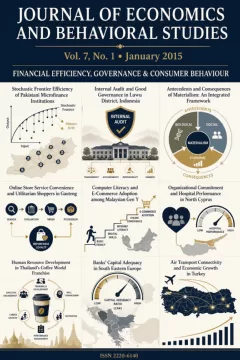 Vol. 7 No. 1(J) (2015)
Financial Efficiency, Governance & Consumer Behaviour
View issue contents
Published
Submissions
Have research to publish? Journal of Economics and Behavioral Studies welcomes submissions.
Make a Submission