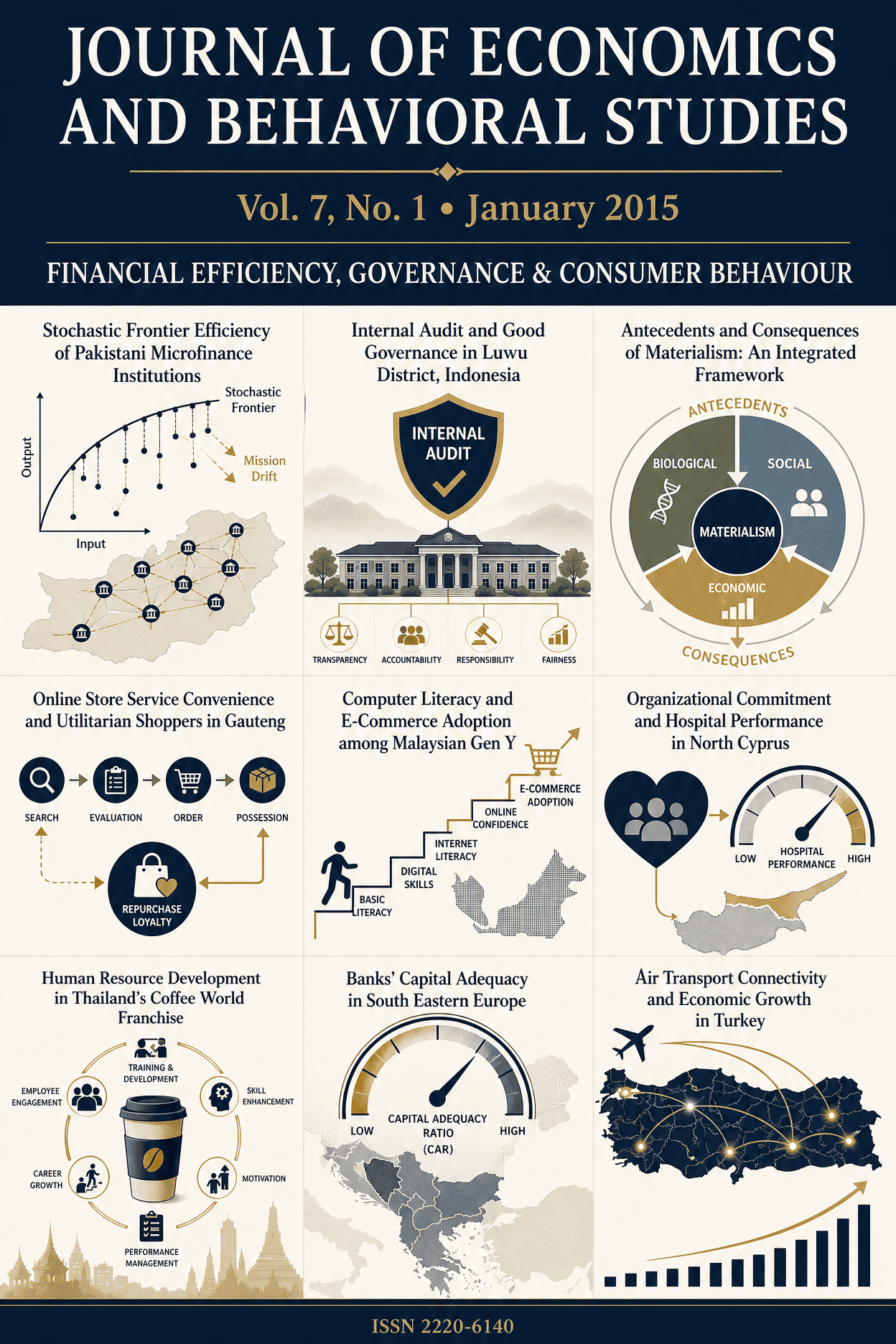
Articles

  • Article 1 in this issue

    In competency Aspects of Microfinance Industry: Via SFA approach

    • Author: Madiha Riaz, Pathiban S. Gopal

    Microfinance is a well known terminology used for microcredit and financial services for financially deprived community. Through informal, semi-formal and formal ways different institutions has been providing these services. Expenditure of the industry is considered to be high because of its inherent structure, dealing with small loans and having high risk of recovery. Therefore, expected inefficiency is greater than its profit. There are several factors and reason. Through this study, we analyzed few factors which have a positive or negative relation with the inefficiency of Microfinance in Pakistan. Stochastic frontier analysis (SFA) is used for weighing up a relationship between inefficiency and its determinants. It is seen that the average efficiency of this sector is low, on average the highest technical efficiency score is 87 only. Age and number of clients have a negative relationship with inefficiency whereas for other variable's relationship is conditional on Microfinance Institutions (MFIs) working status. The number of women borrowers and average loan balance has been incorporated in the study to analyze the focus of MFIs, either on mission drift or achievement. We found that microfinance banks (MFBs) are drifting away, however, Non Government Organizations (NGOs) and Rural Support Programs (RSPs) are fulfilling their social mission efficiently. We did not find a strong evidence of mission drift in the industry because microfinance banks considered their social mission on second priority. Hence, if MFBs are drifting away from their social services, it is not unexpected.

    Pages 1-12

    PDF - In competency Aspects of Microfinance Industry: Via SFA approach (opens in a new tab)
  • Article 2 in this issue

    Effect on performance audit implementation of good corporate governance in kab.Luwu (Case Study Inspectorate Kab.Luwu)

    • Author: Rahmawati, A.

    This paper describes how internal audit can support Good Corporate Governance in local government. How auditor capability and quantity can be accepted by 33 department of the local government Luwu. It also finds that Auditor capacity to do audit with independency, professionalisms and quality of auditor. This paper elaborates that the internal audit such as finance audit, compliance audit, and operational audit is required in local government to decrease fraud before the external audit find, and can be good for corporate governance. One of the things that can realize good corporate governance is seen from the performance of any organization of government activities, good performance in terms of achieving policy objectives, regulations and applicable law, the achievement of performance in an efficient, effective, and economical, as well as the compatibility between the performance achieved with established criteria. To assess the extent to which the achievement of local government performance in serving the interests of society, it is necessary to audit the performance. The purpose of this study was to determine the effect of Internal Audit on the implementation of good corporate governance in local government Luwu. The sample in this study was all local governments Internal Auditor in Luwu district Inspectorate office. The collection of information is done by compiling a list of questions that are appropriate for the respondents submitted to the analysis method used in this research is quantitative method by using a simple linear regression analysis were processed with SPSS software version 18. The results of this study concluded that the existence of an internal audit will encourage the achievement of implementation of good corporate governance system within the Inspectorate so that later in outline will encourage financial governance system within the district will go well. Although many other factors that will support that have not been investigated as thoroughly as the auditor's own characteristics, auditor ethics deal other factors. Accountability and transparency have become important issues in the management of an organization that disclosure with full disclosure will provide a thorough understanding of users of financial statements. Compliance audit of internal audit affects the implementation of good corporate governance can be seen that the results of testing for compliance audits variable has a probability of 0.041 significance where the value is less than 0.05. Thus H4 accepted, this means that the compliance audit of internal audit significantly influence the implementation of good corporate governance in Luwu.

    Pages 13-19

    PDF - Effect on performance audit implementation of good corporate governance in kab.Luwu (Case Study Inspectorate Kab.Luwu) (opens in a new tab)
  • Article 3 in this issue

    Antecedents and Consequences of Materialism: An Integrated Theoretical Framework

    • Author: Helen I. Duh

    Materialism has become an integral part of consumers’ economic activities and modern day living, with mainly negative consequences reported from materialists’ lifestyle. Some of the reported negative consequences of materialism are increasing consumer debt and bankruptcy, shrinking saving, economic crisis and lower levels of life satisfaction and well-being. Consequently, economic psychologists, consumer researchers, sociologists and family psychologists are studying the antecedents of materialism, but there is yet to be an agreement as to how the construct should be defined and on what causes or predicts materialism. Critics of materialism have often seen only negative consequences and blamed marketing activities for the growth of materialism, but substantial academic literature and empirical studies report biological, social, cultural, socio-economic, psychological and even political factors driving materialism. There is therefore a need to develop an integrated and comprehensive theoretical framework, which delineates the various predictors of materialism. There is also the need to highlight the negative, as well as positive consequences of materialism for the interest of retailers, consumer interest groups and policy makers.

    Pages 20-35

    PDF - Antecedents and Consequences of Materialism: An Integrated Theoretical Framework (opens in a new tab)
  • Article 4 in this issue

    Online Store Service Convenience, Customer Satisfaction and Behavioural Intentions: A Focus on Utilitarian Oriented Shoppers

    • Author: Mercy Mpinganjira

    The paper investigates, using transaction cost theory, the concept of service convenience and its influence on utilitarian customer satisfaction and behavioural intentions to repurchase from an online store. Data used in the analysis was collected from utilitarian oriented online shoppers from Gauteng, South Africa using a structured questionnaire. According to the findings search, evaluation, order and possession convenience were identified as unique,reliable and valid dimensions of service convenience in the context of online shopping. The four dimensions were all found to exert significant direct influence on utilitarian customers’ level of satisfaction as well as on intentions to repurchase from specific online stores. The findings further showed that service convenience can be conceptualised as a second order factor made up of all the identified four dimensions and that when conceptualised this way the explanatory power of service convenience on both customersatisfaction and repurchase intentions is greatly enhanced. Additionally, the results show thatoverall satisfaction on the relationship between service convenience and behavioural intentions to repurchase from an online store plays a significant mediating role when service convenience is considered at the dimensional level but not at the overall level. The findings in this study validate the transaction cost theory in the context of online shopping and contribute to a better understanding of the concept of service convenience and its influence on utilitarian oriented online customers. The findings have wide managerial implications on use of convenience as a source of value creation for online store managers and these have been outlined in the paper.

    Pages 36-49

    PDF - Online Store Service Convenience, Customer Satisfaction and Behavioural Intentions: A Focus on Utilitarian Oriented Shoppers (opens in a new tab)
  • Article 5 in this issue

    Malaysian Consumer Research: Does Computer Literacy Affirmative towards E-commerce Activities?

    • Author: Dileep Kumar M., Harvi S., Normala S. Govindarajo

    Rapid expansion of technology application, especially in the field of information technology, with the support of fine tune infrastructure, further correlated with severely with the ecommerce activities. This scenario is not much different in developed as well as developing countries. It is a placid trend nowadays that the customers are moving from traditional direct shopping practices to online shopping. In this scenario it is observed that the generations Y is more contented with online purchasing and adoption of e-commerce practices compare to generation X. It is hypothesized in this research that higher the computer literacy people have with higher the attitude in favor for technology adoption and ecommerce activities. Contextualizing this assumption to Malaysian scenario, fewer studies have been conducted so far and seldom any information that has shared across to the research world. Hence, a study was conducted to analyze the effect of computer literacy on internet usages and ecommerce activities among generation Y in the Malaysian context. This study provides interesting insights into the technology adoption aptitude of generation Y.

    Pages 50-63

    PDF - Malaysian Consumer Research: Does Computer Literacy Affirmative towards E-commerce Activities? (opens in a new tab)
  • Article 6 in this issue

    Organizational Commitment and Perceived Organizational Performance Among Health Care Professionals: Empirical Evidence From A Private Hospital in Northern Cyprus

    • Author: Aysen Berberoglu, Hikmet Secim

    Organizational commitment plays an important role in employee behavior. It is related with self identification of the employee with his/her organization. Self-identified employee, with higher scores of commitment, is expected to be more motivated, retaining at the organization and performing at significant levels of performance. Perceived organizational performance, on the other hand, is concerned with how employees are observing their organizations in terms of success, sustainability and development. The aim of this study was to assess the hypothesized relationship between organizational commitment and perceived organizational performance among health care professionals, by taking a small-sized private hospital in North Cyprus as the setting. The study was conducted by utilizing structured, self-administered questionnaires and collected data was analyzed by using SPSS. Study revealed that in this case, there is a positive significant relationship between organizational commitment and perceived organizational performance and organizational commitment is affecting the perceived organizational performance of the health care workers.

    Pages 64-71

    PDF - Organizational Commitment and Perceived Organizational Performance Among Health Care Professionals: Empirical Evidence From A Private Hospital in Northern Cyprus (opens in a new tab)
  • Article 7 in this issue

    Human Resource Development Activities in a Retail Franchise in Thailand: The Case of Coffee World

    • Author: Thanee Ngaochay, John Walsh

    International franchising in a rapidly developing economy such as Thailand’s can offer a short cut to providing the newly-aspirant middle classes with the contemporary consumer goods brands they desire. The method also offers good opportunities for small scale investors and managers to obtain experience of managing high quality brands with full support from their international partners. However, they are likely to have to shoulder at least some of the burden of training their employees so that they are able to contribute to the overall service offering of the branch concerned. This paper uses a quantitative survey of 205 employees of the Coffee World franchise in Thailand to investigate the relationship between human resource development and organizational development in the businesses concerned. It is shown that the strengths of the relationships are limited and some ideas are provided for explaining why this might be.

    Pages 72-78

    PDF - Human Resource Development Activities in a Retail Franchise in Thailand: The Case of Coffee World (opens in a new tab)
  • Article 8 in this issue

    The Determinants of Banks’ Capital Adequacy Ratio: Some Evidence from South Eastern European Countries

    • Author: Rafet Aktas, Suleyman Acikalin, Bilge Bakin, Gokhan Celik

    The legal authorities set the minimum capital level for the banks. Recent studies have shown that variables used to explain capital structure of non financial firms, such as size, profit, leverage, liquidity and risk, could also be helpful in understanding banks’ capital structure. This paper aims to evaluate the impact of bank-dimensional and environmental factors on bank’s capital adequacy ratio in South Eastern European (SEE) region. Size, profitability (ROA), leverage, liquidity, net interest margin (NIM), and risk are used as bank-dimensional explanatory variables in a feasible GLS regression model. On the other hand, economic growth rate, inflation, real interest rate, Eurozone stock market volatility index, deposit insurance coverage, and governance indicator are added to the original model to control for environmental factors. Annual data from 71 commercial banks belong to 10 different countries in SEE region for the period of 2007 – 2012 is used. This region mainly consists of the “transition economies” which are still experiencing the difficulties of turning into efficient market economies with high economic potentials. The results of our study show that among the bank dimensional explanatory variables size, ROA, leverage, liquidity, net interest margin and risk have statistically significant effects in determining CAR for the banks in the region. Among the environmental factors, economic growth rate, Eurozone stock market volatility index, deposit insurance coverage, and governance have statistically significant effects in determining CAR for the banks in the SEE region.

    Pages 79-88

    PDF - The Determinants of Banks’ Capital Adequacy Ratio: Some Evidence from South Eastern European Countries (opens in a new tab)
  • Article 9 in this issue

    The Relationship between Air Transport and Economic Growth in Turkey: Cross-Regional Panel Data Analysis Approach1

    • Author: Nuri Baltaci, Ozlem Sekmen, Gizem Akbulut

    Today, the economic and social effects of the airports on the region they are located are widely accepted throughout the world including Turkey. In developing countries transportation sector is a significant tool of development. Since millennium there has been a great growth in the number of people who prefer air transportation in Turkey. The decrease in the cost of the transportation of both passengers and freight in air transport leads the increase of its accessibility. In this concept when a region has an active airport it helps to increase the region’s competitiveness and support its economic, social and cultural development. The aim of this study is to analyze whether an active airport and its traffic frequency have an effect on country’s macroeconomic indicators. In this study region - fixed effect and two stage least square (2SLS) models are applied with using panel data for 26 sub-regions at NUTS 2 level in Turkey period of 2004 - 2011. The results of this study support that increasing in number of active airports and its traffic frequency have a positive effect on regional economic growth.

    Pages 89-100

    PDF - The Relationship between Air Transport and Economic Growth in Turkey: Cross-Regional Panel Data Analysis Approach1 (opens in a new tab)