Abstract
Materialism has become an integral part of consumers’ economic activities and modern day living, with mainly negative consequences reported from materialists’ lifestyle. Some of the reported negative consequences of materialism are increasing consumer debt and bankruptcy, shrinking saving, economic crisis and lower levels of life satisfaction and well-being. Consequently, economic psychologists, consumer researchers, sociologists and family psychologists are studying the antecedents of materialism, but there is yet to be an agreement as to how the construct should be defined and on what causes or predicts materialism. Critics of materialism have often seen only negative consequences and blamed marketing activities for the growth of materialism, but substantial academic literature and empirical studies report biological, social, cultural, socio-economic, psychological and even political factors driving materialism. There is therefore a need to develop an integrated and comprehensive theoretical framework, which delineates the various predictors of materialism. There is also the need to highlight the negative, as well as positive consequences of materialism for the interest of retailers, consumer interest groups and policy makers.
Keywords
- Materialism Search this journal for Materialism (opens in a new tab)
- Consumer Socialization Search this journal for Consumer Socialization (opens in a new tab)
- Cultural Factors Search this journal for Cultural Factors (opens in a new tab)
- Socio-Economics Search this journal for Socio-Economics (opens in a new tab)
- Psychological Factors Search this journal for Psychological Factors (opens in a new tab)
References
- Achenreiner, G. B. (1997). Materialism Values and Susceptibility to Influence in Children. Advances in Consumer Research, 24, 82-88.
- Adediwura, A. A. (2007). Religiosity and Perceived Family Support as Correlate of Nigerian University Undergraduates Self-esteem. Ife Psychologia: An International Journal, 15(2), 212-225.
- Ahuvia, A. C. & Wong, N. Y. (2002). Personality and Values Based Materialism: Their Relationship and Origins. Journal of Consumer Psychology, 12 (4), 389-402.
- Baker, A., Moschis, G. P., Benmoyal-Bouzaglo, S. & Pizzutti, C. (2013). How family resources affect materialism and compulsive buying: a cross-country life course perspective. Journal of Cross-Cultural Research , 47(4), 335-362.
- Baker, A. M., Moschis, G. P., Ong, F. S. & Pattanapanyasat, R. (2013). Materialism and Life Satisfaction: The Role of Stress and Religiosity. Journal of Consumers Affairs, 47(3), 548-563.
- Batra, R., Ramaswamy, V., Alden, D. L., Steenkamp, J. E. M. & Ramachander, S. (2000). Effects of Brand Local and Nonlocal Origin on Consumer Attitudes in Developing Countries. Journal of Consumer Psychology, 9(2), 83-95.
- Belk, R. W. (1985). Materialism: Trait Aspects of Living in a Material World. Journal of Consumer Research, 12, 265-280.
- Belk, R. W. (1988). Possessions and the Extended Self. Journal of Consumer Research, 15(2), 139-168.
- Brouskeli, V. & Loumakou, M. (2014). Materialism, Stress and Health Behaviors among Future Educators. Journal of Education and Training Studies, 2(2), 145-150.
- Benmoyal-Bouzaglo, S. & Moschis, G. P. (2010). Effects of Family Structure and Socialization on Materialism: A life Course Study in France. Journal of Marketing Theory and Practice, 18(1), 55-71.
- Browne, B. A. & Kaldenberg, D. O. (1997). Conceptualizing self-monitoring: links to materialism and product involvement, Journal of Consumer Marketing, 14(1), 31-44.
- Burroughs, J. E. & Rindfleisch, A. (1997). Materialism as a Coping Mechanism: An Inquiry into Family Disruption. Advances in Consumer Research, 24, 89-97.
- Burroughs, J. E. & Rindfleisch, A. (2002). Materialism and Well-being: A conflicting Values Perspective. Journal of Consumer Research, 29, 348-370.
- Chang, L. & Arkin, R. M. (2002). Materialism as an Attempt to Cope with Uncertainty. Psychology and Marketing, 19(5), 389-406.
- Chaplin, L. N., Hill, R. P. & John, D. R. (2014). Poverty and Materialism: A Look at Impoverished Versus Affluent Children. Journal of Public Policy & Marketing , 33(1), 78–92.
- Chaplin, L. N. & John, R. D. (2007). Growing up in a Material World: Age Differences in Materialism in Children and Adolescents. Journal of Consumer Research, 34, 000.
- Christopher, A. N., Marek, P. & Carroll, S. M. (2004). Materialism and Attitudes toward Money: An Exploratory Investigation. Individual Differences Research, 2(2), 109-117.
- Churchhill, G. A. & Moschis, G. P. (1979). Television and Interpersonal Influences on Adolescent Consumer Learning. Journal of Consumer Research, 6, 23- 34.
- Clarke, I. C. & Micken K. S. (2002). An exploratory Cross-cultural analysis of the values of materialism. Journal of International Consumer Marketing, 14, 65-89.
- Claxton, R. P. & Murray, J. B. (1994). Object-subject interchange ability: a symbolic interactionist model of materialism. Advances in Consumer Research, 21, 422-426.
- Cohen, P. & Cohen, J. (1996). Life values and adolescent mental health, Mahwah, NJ: Lawrence Erlbaun.
- Csikszentmihalyi, M. & Rochberg-Halton, E. (1981). The meaning of things: Domestic Symbols and the Self, Cambridge: Cambridge University Press.
- De Waal, M. (2013). South Africans are sinking under debt – and the credit amendment bill won’t pull us out, Daily Maverick, 04 June, available at: http://www.dailymaverick.co.za/article/2013-06-04-southafricans-are-sinking-under-debt-and-the-credit-amendment-bill-wont-pull-us-out/#.UiLTFWucH_Q (accessed 31 August 2013).
- Dittmar, H. (2005). A New Look at Compulsive Buying: Self-discrepancies and Materialistic Values as Predictors of Compulsive Buying Tendency. Journal of Social and Clinical Psychology, 24(6), 832859.
- Duh, H. I., Benmoyal-Bouzaglo, S., Moschis, G. P. & Smaoui, L. (2014). Examination of Young Adults’ Materialism in France and South Africa using two Life-course Theoretical Perspectives, Journal of Family and Economic Issues. [Available online] http://link.springer.com/article/10.1007/s10834014-9400-9
- Durvasula, S. & Lysonski, S. (2010). Money, money, money – how do attitudes toward money impact vanity and materialism? – The case of young Chinese consumers. Journal of Consumer Marketing, 27(2), 169-179.
- Eastman, J. K., Fredenberger, B., Campbell, D. & Calvert, S. (1997). The relationship between status consumption and materialism: A cross-cultural comparison of Chinese, Mexican, and American Students. Journal of Marketing Theory and Practice , 5(1), 52-66.
- Flouri, E. (1999). An integrated model of consumer materialism: Can economic socialization and maternal values predict materialistic attitudes in adolescents? Journal of Socio-Economics, 28, 707-724.
- Flouri, E. (2004). Exploring the relationship between mothers’ and fathers’ parenting practices and children’s materialist values. Journal of Economic Psychology, 25(6), 743-752.
- Fournier, S. & Richins, M. (1991). Some Theoretical and Popular Notions Concerning Materialism. Journal of Social Behaviour and Personality, 6, 403-414.
- Garðarsdóttir, R. B. & Dittmar, H. (2012). The relationship of materialism to debt and financial well-being: The case of Iceland’s perceived prosperity. Journal of Economic Psychology, 33, 471-481.
- Ger, G. & Belk, R. W. (1990). Measuring and comparing materialism cross-culturally. Advances in Consumer Research, 17, 186-192.
- Ger, G. & Belk, R. W. (1996). Cross-cultural differences in materialism. Journal of Economic Psychology, 17, 5577.
- Ger, G. & Belk, R. W. (1999). Accounting for Materialism in four Cultures. Journal of Culture, 4(2), 183-204.
- Ger, G., Belk, R. W. & Dana-Nicoletta, L. (1993). The Development of Consumer Desire in Marketizing in Developing Economies: The cases of Romania and Turkey. Advances in Consumer Research, 20, 102107.
- Golberg, M. E., Gorn, G. J., Peracchio, L. A. & Bamossy, G. (2003). Understanding Materialism among Youth. Journal of Consumer Psychology, 13(3), 278-288.
- Grossbart, S., Calson, L. & Wlash, A. (1991). Consumer Socialization and Frequency of Shopping with Children. Journal of Academy of Marketing Science, 19(3), 155-163.
- Heath, T. P. & Chatzidakis, A. (2012). The transformative potential of marketing from the consumers’ point of view. Journal of Consumer Behaviour, 11(4), 283-291.
- Hill, M. S., Yeung, W. J. J. & Duncan, G.J. (2001). Childhood family structure and young adult behaviours. Journal of Population Economics, 14, 271-299.
- Hudders, L. & Pandelaere, M. (2012). The silver lining of Materialism: The impact of luxury consumption on subjective well-being. Journal of Happiness Studies , 13, 411-437.
- Iglehart, R. (1990). Culture Shift in Advanced Industrial Society, Princeton, NJ: Princeton University Press.
- John, D. R. (1999). Consumer socialization of children: a retrospective look at twenty-five years of research. Journal of Consumer Research, 26, 183-213.
- Kasser, T. (2008). Materialistic values and the current economic crisis, Psychologists for Social Responsibility Blog of December 24. Available: http://psysr.wordpress.com/2008/12/24/materialistic-valuesand-the-current-economic-crisis/ (Accessed on July 19, 2014).
- Kasser, T., Ryan, R. M., Zax, M. & Sameroff, A. (1995). The relations of maternal and social environments to late adolescents’ materialistic and prosocial values. Developmental Psychology, 31, 907-914.
- Kasser, T. & Ahuvia, A. C. (2002). Materialism values and well-being in business students. European Journal of Social Psychology, 33(1), 137-146.
- Kasser, T., Cohn, S., Kanner, A. D. & Ryan, R. M. (2007). Some costs of American corporate capitalism: A psychological exploration of value and goal conflicts. Psychological Inquiry, 18(1), 1-22.
- Kasser, T., Koestner, R. & Lekes, N. (2002). Early Family Experiences and adult values: A 26-year prospective longitudinal study. Personality and Social Psychological Bulletin, 28, 826-835.
- Kasser, T., Richard, M. R., Charles, E. C. & Kennon, M. S. (2004). Materialistic Values: Their Causes and Consequences, in Psychology and Consumer Culture, ed. Tim Kasser and Allen D. Kanner, Washington, DC: American Psychological Association, 11-28.
- Kitayama, S. & Markus, H. R. (1992). Construal of the self as cultural frame: Implication for internationalizing psychology, paper presented at the symposium on internationalization and higher education, University of Michigan, Ann Arbor, MI Draft (April).
- Komin, S. (1991). Psychology of the Thai People: Values and Behavioural Patterns, Bangkok: Research Centre, National Institute of Development Administration (NIDA).
- Larsen, V., Sirgy, J. M. & Wright, N. D. (1999). Materialism: The Construct, Measures, Antecedents and Consequences. Academy of Marketing Studies Journal, 3(2), 78-110.
- Leave Our Kids Alone. (2013). We Want an Immediate End to All Advertising Aimed at Children Under 11, petition, (accessed November 04, 2014), [available at http://www.change.org/enGB/petitions/the-uk-government-we-want-an-immediate-endto-all-advertising-aimed-at-childrenunder-11].
- Management Today. (2008). BLACK DIAMONDS, the new South African Middle class, May, 43-47. Moneyweb, (2013). No end to debt troubles, consumers need to cut back, available at: http://www.moneyweb.co.za/moneyweb-financial/no-end-to-debt-troubles (accessed: 19 July 2014)
- Moschis, G. P. (1985). The Role of Family Communication in Consumer Socialization of Children and Adolescents. Journal of Consumer Research, 11, 898- 913.
- Moschis, G. P. (1987). Life course perspective on consumer behaviour. Journal of Academy of Marketing Sciences, 35, 295-307.
- Moschis, G. P. (2007). Life course perspectives on consumer behaviour. Journal of the Academy of Marketing Science, 35, 295-307.
- Moschis, G. P., Hosie, P. & Vel, P. (2009). Effects of family structure and socialization on materialism: Life course study in Malaysia. Journal of Business and Behavioural Sciences , 12(1), 166-181.
- Moschis, G. P., Mathur, A., Kwaiffat, C. & Pizzutti, C. (2013). Effects of Family Structure on Materialism and Compulsive Consumption: A Life Course Study in Brazil. Journal of Research for Consumers, 23, 6696.
- Moschis, G. P., Ong, F. S., Mathur, A., Yamashita, T. & Benmoyal-Bouzaglo, S. (2011). Socialization influences on materialism: across-cultural life-course approach. Journal of Asian Business Studies, 5(2), 124-44.
- Muncy, J. A. & Eastman, J. K. (1998). Materialism and consumer ethics: an exploratory study. Journal of Business Ethics, 17, 137-145.
- Nguyen, H. V., Moschis, G. P. & Shannon, R. (2009). Effects of family structure and socialization on materialism: a life course study in Thailand. International Journal of Consumer Studies, 33, 486–95.
- Noguti, V. & Bokeyar, A. L. (2014). Who am I? The relationship between self-concept uncertainty and materialism. International Journal of Psychology , 49(5) , 323–333.
- Piaget, J. (1973). The Child and Reality, New York: Penguin Book.
- Pollay, R. W. (1986). The Distorted Mirror: Reflections on the Unintended Consequences of Advertising. Journal of Marketing, 3, 18-36.
- Richins, M. L. (1994). Special Possessions and the Expression of Material Values. Journal of Consumer Research, 21, 522-533.
- Richins, M. L. (2004). The Positive and Negative Consequences of Materialism: What Are They and When Do They Occur? Advances in Consumer Research, 31, 232-235.
- Richins, M. L. & Dawson, S. (1992). A Consumer Values Orientation for Materialism and its Measurement: Scale Development and Validation. Journal of Consumer Research, 19, 303-316.
- Richins, M. L. & Rudmin, F. W. (1994). Materialism and economic psychology. Journal of Economic Psychology, 15, 217-231.
- Rindfleisch, A., Burroughs, J. E. & Denton, F. (1997). Family structure, materialism and compulsive consumption. Journal of Consumer Research, 23, 312-325.
- Rink, D. R. (2010). The impact of birth order upon consumers’ decision-making, buying, and post-purchase processes: a conceptualization, Innovative Marketing, 6(4), 71-79.
- Roberts, J. A. (1998). Compulsive buying among college students: An investigation of its antecedents, consequences, and implications for public policy. Journal of Consumer Affairs, 32(2), 295-319.
- Roberts, J. A. & Clement, A. (2007). Materialism and Satisfaction with Over-all Quality of Life and Eight Life Domains. Social Indicators Research, 82(1), 79-92.
- Roberts, J. A. & Jones, E. (2001). Money attitudes, credit card use, and compulsive buying among American college students. Journal of Consumer Affairs, 35(2), 213-240.
- Roberts, J. A., Manolis, C. & Tanner, J. Jr. (2006). Adolescent Autonomy and the Impact of Family Structure on Materialism and Compulsive Buying. Journal of Marketing Theory and Practice, 14(4), 301-314
- Roberts, J. A., Tanner, J. Jr. & Manolis, C. (2005). Materialism and the Family Structure-Stress Relation. Journal of Consumer Psychology, 15(2), 183-190.
- Rochberg-Halton, E. (1984). Object Relations, Role Models, and Cultivation of the Self. Environment and Behaviour, 16(3), 335-368.
- Rokeach, M. (1973). The nature of Human values, New York: Free Press.
- Roth, M. S. (1995a). The Effects of Culture and Socioeconomics on the Performance of Global Brand Image Strategies. Journal of Marketing Research, 32(2), 163-176.
- Ryan, L. & Dziurawiec, S. (2001). Materialism and its Relationship to Life Satisfaction. Social Indicators Research, 55, 185-197.
- Ryan, R. & Deci, E. (2000). Self-determination theory and facilitation of intrinsic motivation, social development, and well-being. American Psychologist, 55, 68-78.
- Schiffman, L. G. & Kanuk, L. L. (2004). Consumer Behaviour, 8th edn., Pearson Prentice-Hall. Pearson Education International.
- Schor, J. B. (1998). The overspent American: Upscaling, downshifting and the new consumer, New York: Basic Books.
- Segal, B. & Podoshen, J. S. (2013). An examination of materialism, conspicuous consumption and gender differences. International Journal of Consumer Studies , 37(2), 189–198
- Sharma, A. & Malhotra, D. (2010). Social-Psychological Correlates of Happiness in Adolescents. European Journal of Social Sciences, 12(4), 651-662.
- Sheldon, K. M. & Lawrence Krieger, S. (2014). Service job lawyers are happier than money job lawyers, despite their lower income. The Journal of Positive Psychology , 9(3), 219-226
- Shrum, L. J., Wong, N., Arif, F., Chugani, S. K., Gunz, A., Lowrey, T. M., Nairn, A., Pandelaere, M., Ross, S.M., Ruvio, A., Scott, K. & Sundie, J. (2013). Reconceptualizing materialism as identity goal pursuits: Functions, processes, and consequences. Journal of Business Research, 66, 1179-1185.
- Tsang, J, Carpenter, T. P., Roberts, J. A., Michael B. Frisch, M. B. & Carlisle, R. D. (2014). Why are materialists less happy? The role of gratitude and need satisfaction in the relationship between materialism and life satisfaction. Personality and Individual Differences, 64, 62-66.
- Tuan, Y. (1980). The Significance of the Artifact. Geographical Review, 70(4), 462-472.
- Ward, S. (1974). Consumer Socialization. Journal of Consumer Research, 1, 1-14.
- Watson, J. J. (2003). The relationship of materialism to spending tendencies, saving, and debt. Journal of Economic Psychology, 24, 723-739.
- Weaver, T., Moschis, G. P. & Davis, T. (2011). Antecedents of materialism and compulsive consumption: A life course study in Australia. Journal of Australasia Marketing, 19(44), 247–256.
- Webster, C. & Beatty, R. C. (1997). Nationality, Materialism, and Possessions Importance. Advances in Consumer Research, 24, 204-210.
- Whitbeck, L. B., Simons, R. L., Conger, R. D., Lorenz, F. O., Huck, S. M. & Elder, G. H. Jr. (1991). Family economic hardship, parental support, and adolescent self-esteem. Social Psychology Quarterly, 54(6), 353-363.
- Wong, N. Y. & Ahuvia, A. (1995). Self-Concepts and Materialism: A cross-cultural approach. American Marketing Association, 2, 112-119.
- Wong, N., Shrum, L. J., Arif, F., Chugani, S., Gunz, A., Lowrey, T. M., Nairn, A., Pandelaere, M., Ross, S. M., Ruvio, A., Scott, K. & Sundie, J. (2011). Rethinking Materialism: A Process View and Some Transformative Consumer Research Implications. Journal of Research for Consumers, 19, 1-4.
Downloads
No downloads have been recorded for this article yet. Figures appear here once readers begin downloading the full text.
How to Cite
Share this article
License
Copyright (c) 2015 Helen I. Duh (Author)

This work is licensed under a Creative Commons Attribution 4.0 International License.
Author (s) should affirm that the material has not been published previously. It has not been submitted and it is not under consideration by any other journal. At the same time author (s) need to execute a publication permission agreement to assume the responsibility of the submitted content and any omissions and errors therein. After submission of revised paper in the light of suggestions of the reviewers, the editorial team edits and formats manuscripts to bring uniformity and standardization in published material.
This work will be licensed under Creative Commons Attribution 4.0 International (CC BY 4.0) and under condition of the license, users are free to read, copy, remix, transform, redistribute, download, print, search or link to the full texts of articles and even build upon their work as long as they credit the author for the original work. Moreover, as per journal policy author (s) hold and retain copyrights without any restrictions.
Keywords
- Materialism Search this journal for Materialism (opens in a new tab)
- Consumer Socialization Search this journal for Consumer Socialization (opens in a new tab)
- Cultural Factors Search this journal for Cultural Factors (opens in a new tab)
- Socio-Economics Search this journal for Socio-Economics (opens in a new tab)
- Psychological Factors Search this journal for Psychological Factors (opens in a new tab)
Section
Published in
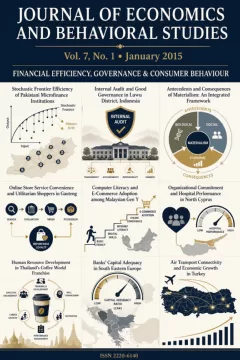 Vol. 7 No. 1(J) (2015)
Financial Efficiency, Governance & Consumer Behaviour
View issue contents
Published
Submissions
Have research to publish? Journal of Economics and Behavioral Studies welcomes submissions.
Make a Submission