Abstract
Organizational commitment plays an important role in employee behavior. It is related with self identification of the employee with his/her organization. Self-identified employee, with higher scores of commitment, is expected to be more motivated, retaining at the organization and performing at significant levels of performance. Perceived organizational performance, on the other hand, is concerned with how employees are observing their organizations in terms of success, sustainability and development. The aim of this study was to assess the hypothesized relationship between organizational commitment and perceived organizational performance among health care professionals, by taking a small-sized private hospital in North Cyprus as the setting. The study was conducted by utilizing structured, self-administered questionnaires and collected data was analyzed by using SPSS. Study revealed that in this case, there is a positive significant relationship between organizational commitment and perceived organizational performance and organizational commitment is affecting the perceived organizational performance of the health care workers.
Keywords
- Organizational Commitment Search this journal for Organizational Commitment (opens in a new tab)
- Health Care Search this journal for Health Care (opens in a new tab)
- Perceived Organizational Performance Search this journal for Perceived Organizational Performance (opens in a new tab)
- Private Hospital Search this journal for Private Hospital (opens in a new tab)
- Employee Behavior Search this journal for Employee Behavior (opens in a new tab)
References
- Al-Aameri, A. S. (2000). Job satisfaction and organizational commitment for nurses. Saudi Medical Journal , 21(6), 531-535.
- Altındiş, S. (2011). Job motivation and organizational commitment among the health professionals: A questionnaire survey. African Journal of Business Management , 5, 8601-8609
- Angle, H. L. & Perry, J. L. (1981). An Empirical Assessment of Organizational Commitment and Organizational Effectiveness. Administrative Science Quarterly , 26(1), 1-14.
- Bakiev, E. (2013). The Influence of Interpersonal Trust and Organizational Commitment on Perceived Organizational Performance. Journal of Applied Economics and Business Research JAEBR , 3(3), 166-180
- Becker, H. S. (1960). Notes on the concept of commitment. American Journal of Sociology , 66, 32-42
- Biçer, İ. H., Erçek, M., Küskü, F. & Çakmak, A. F. (2009). Örgütsel bağlılığın duygusal bileşenleri: Türk kamu kuruluşunda kapsamlı bir yapısal denklem modeli. İstanbul Teknik University Journal , 8(4).
- Camilleri, E. & Van der Heijden, B. I. J. M. (2007). Organizational commitment, public service motivation, and performance within the Public Sector. Public Performance & Management Review , 31(2), 241-274.
- Çayköylü, S., Egri, C. P., Havlovic, S. & Bradley, C. (2011). Key organizational commitment antecedents for nurses, paramedical professionals and non-clinical staff. Journal of Health Organization Management , 25, 7-33
- Delaney, J. T. & Huselid, M. A. (1996). The Impact of Human Resource Management Practices on Perceptions of Organizational Performance. Academy of Management Journal , 39, 949-969.
- George, J. M. & Jones, G. R. (2012). Understanding and Managing Organizational Behavior sixth ed. Prentice Hall New Jersey
- Giauque, D., Anderfuhren-Biget, S. & Varone, F. (2013). HRM Practices, Intrinsic Organizational Performance in the Public Sector. Public Personnel Management , 42(2), 123-150
- Jain, A. K. (2012). Impact of Organizational Size & Alliance Formations on Perceived Organizational Performance. The Indian Journal of Industrial Relations , 47(3).
- Knoop, R. (1995). Relationships among job involvement, job satisfaction, and organizational commitment for nurses. The Journal of Psychology , 129(6), 643-649
- Lum, L. (1998). Explaining nursing turnover intent: job satisfaction, pay satisfaction, or organizational commitment? Journal of Organizational Behavior , 19, 305-21
- Mansour, N., Gara, E. & Gaha, C. (2013). Getting inside the black box: HR practices and firm performance within the Tunisian financial services industry. Personnel Review , 43(4), 490-514
- McNeese-Smith, D. K. & Nazarey, M. (2001). A nursing shortage: building Organizational commitment among nurses / practitioner application. Journal of Health Care Management , 46, 173-187
- Meyer, J. P. & Allen, N. J. (1991). A Three Component Conceptualization of Organizational Commitment. Human Resource Management Review , 1, 61-89
- Mullins, L. (2010). Management and Organizational Behavior Ninth. Ed. Pearson Education Essex England
- Porter, L. W., Steers, R. M. & Boulian, P. V. (1974). Organizational Commitment, Job Satisfaction and Turnover Among Psychiatric Technicians. Journal of Applied Psychology , 59, 603-609
- Seçim, H. (1994). Hastane Yönetimi ve Organizasyonu. Eskişehir: Anadolu University Publishings, 845, 2.
- Tzafrir, S. S. (2006). A universalistic perspective for explaining the relationship between HRM practices and firm performance at different points in time. Journal of Managerial Psychology , 21(2), 109 - 130
Downloads
No downloads have been recorded for this article yet. Figures appear here once readers begin downloading the full text.
How to Cite
Share this article
License
Copyright (c) 2015 Aysen Berberoglu, Hikmet Secim (Author)

This work is licensed under a Creative Commons Attribution 4.0 International License.
Author (s) should affirm that the material has not been published previously. It has not been submitted and it is not under consideration by any other journal. At the same time author (s) need to execute a publication permission agreement to assume the responsibility of the submitted content and any omissions and errors therein. After submission of revised paper in the light of suggestions of the reviewers, the editorial team edits and formats manuscripts to bring uniformity and standardization in published material.
This work will be licensed under Creative Commons Attribution 4.0 International (CC BY 4.0) and under condition of the license, users are free to read, copy, remix, transform, redistribute, download, print, search or link to the full texts of articles and even build upon their work as long as they credit the author for the original work. Moreover, as per journal policy author (s) hold and retain copyrights without any restrictions.
Keywords
- Organizational Commitment Search this journal for Organizational Commitment (opens in a new tab)
- Health Care Search this journal for Health Care (opens in a new tab)
- Perceived Organizational Performance Search this journal for Perceived Organizational Performance (opens in a new tab)
- Private Hospital Search this journal for Private Hospital (opens in a new tab)
- Employee Behavior Search this journal for Employee Behavior (opens in a new tab)
Section
Published in
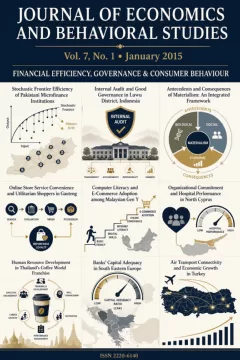 Vol. 7 No. 1(J) (2015)
Financial Efficiency, Governance & Consumer Behaviour
View issue contents
Published
Submissions
Have research to publish? Journal of Economics and Behavioral Studies welcomes submissions.
Make a Submission