Abstract
International franchising in a rapidly developing economy such as Thailand’s can offer a short cut to providing the newly-aspirant middle classes with the contemporary consumer goods brands they desire. The method also offers good opportunities for small scale investors and managers to obtain experience of managing high quality brands with full support from their international partners. However, they are likely to have to shoulder at least some of the burden of training their employees so that they are able to contribute to the overall service offering of the branch concerned. This paper uses a quantitative survey of 205 employees of the Coffee World franchise in Thailand to investigate the relationship between human resource development and organizational development in the businesses concerned. It is shown that the strengths of the relationships are limited and some ideas are provided for explaining why this might be.
Keywords
- Franchising Search this journal for Franchising (opens in a new tab)
- Human Resources Development Search this journal for Human Resources Development (opens in a new tab)
- Small and Medium-Sized Enterprises Search this journal for Small and Medium-Sized Enterprises (opens in a new tab)
- Thailand Search this journal for Thailand (opens in a new tab)
- Training Search this journal for Training (opens in a new tab)
References
- Brimble, P. & Doner, R. F. (2007). University-Industry Linkages and Economic Development: The Case of Thailand. World Development , 35(6), 1021-36.
- Chan, P. S. & Justis, R. T. (1990). Franchise Management in East Asia. Academy of Management Perspectives , 4(2), 75-85.
- Chew, J. & Chan, C. C. A. (2008). Human Resource Practices, Organizational Commitment and Intention to Stay. International Journal of Manpower , 29(6), 503-22.
- De-Kok, J. M. P. & Uhlaner, L. M. (2001). Organizational Context and Human Resource Management in the Small Firm. Small Business Economics , 17(4), 273-291.
- Eli, H. (2004). Knowledge networking in global organizations: The transfer of knowledge. Agder University College, Tucson, Arizona USA.
- Garavan, T. (2007). A Strategic Perspective on Human Resource Development. Advances in Developing Human Resources , 9(1), 11-30.
- Garavan, T., Heraty, N. & Barnicle, B. (1999). Human resource development literature: current issues, priorities and dilemmas. Journal of European Industrial Training , 23(4-5), 169-179.
- Gibb, S. (2006). Human Resource Development (Edinburgh: Herriott Watt University).
- Global Franchise Architects. (2012). About us, available at: www.gfacorp.com/about-gfa.aspx.
- Global Franchise Architects. (2014). Locations, available at: www.gfacorp.com/store-locator.aspx.
- Gold, J. J., Walton, P. C. & Anderson, L. (2011). Theorizing and Practitioners in HRD: The Role of Abductive Reasoning. Journal of European Industrial Training , 35(3), 230-46.
- Heneman, H. G. & Berkley, R. A. (1999). Applicant attraction practices and outcomes among small businesses. Journal of Small Business Management , 37(1), 53-74.
- Hill, R. & Stewart, J. (1999). Human resource development in small organizations. Human Resource Development International , 2(2), 103-123.
- Holton, E. F., Bates, R. A. & Ruona, W. E. A. (2000). Development of a Generalized Learning Transfer System Inventory. Human Resource Development Quarterly , 11(4), 333-60.
- International Coffee Organization. (2014). Coffee Consumption in East and Southeast Asia, 1990-2012, available at: www.ico.org/news/icc-112-4e-consumption-asia.pdf.
- Ives, B., Gifford, T. & Hankins, D. (1998). Integrating learning through knowledge (&skills) management. ACM SIGGROUP Bulletin, 19(1), 51-55.
- Jackson, S. E., Schuler, R. S. & Rivero, J. C. (1989). Organizational characteristics as predictors of personnel practices. Personnel Psychology , 42, 727-786.
- Jordan, P. J. & Ashlea, C. T. (2002). Emotional intelligence and conflict resolution: Implications for human resource development. Advances in Developing Human Resources , 4(1), 62-79.
- Justis, R. T. & Chan, P. S. (1997). Training for Franchise Management. Journal of Small Business Management , 29(3), 87.
- Leng, S. K. (2013). Unraveling Thailand’s Coffee Culture, Bean Scene Magazine (April), available at: www.beanscenemag.com.au/travel/article/unravelling-thailands-coffee-culture.
- Luangsuvimol, T. & Kleiner, B. H. (2004). Effective Franchise Management. Management Research News , 27(45), 63-71.
- Sambrook, S. (2000).Talking of HRD. Human Resource Development International , 3(2), 159-178.
- Smith, D. (2004). Motivating information system project team members: A theoretical perspective. University of Cape Town.
- Whittington, R. (1993). What is strategy and does it matter? London: Routledge.
Downloads
No downloads have been recorded for this article yet. Figures appear here once readers begin downloading the full text.
How to Cite
Share this article
License
Copyright (c) 2015 Thanee Ngaochay, John Walsh (Author)

This work is licensed under a Creative Commons Attribution 4.0 International License.
Author (s) should affirm that the material has not been published previously. It has not been submitted and it is not under consideration by any other journal. At the same time author (s) need to execute a publication permission agreement to assume the responsibility of the submitted content and any omissions and errors therein. After submission of revised paper in the light of suggestions of the reviewers, the editorial team edits and formats manuscripts to bring uniformity and standardization in published material.
This work will be licensed under Creative Commons Attribution 4.0 International (CC BY 4.0) and under condition of the license, users are free to read, copy, remix, transform, redistribute, download, print, search or link to the full texts of articles and even build upon their work as long as they credit the author for the original work. Moreover, as per journal policy author (s) hold and retain copyrights without any restrictions.
Keywords
- Franchising Search this journal for Franchising (opens in a new tab)
- Human Resources Development Search this journal for Human Resources Development (opens in a new tab)
- Small and Medium-Sized Enterprises Search this journal for Small and Medium-Sized Enterprises (opens in a new tab)
- Thailand Search this journal for Thailand (opens in a new tab)
- Training Search this journal for Training (opens in a new tab)
Section
Published in
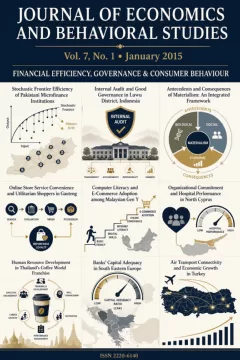 Vol. 7 No. 1(J) (2015)
Financial Efficiency, Governance & Consumer Behaviour
View issue contents
Published
Submissions
Have research to publish? Journal of Economics and Behavioral Studies welcomes submissions.
Make a Submission