Abstract
Today, the economic and social effects of the airports on the region they are located are widely accepted throughout the world including Turkey. In developing countries transportation sector is a significant tool of development. Since millennium there has been a great growth in the number of people who prefer air transportation in Turkey. The decrease in the cost of the transportation of both passengers and freight in air transport leads the increase of its accessibility. In this concept when a region has an active airport it helps to increase the region’s competitiveness and support its economic, social and cultural development. The aim of this study is to analyze whether an active airport and its traffic frequency have an effect on country’s macroeconomic indicators. In this study region - fixed effect and two stage least square (2SLS) models are applied with using panel data for 26 sub-regions at NUTS 2 level in Turkey period of 2004 - 2011. The results of this study support that increasing in number of active airports and its traffic frequency have a positive effect on regional economic growth.
Keywords
References
- Bowen, J. (2000). Airline hubs in Southeast Asia: national economic development and nodal accessibility. Journal of Transport Geography , 8(1), 25-41.
- Brueckner, J. K. (2003). Airline Traffic and Urban Economic Development. Urban Studies , 40(8), 1455– 1469.
- Button, K. & Taylor, S. (2000). International Air Transportation and Economic Development. Journal of Air Transport Management , 6(4), 209-222.
- Debbage, K. (1999). Air transportation and urban-economic restructuring: competitive advantage in the US Carolinas. Journal of Air Transport Management , 5, 211–221.
- Dharmawan, I. G. N. I. (2012). The Effect of Air Transport to Economic Development in Indonesia, Erasmus University.
- Fernandes, E. & Pacheco, R. R (2010). The causal relationship between GDP and domestic air passenger traffic in Brazil. Transportation Planning and Technology , 33(7), 569-581.
- Florida, R., Mellander, C. &Holgersson, T. (2012). Up in the air: The role of airports for regional economic development, Royal Institute of Technology, Paper No. 267, CESIS-Centre of Excellence for Science and Innovation Studies.
- Goetz, A.R. (1992). Air Passenger Transportation and Growth in the US Urban System, 1950-1987. Growth and Change , 23, 218-242.
- Hakfoort, J., Poot, T. &Rietveld, P. (2001). The regional economic impact of an airport: the case of Amsterdam Schiphol Airport. Regional Studies , 35(7), 595-604.
- Ishutkına, M. A. (2009). Analysis of the interaction between air transportation and economic activity: a worldwide perspective, PhD Thesis, Massachusetts Institute of Technology Cambridge, MA 02139 USA.
- Mukkala, K. &Tervo, H. (2013). Air Transportation And Regional Growth: Which Way Does The Causality Run? Environment and Planning A , 45(6), 1508-1520.
- Ozcan, I.C. (2012). The effect of air cargo traffic on regional job creation in Turkey, unpublished working paper.
- Directorate General of Civil Aviation. (2011). Directorate General of Civil Aviation’s Annual Report.
- Srivastava, M. S. (2002). Methods of Multivariate Statistics. New York: Wiley.
- TSI. (2014). http://tuikapp.tuik.gov.tr/Bolgesel/anaSayfa.do, (Access Date: 20/08/2014).
- Republic of Turkey Ministry of Transport, Maritime Affairs and Communications(2010). www.ubak.gov.tr/BLSM.../tr/.../20100518_171202_204_1_64.pdf
- Greene, W. H. (2008). Econometric analysis. Granite Hill Publishers.
- Yao, S. & Yang, X. (2008). Airport development and regional economic growth in China, Research Paper Series, University of Nottingham.
Downloads
No downloads have been recorded for this article yet. Figures appear here once readers begin downloading the full text.
How to Cite
Share this article
License
Copyright (c) 2015 Nuri Baltaci, Ozlem Sekmen, Gizem Akbulut (Author)

This work is licensed under a Creative Commons Attribution 4.0 International License.
Author (s) should affirm that the material has not been published previously. It has not been submitted and it is not under consideration by any other journal. At the same time author (s) need to execute a publication permission agreement to assume the responsibility of the submitted content and any omissions and errors therein. After submission of revised paper in the light of suggestions of the reviewers, the editorial team edits and formats manuscripts to bring uniformity and standardization in published material.
This work will be licensed under Creative Commons Attribution 4.0 International (CC BY 4.0) and under condition of the license, users are free to read, copy, remix, transform, redistribute, download, print, search or link to the full texts of articles and even build upon their work as long as they credit the author for the original work. Moreover, as per journal policy author (s) hold and retain copyrights without any restrictions.
Keywords
Section
Published in
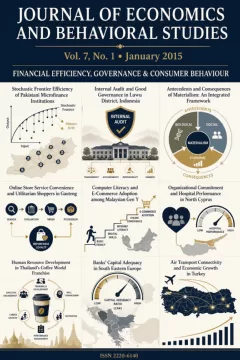 Vol. 7 No. 1(J) (2015)
Financial Efficiency, Governance & Consumer Behaviour
View issue contents
Published
Submissions
Have research to publish? Journal of Economics and Behavioral Studies welcomes submissions.
Make a Submission