Abstract
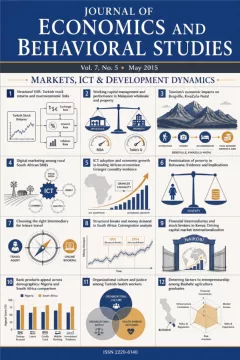
The paper tests the null hypothesis of a stable long-run money demand in South Africa over the period 1970-2013. We employ the Gregory-Hansen (GH) method to test for the possibility of structural breaks in the money demand function. The Johansen Maximum likelihood procedure is carried out to determine the cointegration vector from which existence of one cointegrating vector is supported. Also based on the GH criterion, there is existence of one cointegrating vector. GH proposes three structural breaks for the money demand function. Results suggest that endogenous breaks occurred in 1991 and 1994. The GH cointegration equations reject M1 whilst M2 and M3 pass and we proceed to estimate the error-correction model. Complemented by the CUSUM and CUSUM of squares, the tests carried out suggest that monetary policy shifts did not introduce instability.
Keywords
- Structural Break Search this journal for Structural Break (opens in a new tab)
- Money Demand Search this journal for Money Demand (opens in a new tab)
- Cointegration Search this journal for Cointegration (opens in a new tab)
- Error Correction Search this journal for Error Correction (opens in a new tab)
References
- Akinlo, A. E. (2006). The Stability of Money Demand in Nigeria: An Autoregressive Distributed Lag Approach. Journal of Policy Modeling , 28, 445-452.
- Anderson, R. G. & Duca, J. V. (2013). Money Demand and the Liquidity Accelerator in an Era of Financial Uncertainty and Innovation. Federal Reserve Bank of St. Louis, December 18, 2013.
- Anwar, S. & Asghar, N. (2012). Is Demand For Money Stable in Pakistan? Pakistan Economic and Social Review , 50(1), 1-22.
- Apergis, N. (1999). Inflation uncertainty and money demand: Evidence from a monetary regime change and the case of Greece. International Economic Journal , 13(2), 21-30.
- Carruth, A. & Sanchez-Fung, J. R. (1997). Money Demand in the Dominican Republic. Applied Economics , 32, 1439-1449.
- Carstensen, K. (2004). Is European Money Demand Still Stable. Kiel Working Paper , 1179, 1-43.
- Chowdhury, A. R. (1997). The financial structure and the demand for money in Thailand. Applied Economics , 29, 401-409.
- Dickey, D. A. & Fuller, W. A. (1979). Distribution of the estimators for autoregressive time series with a unit root. Journal of the American Statistical Association , 74, 427-431.
- Dube, S. (2013). The Stability of Broad Money Demand (M3) in South Africa: Evidence from a Shopping-Time TEchnology ad an ARDL Model. Journal of Applied Finance & a 3(6), 225-247.
- Duca, J. & VanHoose, D. (2004). Recent developments in understanding the demand for money. Journal of Economics and Business , 56, 247-272.
- Engle, R. & Granger, C. (1987). Cointegration and Error Correction: Representation, Estimation and Testing. Econometrica , 55, 251-276.
- Gabriel, V. J. & MArtins, L. F. (2010). Cointegration TEsts Under Multiple Regime Shifts: An Application To The Stock Price-Dividend Relationship. Discussion Papers in Economics DP09/10 (University of Surrey), 2010.
- Gregory, A. W. & Hansen, B. E. (1996a). Residual-based ests for cointegration in models with regime shifts. Journal of Econometrics , 70(1), 99-126.
- Gregory, A. W. & Hansen, B. E. (1996b). Tests for cointegration in models with regime and trend shifts. Oxford Bulletin of Economics and Statistics , 58(3), 555-559.
- Gregory, A. W., Nason, J. M. & Watt, P. G. (1996). Testing for structural breaks in cointegrated relationships. Journal of Econometrics , 71, 321-341.
- Hall, S., Hondroyiannis, G., Swamy, P. A. V. B. & Tavlas, G. (2009). Where has all the Money Gone? Wealth and Demand for Money in South Africa. Journal of African Economies , 18(1), 84-112.
- Hayo, B. (1999). Estimating a European money demand function. Scottish Journal of Political Economy , 46(3), 221-224.
- Hoque, A. & Al-Mutairi, N. (1996). Financial deregulation, demand for narrow money and mnetary policy in Australia. Applied Financial Economics , 6, 301-305.
- Inoue, T. & Shigeyuki, H. (2008). An Empirical Analysis of the Money Demand Function in India. Economics Discussion Paper 66, September 2008.
- Johansen, S. (1988). Statistical Analysis of Cointegration Vectors. Journal of Economic Dynamics and Control , 12(203), 231-254.
- Johansen, S. & Juselius, K. (1990). Maximum Likelihood Estimation and Inference on Cointragration with Applications to the Demand for Money. Oxford Bulletin of Economics and Statistics , 52(2), 169-210.
- Johnson, G. (2001). Inflation, Money Demand and Purchasing Power Parity in South Africa. IMF Staff Papers , 48(2), 243-265.
- Jonsson, G. (1999). Inflation, Money Demand and Purchasing Powe Parity in South Africa. International Monetay Fund Staff Papers , 48(2), 243-265.
- Mackinnon, J. G. (1991). Critical values for cointegration tests. In Long run Economic Relationship: Readings in Cointegration, edited by R.F Engle and C.W.J Granger, 267-276. Oxford University Press, 1991.
- Miller, S. M. (1991). Monetary Dynamics: An application of cointegration and error-correction modeling. Journal of Money, Credit and Banking , 23, 139-154.
- Mohr, P. & Rogers, C. (1995). Macroeconomics. Third. Johannesburg: Lexicon Publishers, 1995.
- Moll, P. G. (2000). The Demand for Money in South Africa: Parameter Stability and Predictive Capacity. South African Journal of Economics , 68(2), 190-211.
- Moll, P. G. (2000). The Demand for Money in South Africa:Parameter Stability and Predictive Capacity." South African Journal of Economics , 68(2), 190-208.
- Mutsau, I. (2013). Empirical Analysis of Money Demand in South Africa (1980-2011). Mcom Economics Dissertation, Richards Bay, South Africa: University of Zululand, 2013.
- Nell, K. S. (1999). The Stability of Money Demand in South Africa, 1965-1997." Studies in Economics , 99(5).
- Nell, K. S. (2003). The Stability of M3 Money Demand and Monetary Growth Targets: The case of South Africa. Journal of Developments Studies , 39(3), 233-252.
- Perron, P. & Vogelsang, T. J. (1992). Nonstationarity and level shifts with an applicatinon to purchasing power parity. Journal of Business and Economic Statistics , 10, 301-320.
- Phillips, P. C. B. & Peron, D. (1988). Testing for a unit root in time series regressions. Biometrica , 75(2), 335346.
- Poole, W. (1970). The Optimal Choice of Monetary Policy Instruments in a Simple Macro Model. Quarterly Journal of Econometrics , 84, 192-216.
- Stals, C. (1997). The current monetary situation and implications for 1998. Huysamer Stals Investment Conference. Johannesburg, 1997.
- Tlelima, T. & Turner, P. (2004). The Demand for Money in South Africa: Specification and Tests for Instability. South African Journal of Economics , 72(2), 25-36.
- Wesso, G. R. (2002). Broad money demand and financial liberalisation in South Africa. Occasional Paper No 18 (South African Reserve Bank).
- Zivot, E. & Andrews, D. W. K. (1992). Further Evidence on the Great Crash, The Oil-Price Shock and the Unit Root Hypothesis. Journal of Business and Economic Statistics , 10, 251-270.
Downloads
No downloads have been recorded for this article yet. Figures appear here once readers begin downloading the full text.
How to Cite
Share this article
License
Copyright (c) 2015 Sambulo Malumisa (Author)

This work is licensed under a Creative Commons Attribution 4.0 International License.
Author (s) should affirm that the material has not been published previously. It has not been submitted and it is not under consideration by any other journal. At the same time author (s) need to execute a publication permission agreement to assume the responsibility of the submitted content and any omissions and errors therein. After submission of revised paper in the light of suggestions of the reviewers, the editorial team edits and formats manuscripts to bring uniformity and standardization in published material.
This work will be licensed under Creative Commons Attribution 4.0 International (CC BY 4.0) and under condition of the license, users are free to read, copy, remix, transform, redistribute, download, print, search or link to the full texts of articles and even build upon their work as long as they credit the author for the original work. Moreover, as per journal policy author (s) hold and retain copyrights without any restrictions.
Keywords
- Structural Break Search this journal for Structural Break (opens in a new tab)
- Money Demand Search this journal for Money Demand (opens in a new tab)
- Cointegration Search this journal for Cointegration (opens in a new tab)
- Error Correction Search this journal for Error Correction (opens in a new tab)
Section
Published
Submissions
Have research to publish? Journal of Economics and Behavioral Studies welcomes submissions.
Make a Submission