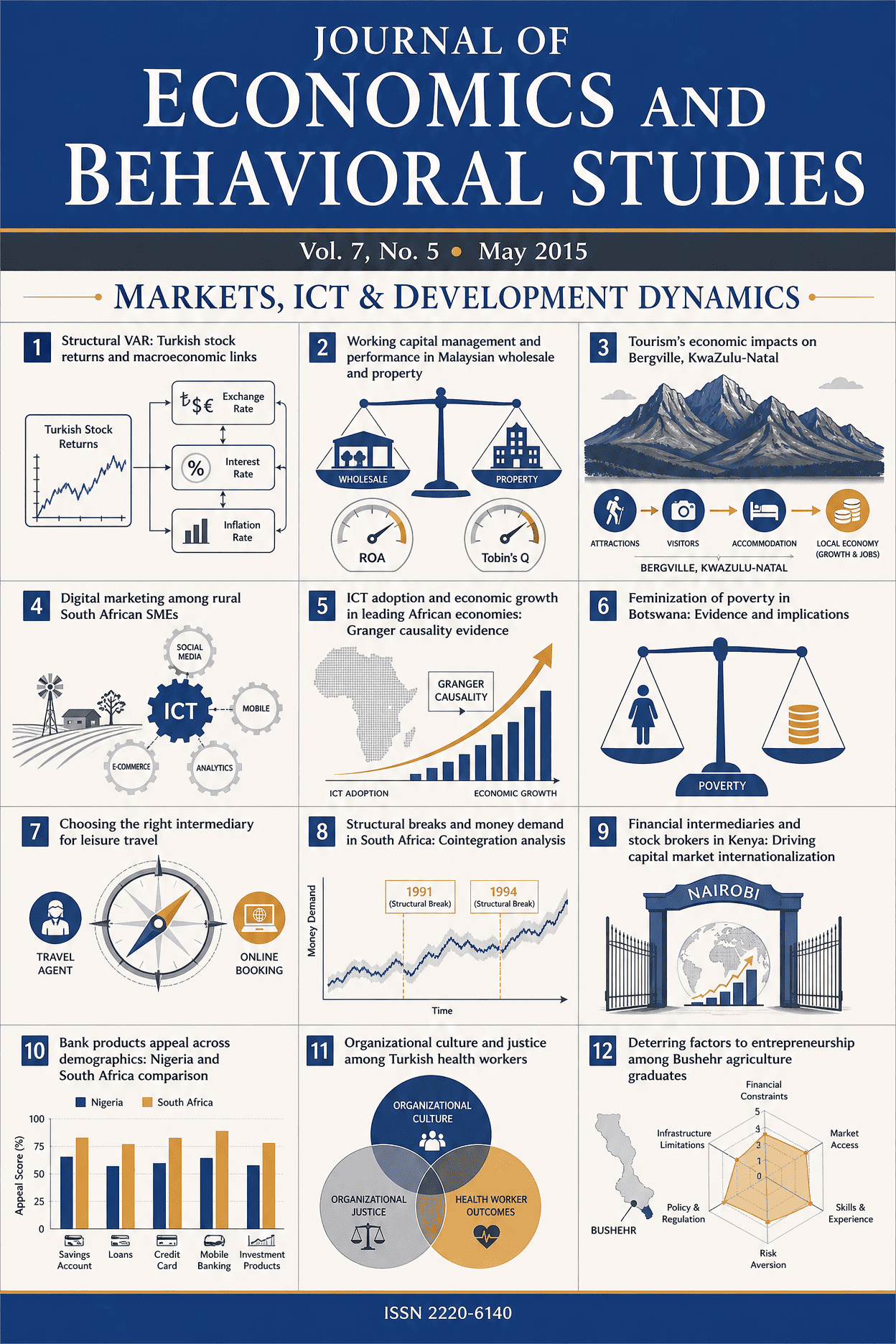
Articles 1–10 of 12

  • Article 1 in this issue

    Relationship Between Stock Market Returns and Macroeconomic Variables: Evidence from Turkey

    • Author: Erhan Cankal

    Financial sector is considered to be important in signaling about economic development. It is a common belief that stock market returns contain significant information on economic well-being and act as a good source of market indicator in a country. This common belief is tested for a number of countries using various methods in literature. Whether stock market returns are affected by changes in primary macroeconomic variables have been tested for different time periods in many countries. The findings of the previous studies proved that the results may vary depending on country specific characteristics. The directions and magnitudes of the examined relationships seemed to be different for various economies. However, the mainstream of the findings is consistent with theoretical expectations. This study attempts to bring a light to the relationship between stock market returns and basic macroeconomic variables using monthly data between 2003 and 2015 and employing structural vector autoregressive (SVAR) model for the Turkish economy. Turkey is considered as one of the most vulnerable five countries whose stock prices are most responsive to, exchange rate shocks. This study concludes that the stock prices in Turkey responsive to the shocks in exchange rate, interest rate, and inflation in order. The results of the analyses are in accordance with theoretical expectations as well as with the findings of the vast majority in the literature.

    Pages 6-18

    PDF - Relationship Between Stock Market Returns and Macroeconomic Variables: Evidence from Turkey (opens in a new tab)
  • Article 2 in this issue

    Working Capital Management Effect on the Performance of Wholesale and Property Industry in Malaysia

    • Author: Lee Hui Shan, Har Wai Mun, Yow Taw Onn, Lee Sin Yee, Sim Kee Chuan

    This paper provides the influence of working capital management (WCM) on the performance of public listed wholesale & retail industry and property industry in Malaysia from 2002 to 2011. Regression model is employed by using two measures of companies’ performance namely Return on Assets, ROA (proxy to gauge the firm’s profitability) and Tobin’s Q, TQ (proxy to gauge the firm’s market value) as the dependant variables. WCM components include Current Liabilities to Total Assets Ratio and Current Assets to Total Assets Ratio with three control variables which include of Firm Size (SIZE), Sales Growth (SLGR) and Financial Leverage (LEV) as the independent variables. The results to a very large extent indicate that CATAR and SIZE have significant positive effect on the performance of firm. It suggests that wholesale & retail industry and property industry in Malaysia should pursue unadventurous investment strategy by implementing high altitude of short term investment in order to make profit and create value for their shareholders. It also reveals that the larger the firms are, the more profitable they are; recommending the firms shall expand their business to achieve higher profit and accomplish shareholder wealth maximisation.

    Pages 19-28

    PDF - Working Capital Management Effect on the Performance of Wholesale and Property Industry in Malaysia (opens in a new tab)
  • Article 3 in this issue

    The Economic Impacts of Tourism on the Local Community of Bergville, Kwazulu Natal, South Africa

    • Author: Simiso Lindokuhle Mabaso

    Tourism is playing an increasingly important role in the local and national economy. The outstanding beauty of the northern Drakensberg is a prime tourist attraction in KwaZulu-Natal, attracting a regular flow of tourists throughout the year (Okhahlamba Municipality, 2013). The primary objective of this research is to investigate whether the benefits of tourism that are supposed to be reaped by the local community of Bergville, exist. If so, what are these benefits? There might be people from the local community, who are working within the tourism sector, but what are the types of jobs that they do, their level of job-satisfaction, and the extent to which they are able to earn a living from employment within the tourism sector? Do they have the necessary skills and training to allow them to make a successful career within the tourism sector? The White Paper on the Development and Promotion of Tourism (DEAT, 1996), states that with any tourism development in the local communities, local people should be involved in the decision making. They should be trained if they lack the necessary skills required to participate in that development. All these issues are relevant to Bergville as the region has a lot of tourism development, and it is a place that integrates tourism and conservation.

    Pages 29-36

    PDF - The Economic Impacts of Tourism on the Local Community of Bergville, Kwazulu Natal, South Africa (opens in a new tab)
  • Article 4 in this issue

    An Exploration of the Impact of Digital Marketing on SMEs Growth and Brand Popularity in Rural South Africa

    • Author: Lawrence Mpele LEKHANYA

    The purpose of the study is to establish understand of digital marketing and its use by SMEs in rural South Africa, the extent of its use, examining contributing factors to its use and their implications. Primary data was collected using a quantitative research technique with the use of a structured questionnaire as the survey instrument. A total of 134 SMEs operating in rural KwaZulu –Natal were selected. Questionnaires were distributed to the business owners/ mangers between august and December 2014. SPSS (22.0) version was employed to for data analysis. The findings of this study revealed that some rural places in South Africa still experiencing ICT problems for being not available make it difficult for SMEs growth through the use of digital marketing. The reliability analysis, reflected coefficient values from 0.70 to 0.833. The analysis of factors limiting use of digital marketing among the rural SMEs, are presented with recommended strategies and implications on how to approach the challenges. Digital marketing of rural SMEs may be strengthened through awareness and providing adequate information about ICT and through diverse of internet marketing programmes.

    Pages 37-42

    PDF - An Exploration of the Impact of Digital Marketing on SMEs Growth and Brand Popularity in Rural South Africa (opens in a new tab)
  • Article 5 in this issue

    ICT Adoption and Economic Growth Nexus: Evidence from Leading African Economies

    • Author: Adekunle Oluwole BINUYO, Rafiu Adewale Aregbeshola

    This paper examines the impact of information and communication technology (ICT) on output growth in Nigeria, South Africa, Egypt, Algeria, Morocco, Libya, Sudan, Kenya, and Ghana. We use annual data on GDP (PPP) to proxy economic growth whilst internet users, mobile phone users, telephone users, personal computers users, and school enrolment (tertiary) covering from 1990 – 2013 were used to proxy ICT. The data were analysed in a dynamic panel environment using the 2SLS method. The robustness of the 2SLS result was confirmed by the GMM regression. The results imply a positive relationship between ICT and economic growth in accord with earlier studies. Few of the earlier studies investigate the causality aspect of the relationship and the few that did use ICT directly without resolving it into its sub-variables as done in this study. The Granger causality test results indicate that only fixed wireless communication system Granger cause GDPPPP out of the five predictors suggesting that the other ICT predictors merely associate with GDP not necessarily Granger cause it as most of the earlier studies erroneously suggest. The policy implication is that the affected countries should give policy priority to development of ICT infrastructure with specific emphasis on the fixed wireless communication system as precursors for ensuring sustainable growth in the medium and long - term.

    Pages 43-54

    PDF - ICT Adoption and Economic Growth Nexus: Evidence from Leading African Economies (opens in a new tab)
  • Article 6 in this issue

    Examining the Evidence of the Feminization of Poverty in Botswana

    • Author: Khaufelo Raymond Lekobane, Keneilwe S. Mooketsane

    Poverty in Botswana is more pronounced in female-headed households (FHHs) especially those residing in rural areas where employment opportunities are limited. Similarly, the proportion of the FHHs to the total poor increased between 2002/03 and 2009/10. However, no study has so far analyzed whether feminization of poverty has occurred. This paper therefore, examines feminization of poverty in Botswana using the 2009/10 Botswana Core Welfare Indicator Survey and the 2002/03 Household Income and Expenditure Survey datasets. The results indicate no evidence of feminization of poverty (at both national and regional levels). However, the results reveal evidence of feminization of poverty amongst the married couples, the widowed, the divorced, the unemployed, those working in own farms and the self-employed. Therefore, public policy should focus on gender sensitive poverty alleviation strategies, with specific focus on the vulnerable FHHs, especially the divorced/separated and the widowed, in order to fully address the feminization of poverty amongst these groups.

    Pages 55-64

    PDF - Examining the Evidence of the Feminization of Poverty in Botswana (opens in a new tab)
  • Article 7 in this issue

    Choice of Intermediary for Leisure Travel Arrangements

    • Author: Ikechukwu O. Ezeuduji, Kobus de Jager

    Travellers can plan and arrange holidays themselves online or through the supplier, or use the services of a travel organizer, such as a travel agent. Consumers of travel services will seek to optimize choices by selecting a distribution channel which will provide them with the greatest perceived value. The primary goal of this study is to explore the underlying factors that influence consumer behaviour in making travel decisions, with specific reference to choosing between booking through a travel agent or online. Research with a perspective on travel decision-making in South Africa is limited. This study surveyed 408 respondents residing in South Africa using a structured questionnaire examining preference in booking holiday flights or accommodation through a travel agent or Internet. Exploratory factor analysis was used to identify factors influencing traveller decision-making. Factors that influence travel decision-making were identified to include ‘trust ’, ‘ convenience and adoption of technology ’, ‘ best deal and price ’, and ‘ personal contact ’. Travellers who preferred booking through the Internet found the potential of technology to save time and effort and to be convenient, due to the Internet being available day and night, important advantages of booking online. Travellers who preferred booking through a travel agent placed a premium on personal contact and social interaction between traveller and travel agent. They further valued the travel experience and ability of the travel agent to group transactions.

    Pages 65-78

    PDF - Choice of Intermediary for Leisure Travel Arrangements (opens in a new tab)
  • Article 8 in this issue

    Structural Breaks, Stability and Demand for Money in South Africa

    • Author: Sambulo Malumisa

    The paper tests the null hypothesis of a stable long-run money demand in South Africa over the period 1970-2013. We employ the Gregory-Hansen (GH) method to test for the possibility of structural breaks in the money demand function. The Johansen Maximum likelihood procedure is carried out to determine the cointegration vector from which existence of one cointegrating vector is supported. Also based on the GH criterion, there is existence of one cointegrating vector. GH proposes three structural breaks for the money demand function. Results suggest that endogenous breaks occurred in 1991 and 1994. The GH cointegration equations reject M1 whilst M2 and M3 pass and we proceed to estimate the error-correction model. Complemented by the CUSUM and CUSUM of squares, the tests carried out suggest that monetary policy shifts did not introduce instability.

    Pages 79-90

    PDF - Structural Breaks, Stability and Demand for Money in South Africa (opens in a new tab)
  • Article 9 in this issue

    The Role of Financial Intermediaries in the Internationalization of Capital Markets in Kenya: A Study of stock brokers in Kenya

    • Author: Robert Arasa, Monicah Mwaniki, Prudensia Kaihula

    Financial intermediaries continue to play a big role in the internationalization of capital markets. In Kenya all transactions in the Nairobi Securities Exchange must be carried out by an authorized stock broker. This study covered the stockbrokers and their role in the internationalization of capital markets within Kenya. The study adopted a descriptive survey. Population of interest comprised of 19 stockbrokerage firms licensed to operate at the Nairobi Securities Exchange (NSE). The study findings indicate that stock brokers contribute to the internationalization of capital markets through their roles in facilitating cross-listing, offshoring and foreign investor by aiding in sourcing for investment opportunities, provision of relevant information and transaction facilitation. Study findings further reveals that the government issues, lack of awareness and knowledge on innovative strategies, adequate financial resources, availability of adequate infrastructure and trading costs affects stock brokers role in the internationalization of capital markets. The study recommends that the government and policy makers should direct efforts towards addressing the various bottlenecks that hinder the effectiveness of the stock brokers in the internationalization of capital markets in Kenya. Further, towards realizing efficiency and effectiveness these firms need to embrace technology and innovation.

    Pages 91-102

    PDF - The Role of Financial Intermediaries in the Internationalization of Capital Markets in Kenya: A Study of stock brokers in Kenya (opens in a new tab)
  • Article 10 in this issue

    Evaluation of Bank Products Appeal across Demographic Consideration: A Comparative Study of Nigeria and South Africa

    • Author: Binuyo, Adekunle Oluwole, Aregbeshola, Rafiu Adewale

    Influence of demographic variables on banking has continued to attract the interest of researchers over the years with a good number focussing on impact of demographic variables on choice of banks by customers. This study however differs from previous studies in that its focus is on the evaluation of bank products appeal across demographic variables in South Africa and Nigeria. This descriptive study made use of primary data collected by administering validated and pre-tested questionnaires to 3,684 bank customers within selected strategic locations across Nigeria and South Africa using the snowball sampling technique. Both descriptive and inferential statistics were used to analyse the data generated. High Chi-Square statistics (corroborated with cross – tabulation and correlation analyses) coupled with very low probability values indicate highly significant associations between demographic variables and the dependent variables. The study recommends customer-centric approach on the part of banks to be able to provide customers with effective and unique value offers for various customer segments. Also, policy intervention is required to promote infrastructural upgrade for better product and service delivery. A more inclusive regulatory framework is required to draw more of the unbanked self – employed populace in the interest of boosting the economic performance of both countries.

    Pages 103-116

    PDF - Evaluation of Bank Products Appeal across Demographic Consideration: A Comparative Study of Nigeria and South Africa (opens in a new tab)