Abstract
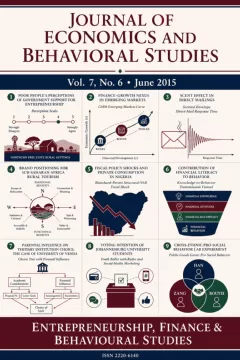
Unemployment is a global concern; therefore many developing countries focus on entrepreneurship development and small business promotion as a possible solution. Entrepreneurs are regarded as drivers of the economy as they not only provide income for themselves but also create job opportunities for other people. The South African Government focuses on job creation as a priority, involving many strategies and policies. However, many marginalised and impoverished people still do not benefit from these policies. The central purpose of this article is to analyse poor people’s perceptions of the role of government in creating jobs and assistance in providing entrepreneurial skills training and support. A socioeconomic household survey, consisting of approximately 3200 households, was conducted within various areas in the Metsimaholo, Moqhaka, Ngwathe and Mafube Local Municipalities, all located in the rural Northern Free State region in South Africa. Results of the survey show that 68.3% of participants feel that government is not doing enough to create jobs while a total of 49.1% indicated that government could assist in job creation by providing entrepreneurial skills training. A total of 56.2% indicated that they would like to open a small business. Improved government support and initiatives could lead to many poor households generating their own income through entrepreneurial activities.
Keywords
- Entrepreneurship Search this journal for Entrepreneurship (opens in a new tab)
- Government Support Search this journal for Government Support (opens in a new tab)
- Rural Townships Search this journal for Rural Townships (opens in a new tab)
- Small Business Development Search this journal for Small Business Development (opens in a new tab)
- South Africa Search this journal for South Africa (opens in a new tab)
References
- Ambrish, D. R. (2014). Entrepreneurship development: An approach to economic empowerment of women. International Journal of Multidisciplinary Approach and Studies , 1(6), 224-232.
- APWA (American Public Works Association). Discover public works. Retrieved from http://www.apwa.net/discover.
- Botha, M., Nieman, G. & van Vuuren, J. (2007). Measuring the effectiveness of the Women Entrepreneurship Programme on potential, start-up and established women entrepreneurs in South Africa. South African Journal of Economic and Management Sciences , 10(2), 163-183.
- De Bruin, A., Brush, C. G. & Welter, F. (2006). Introduction to the special issue: Towards building cumulative knowledge on women’s entrepreneurship. Entrepreneurship Theory and Practice , (2), 585-593.
- Department of Rural Development and Land Reform (DRDLR). (2010). A study on the revitalization of rural towns and regions in South Africa. Department of Rural Development and Land Reform. Pretoria: Government Printers.
- Field, E., Jayachandran, S. & Pande, R. (2010). Do traditional institutions constrain female entrepreneurship? A field experiment on business training in India. American Economic Review, Papers and Proceedings , 100, 125-129.
- Gauteng Department of Agriculture and Rural Development (GDARD). (2011). Gauteng comprehensive rural development strategy. Information brochure. Branch: Rural development. Johannesburg.
- GEP (Gauteng Enterprise Propeller). (2015). Home Page. Retrieved from http://www.gep.co.za
- Herrington, M., Kew, J. & Kew, P. (2009). Tracking entrepreneurship in South Africa: a GEM perspective. University of Cape Town, Cape Town South Africa.
- Herrington, M., Kew, J. & Kew, P. (2015). 2014 GEM South Africa Report: South Africa: The crossroads – a goldmine or a time bomb? University of Cape Town, Cape Town South Africa.
- Kock, A. (2008). A framework for the development of entrepreneurship in the Ekurhuleni district. Potchefstroom: North-West University. (Unpublished MBA mini-dissertation.)
- Koven, S. G. & Lyons, T. S. (2003). Economic development: strategies for state and local practice. Washington DC: ICMS.
- Kroon, J. (2002). ’n Strategie vir entrepreneurskapsontwikkeling in Suid-Afrika. Tydskrif vir Geesteswetenskappe , 42(3), 215-223.
- Lebakeng, M. A. (2008). An exploration of women entrepreneurship in Lesotho. Potchefstroom: North-West University. (Unpublished MBA mini-dissertation.)
- Meyer, D. F. (2013). An exploration of revitalization strategies for rural areas: the case of the northern Free State. Potchefstroom: North-West University. (PhD Thesis.)
- Meyer, N. (2014). Creating an entrepreneurial culture among students through entrepreneurship development programmes (EDP). Mediterranean Journal of Social Sciences , 5(13), 281-288.
- NEF (National Empowerment Fund). (2015). About the NEF. Retrieved fromh ttp://www.nefcorp.co.za/ About brtheNEF/StrategicPositioning.aspx
- Phillips, M., Moos, M. & Nieman, G. (2014). The impact of government support initiatives on the growth of female businesses in Tshwane South Africa. Mediterranean Journal of Social Sciences , 5(15), 85-92.
- Ravallion, M. (2010). World Bank’s $1.25/day poverty measure: countering the latest criticisms. Retrieved from http://econ.worldbank.org/WBSITE/EXTERNAL/ EXTDEC/ EXTRESEARCH/ 0,,content MDK:22510787~pagePK:64165401~piPK:64165026~theSitePK:469382,00.html
- Rogerson, C. M. (2004). The impact of the South African government’s SMME programmes: a ten year review (1994-2003). Development and Southern Africa , 21(5), 765-874.
- SARS (South African Revenue Service). (2015). Small business. Retrieved from http://www.sars.gov.za/ Client Segments/Businesses/Small Businesses/Pages/default.aspx.
- SBA (Small Business Association). (2015). Small business size standards. Retrieved from https://www.sba.gov/category/navigation-structure/contracting/contracting-officials/smallbusiness-size-standards .
- SEDA (Small Business Development Agency). (2015). Welcome to the Small Enterprise Development Agency. Retrieved from http://www.seda.org.za/Pages/Home.aspx
- SEFA (Small Enterprise Finance Agency). (2015). Home Page. Retrieved from http://www.sefa.org.za
- Sivvam, M. (2012). Women entrepreneurship: An Indian perspective . Saarbrücken, Germany: LAP Lambert.
- Statistics South Africa. (2015). Statistical Release P0211.4.4, National and provincial labour market: Long term unemployment (Q3:2008 – Q3:2014). Pretoria: Government Printer.
- The National Planning Commission. (2012). National Development Plan (NDP) - 2030. Pretoria: Government Printer.
- Thwala, W. D. (2008). Employment creation through public works programmes and projects in South Africa. Acta Commercii , 1, 103-112.
- Vidovic, A. B. (2014). Role of the state in the development of entrepreneurship. Socioeconomica , 3(6), 269-276. WEF (World Economic Forum). (2007). Global Education Initiative. Davos.
- WEF (World Economic Forum). (2011). Final report on the entrepreneurship education work stream. Global Education Initiative. Switzerland.
- World Bank. (2001). Poverty manual. Washington: World Bank Institute.
Downloads
No downloads have been recorded for this article yet. Figures appear here once readers begin downloading the full text.
How to Cite
Share this article
License
Copyright (c) 2015 Natanya Meyer (Author)

This work is licensed under a Creative Commons Attribution 4.0 International License.
Author (s) should affirm that the material has not been published previously. It has not been submitted and it is not under consideration by any other journal. At the same time author (s) need to execute a publication permission agreement to assume the responsibility of the submitted content and any omissions and errors therein. After submission of revised paper in the light of suggestions of the reviewers, the editorial team edits and formats manuscripts to bring uniformity and standardization in published material.
This work will be licensed under Creative Commons Attribution 4.0 International (CC BY 4.0) and under condition of the license, users are free to read, copy, remix, transform, redistribute, download, print, search or link to the full texts of articles and even build upon their work as long as they credit the author for the original work. Moreover, as per journal policy author (s) hold and retain copyrights without any restrictions.
Keywords
- Entrepreneurship Search this journal for Entrepreneurship (opens in a new tab)
- Government Support Search this journal for Government Support (opens in a new tab)
- Rural Townships Search this journal for Rural Townships (opens in a new tab)
- Small Business Development Search this journal for Small Business Development (opens in a new tab)
- South Africa Search this journal for South Africa (opens in a new tab)
Section
Published in
 Vol. 7 No. 6(J) (2015)
Entrepreneurship, Finance & Behavioural Studies
View issue contents
Published
Submissions
Have research to publish? Journal of Economics and Behavioral Studies welcomes submissions.
Make a Submission