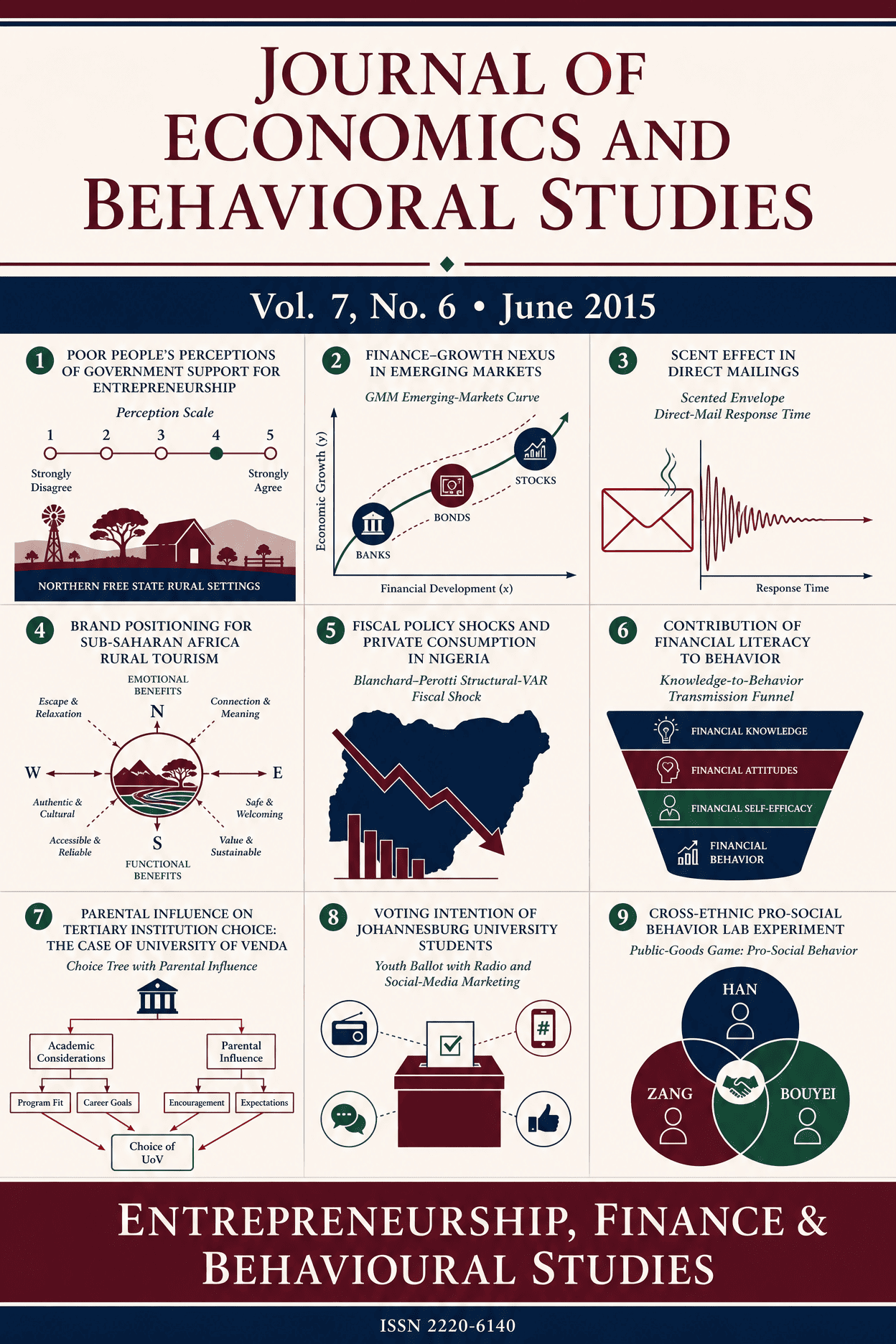
Articles

  • Article 1 in this issue

    Poor People’s Perceptions of Government Support for Entrepreneurship and Small Business Promotion in a Developing Country

    • Author: Natanya Meyer

    Unemployment is a global concern; therefore many developing countries focus on entrepreneurship development and small business promotion as a possible solution. Entrepreneurs are regarded as drivers of the economy as they not only provide income for themselves but also create job opportunities for other people. The South African Government focuses on job creation as a priority, involving many strategies and policies. However, many marginalised and impoverished people still do not benefit from these policies. The central purpose of this article is to analyse poor people’s perceptions of the role of government in creating jobs and assistance in providing entrepreneurial skills training and support. A socioeconomic household survey, consisting of approximately 3200 households, was conducted within various areas in the Metsimaholo, Moqhaka, Ngwathe and Mafube Local Municipalities, all located in the rural Northern Free State region in South Africa. Results of the survey show that 68.3% of participants feel that government is not doing enough to create jobs while a total of 49.1% indicated that government could assist in job creation by providing entrepreneurial skills training. A total of 56.2% indicated that they would like to open a small business. Improved government support and initiatives could lead to many poor households generating their own income through entrepreneurial activities.

    Pages 6-12

    PDF - Poor People’s Perceptions of Government Support for Entrepreneurship and Small Business Promotion in a Developing Country (opens in a new tab)
  • Article 2 in this issue

    The Finance-Growth Nexus: Evidence from Emerging Markets

    • Author: Ashenafi Beyene Fanta

    The finance growth literature ignores the role of bond markets in financing private investments. Moreover, the impact of bank crisis on the finance growth link has been largely overlooked. This paper aims at casting light at the finance growth link in emerging economies by accounting for bond markets and controlling for banking sector crises. Data on economic growth and financial development indicators for 15 emerging economies (drawn from Africa, Asia, Latin America, and Europe) were analysed using a system generalized-method-of-moments (GMM) technique. It is observed that while banking sector development is related to economic growth (albeit negatively), no statistically significant relation is observed between stock markets and/or bonds markets and economic growth. Moreover, a banking crisis is found to affect the finance growth link in such a manner that the link weakens when a banking crisis is introduced to the model. Our results are robust to omitted variable bias, simultaneity problem, heteroscedasticity and autocorrelation.

    Pages 13-23

    PDF - The Finance-Growth Nexus: Evidence from Emerging Markets (opens in a new tab)
  • Article 3 in this issue

    Scent in Mail: The Effect of Scented Direct Mailings

    • Author: Martin Amsteus, Simon de Vries, Vidar Hwang

    The purpose of the present study is to test the effect of scent on response time and sales in direct mailings. It is proposed that congruent scent influences response time and sales in direct mailings. A total of 1571 direct mailings were sent out.The hypotheses were tested through a Mann-Whitney U test and a Wilcoxon signed-rank test. The results show that scent influences response time to direct mailings but that it does not influence sales.Future research should perform exploratory studies to test the effect of scent with regard to various forms of direct marketing and offerings as well as in general product and service contexts. Managers may want to consider scenting direct mailings when a fast response is critical. The result provides empirical support for the idea that scent has an effect on response time in direct mailings.

    Pages 24-33

    PDF - Scent in Mail: The Effect of Scented Direct Mailings (opens in a new tab)
  • Article 4 in this issue

    Brand Positioning for Sub-Saharan Africa’s Rural Tourism Development

    • Author: Ikechukwu O. Ezeuduji

    Well-conceived and effectively managed rural tourism brand in sub-Saharan Africa (SSA) can help build favourable reputation which enhances the confidence of tourists. The purpose of this paper is to formulate brand essence (functional and emotional benefits derivable from a brand) and brand position statement, for SSA’s rural tourism development. This study conducted descriptive analysis of brand essence for SSA’s rural tourism development. It is exploratory, rather than conclusive in nature. Functional benefits of SSA’s rural tourism include her diverse natural and cultural attributes, friendliness of population, climatic conditions, and unique rural landscape. Her emotional benefits include the ‘feel-good’ factor when tourists are offered the ‘rural idyll’ experience not found in any other continent or sub-continent, or buy local foods and souvenirs. This positive feeling of visiting SSA’s rural areas adds richness and depth to the tourists’ experience of being involved with her brand. The knowledge of rural tourism brand essence can help SSA’s local communities, local governments and national governments to communicate not just the functional values, but also the emotional values of visiting rural areas to tourists. This will lead to particular relationships between local communities and stakeholders to enact these emotional values or rewards. SSA’s rural tourism brand positioning statement could read: “To tourists seeking nostalgic experiences, novelty and escape, rural SSA offers authentic rural landscape, ‘rural idyll’ experience, and amazing friendly populations” .

    Pages 34-41

    PDF - Brand Positioning for Sub-Saharan Africa’s Rural Tourism Development (opens in a new tab)
  • Article 5 in this issue

    Fiscal Policy Shocks and Private Consumption in Nigeria: Blanchard-Perotti (2002) Approach

    • Author: OSENI Isiaq Olasunkanmi

    This paper examines the effects of fiscal policy shocks on private consumption in Nigeria. Albeit, there is a considerable number of works examining the effects of fiscal policy shocks on private consumption globally but in Nigeria, no study has used the structural VAR approach by Blanchard and Perotti (2002) as used in this paper. This approach relies on institutional information about the tax and transfer systems and the timing of tax collection to identify the automatic response of taxes and spending to private consumption as well as to infer fiscal shocks. The key result of this paper is that positive government spending shocks in Nigeria have an instantaneous negative effect on private consumption. The effect becomes significant in the period following the shock. Also, positive tax shocks have a negative effect on private consumption in the period of a shock and the effect becomes statistically insignificant afterwards. On this premises, one-off changes in government spending and taxes in Nigeria are long-lived and short-lived respectively. Thus, the government expenditure changes can be used to support private consumption in the long-run while that of taxes can only be used to support private consumption for a short period.

    Pages 42-60

    PDF - Fiscal Policy Shocks and Private Consumption in Nigeria: Blanchard-Perotti (2002) Approach (opens in a new tab)
  • Article 6 in this issue

    Contribution of Financial Literacy to Behavior

    • Author: Ramesh Prasad Chaulagain

    Almost all the people around the world behave with money in daily lives whereas understanding how they behave is important. It is obvious that the education, which can not affect behavior of people, is worthless. Financial literacy also is believed to change financial behavior of individuals. Financial literacy implies two sides, i.e. concept and application of personal finance. The concept consists financial knowledge and basic skill of numeracy and financial decisions; the application consists the financial behavior. The focus of the article is to discuss how the financial literacy contributes financial behavior and thereby financial wellbeing of individuals. For this, the article presents a transmission mechanism of financial knowledge and skill to the financial behavior through a framework. However, there are some contexts, conditions and criterions to transmit the financial knowledge and skill into financial behavior and well-being. Moreover, categorizing the financial behavior of individuals is a significant issue in study of financial literacy. Particularly for the survey research, a new categorization and degree of the financial behavior is presented, which is ranked as good, moderate and weak financial behavior in comparative ways. The study establishes the relevancy of the evaluation criteria of financial behavior and also presents a framework on how the financial educations work/contribute in financial behavior.

    Pages 61-71

    PDF - Contribution of Financial Literacy to Behavior (opens in a new tab)
  • Article 7 in this issue

    Do parents Influence the Choice of Tertiary Institutions for their Children? Some Statistical Analyses

    • Author: Kwabena A. Kyei, A. Muthelo

    The paper investigates whether or not parents influence their children’s choice for tertiary institution to attend. Education has increasingly become more important in this present age to the extent that, without higher qualifications, employment and success become very difficult to achieve. Parents are trying to send their children to tertiary institutions so that these children will be employable. But the question is: Do parents choose the tertiary institutions for their children? The paper wants to find out whether or not parents have a say in their children’s choice for tertiary institution; and if so, look at factors that could play in the choice. A survey was conducted at the University of Venda from February 2015 to June 2015 and 500 students were conveniently sampled and interviewed. Using some statistical analyses, including Generalized Linear Modelling (GLM), the study concludes that age and the campus environment are the only factors that determine parents’ influence on their children’s choice for higher education. The study further shows that female students are more influenced by their parents than males in the choice of higher institution.

    Pages 72-80

    PDF - Do parents Influence the Choice of Tertiary Institutions for their Children? Some Statistical Analyses (opens in a new tab)
  • Article 8 in this issue

    To Vote or Not To Vote: Marketing Factors Influencing the Voting Intention of University Students in Johannesburg

    • Author: Anjali Morar, Marike Venter, Tinashe Chuchu

    Voting intention has become an issue of concern worldwide with regard to successful political elections. With only 6% of South Africa’s youth having registered to vote in the 2014 elections, it is of vital importance to get a better understanding of the main reasons behind these statistics and factors that have influenced voting intentions. Although several studies have explored this area of research, it remains a topic of interest. This research paper aims to examine the factors behind voting intention of the youth in South Africa, as most are in their first or second democratic election. This study adds to existing literature on political parties as brands and factors influencing the youth’s intention to vote. These factors include advertising mediums, convenience factors of location and registration, and social pressures from peers or family on voting intention. By means of quantitative research, two hundred and fifty questionnaires were distributed amongst students from the University of Witwatersrand. The findings indicate that five of the six hypotheses are insignificant with the exception of radio advertising. The results of this study provide political parties with a better understanding of the factors that prove to be ineffective when targeting Generation Y consumers in South Africa. It further provides political parties with an opportunity to more successfully reach such individuals through other media platforms.

    Pages 81-93

    PDF - To Vote or Not To Vote: Marketing Factors Influencing the Voting Intention of University Students in Johannesburg (opens in a new tab)
  • Article 9 in this issue

    Does Culture Matter to Pro-Social Behavior? Evidence from a Cross-Ethnic Lab Experiment

    • Author: Fengwei Sun, Xunzhou Ma, Xiaoxiao Wang, Quanlan Yi, Mengliang Wu

    Recent investigations have uncovered large, consistent deviations from the predictions of Homo economics that individuals are entirely self-regarding. Our study undertook a cross-cultural study of behavior search for the evidences of other-regarding behaviors and its ethnic difference, and accounted for by anatomy of culture. This study recruited 90 subjects of three ethnic groups from market trade-based (ethnic Han), nomadism-based (ethnic Zang) and agriculture-based (ethnic Bouyei) areas in China and conducted public good provision experiment with stranger-treatment design. Under the assumption of self-regarding preferences, the Nash equilibrium is zero contribution by all in public account using backward induction. However, we found contributions did not reduce to zero over all three sessions. Besides, the differences in contributions between ethnicities strongly depended on the degree of ethnic dominance, and Zang harbored the strongest reciprocal preference generally over all group structures. A particular set of measurable factors was identified as proxies for cultural influences on behavioral differences observed in experiments between ethnicities. The results showed all of the cultural factors accounted for the behavioral differences between the ethnic Han and the other two minor ethnicities. However, behavioral difference between minor ethnicities was attributed to group structure only. (1) People may harbor various forms of prosocial emotions in economic affairs, and especially exhibit stronger at the initial phase rather than what canonical model assumes. (2) Behavioral differences between ethnicities are prominent and can be explained by differences in cultural influence.

    Pages 94-110

    PDF - Does Culture Matter to Pro-Social Behavior? Evidence from a Cross-Ethnic Lab Experiment (opens in a new tab)