Abstract
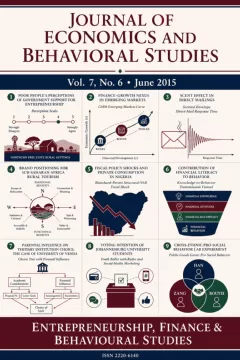
The purpose of the present study is to test the effect of scent on response time and sales in direct mailings. It is proposed that congruent scent influences response time and sales in direct mailings. A total of 1571 direct mailings were sent out.The hypotheses were tested through a Mann-Whitney U test and a Wilcoxon signed-rank test. The results show that scent influences response time to direct mailings but that it does not influence sales.Future research should perform exploratory studies to test the effect of scent with regard to various forms of direct marketing and offerings as well as in general product and service contexts. Managers may want to consider scenting direct mailings when a fast response is critical. The result provides empirical support for the idea that scent has an effect on response time in direct mailings.
Keywords
References
- Baron, R. & Kalsher, M. (1998). Effects of a pleasant ambient fragrance on simulated driving performance: The sweet smell of safety? Environment And Behavior, 30(4), 535-552.
- Bellizzi, J., Crowley, A. & Hasty, R. (1983). The Effects of Color in Store Design. Journal Of Retailing, 59(1), 2146.
- Bolfing, C. (1988). Integrating Consumer Involvement and Product Perceptions with Market Segmentation and Positioning Strategies. The Journal of Consumer Marketing, 5(2), 49-57.
- Bone, P. & Ellen, P. (1994). Olfaction and Marketing: Does it Make Sense to Use Scents? Unpublished working paper. Department of Marketing. West Virginia University.
- Bone, P. & Ellen, P. (1998). Scents in The Marketplace: Explaining a Fraction of Olfaction. Journal Of Retailing, 75(2), 243-262.
- Bone, P. & Jantrania, S. (1992). Olfaction as a Cue for Product Quality. Marketing Letters, 3(3), 289-296.
- Cain, W. (1988). Olfaction. In R. C. Atkinson, R. J. Herrnstein, G. Lindzey & R. D. Luce (Eds.), Stevens’ Handbook of Experimental Psychology: Perception and Motivation, 1, 409–459. New York: Wiley.
- Celsi, R. L. & Olson, J. C. (1988). The Role of Involvement In Attention and Comprehension Processes. Journal of Consumer Research, 15(2), 210-224.
- Chang, S. & Morimoto, M. (2003). An Assessment of Consumer Attitudes toward Direct Marketing Communication Channels: A Comparison between Unsolicited Commercial E-mail and Postal Direct Mail. Paper presented at the Annual convention of The Association for Education in Journalism and Mass Communication, Kansas City, MO.
- Chebat, J. & Michon, R. (2003). Impact of ambient odors on mall shoppers’ emotions, cognition, and spending: A test of competitive causal theories. Journal of Business Research, 56(7), 529-539.
- Cirrincione, A., Estes, Z. & Carù, A. (2014). The Effect of Ambient Scent on the Experience of Art: Not as Good as It Smells. Psychology & Marketing, 31(8), 615-627. doi: 10.1002/mar.20722
- Cooper, G. (2010). How DM bounced back to reach brand new heights. Marketing Intelligence & Planning , 3, 16-17.
- Cox, D. F. (1967). The Sorting Rule Model of the Consumer Product Evaluation Process Risk Taking and Information Handling in Consumer Behavior. Boston: Harvard University.
- Davies, B., Kooijman, D. & Ward, P. (2003). The Sweet Smell of Success: Olfaction in Retailing. Journal Of Marketing Management, 19(5), 611-627.
- Diego, M., Jones, N., Field, T., Hernandez-Reif, M., Schanberg, S., Kuhn, C. & Galamaga, M. (1998). Aromatherapy positively affects mood, eeg patterns of alertness and math computations. International Journal Of Neuroscience, 96(3), 217-224.
- Donovan, R. & Rossiter, J. (1994). Store Atmosphere and Purchasing Behavior. Journal Of Retailing, 70(3), 283-294.
- Durango-Cohen, E. J., Torres, R. L. & Durango-Cohen, P. L. (2013). Donor Segmentation: When Summary Statistics Don't Tell the Whole Story. Journal of Interactive Marketing, 27(3), 172-184.
- Ehrlichman, H. & Bastone, L. (1992). Olfaction and emotion. In M. J. Serby & K. L. Chobor (Eds.), Science of Olfaction , 15, 410-438. New York: Springer-Verlag.
- Ehrlichman, H. & Halpern, J. N. (1988). Affect and memory: effects of pleasant and unpleasant odors on retrieval of happy and unhappy memories. Journal of Personality and Social Psychology, 55(1), 769779.
- Feld, S., Frenzen, H., Krafft, M., Peters, K. & Verhoef, P. C. (2013). The effects of mailing design characteristics on direct mail campaign performance. International Journal of Research in Marketing, 30, 143-159. doi: 10.1016/j.ijresmar.2012.07.003
- Francis, L. (1987). Chess Talk in Washington Park: Control in a Miniature World. Paper presented at the The Anthropological Association for the Study of Play, Montreal.
- Goi, M. T., Kalidas, V. & Zeeshan, M. (2014). Personality as a Moderator of SOR Model. Review of Integrative Business & Economics Research, 3(2), 67-76.
- Goldstein, E. (2009). Sensation And Perception. Belmont: Wadsworth.
- Greenfield, J. M. (2004). Fundraising Fundamentals: A Guide to Annual Giving for Professionals and Volunteers. New York, NY: John Wiley & Sons.
- Guéguen, N. & Petr, C. (2006). Research note: Odors and consumer behavior in a restaurant International Journal of Hospitality Management, 25(1), 335-339.
- Gulas, C. & Bloch, P. (1995). Right under our noses: ambient scent and consumer responses. Journal of Business & Psychology, 10(1), 87-98.
- Hair, J. F. Jr., Black, W. C., Babin, B. J., Anderson, R. E. & Tatham, R. L. (2006). Multivariate Data Analysis (6 ed.). New Jersey: Pearson Education.
- Herrmann, A., Zidansek, M., Sprott, D. E. & Spangenberg, E. R. (2013). The power of simplicity: processing fluency and the effects of olfactory cues on retail sales. Journal of Retailing, 89(1), 30-43.
- Hirsch, A. R. & Gay, S. (1991). The Effect of Ambient Ol- factory Stimuli on the Evaluation of a Common Consumer Product. Paper presented at the Thirteenth Annual Meeting of the Association for Chemoreception Sciences, Sarasota.
- Hultén, B. . (2012). Sensory cues and shoppers' touching behaviour: the case of IKEA. International Journal of Retail & Distribution Management, 40(4), 273-289.
- Hultén, B., Broweus, N. & Dijk, M. . (2009). Sensory Marketing. New York: Palgrave Macmillan.
- Jacob, C., Stefan, J. & Gueguen, N. (2014). Ambient scent and consumer behavior: a field study in a florist's retail shop. International Review of Retail, Distribution & Consumer Research, 24(1), 116-120.
- Jacoby, J. (2002). Stimulus-Organism-Response Reconsidered: An Evolutionary Step in Modeling (Consumer) Behavior. Journal of Consumer Psychology, 12(1), 51-57.
- Kapferer, J. & Laurent, G. (1985). Consumer’s involvement profile: New empirical results Advances in Consumer Research, 12(1), 290-295.
- Knasko, S. (1995). Pleasant odors and congruency: Effects on approach behavior. Chemical Senses, 20(1), 479487.
- Kotler, P. & Armstrong, G. (2013). Principles of Marketing . Boston: Pearson Prentice Hall.
- Kumar, S. & Sharma, R. R. (2014). An Empirical Analysis of Unsolicited Commercial E-mail. Paradigm, 18(1), 1-19. doi: 10.1177/0971890714540363
- Laird, D. (1932). How the consumer estimates quality by subconscious sensory impressions. Journal of Applied Psychology, 16(3), 241-246.
- Leenders, M., Smidts, A. & Langeveld, M. (1999). Effects of ambient scent in supermarkets: a field experiment. Paper presented at the The 28th EMAC Conference, Umbold University, Berlin, Berlin.
- Lefevre, J. (1988). Row and the Quality of Experience During Work and Leisure. In M. Csikszentmihaiyi & I. S. Csikszentmihaiyi (Eds.). Optimal Experience: Psychological Studies of Flow in Consciousness , 1, 307318. Cambridge: Cambridge University Press.
- Levin, J. & McBumey, D. H. (1986). The Role of Ol- faction in Social Perception and Behavior. In C. P. Herman, M. P. Zanna & E. T. Higgins (Eds.). Physical Ap- pearance Stigma, and Social Behavior: The Ontario Symposium , 3, 179-217. Hillsdale: Lawrence Erlbaum Associates.
- Lindstrom, M. (2005). Brand Sense : How To Build Powerful Brands Through Touch, Taste, Smell, Sight and Sound. New York Free Press.
- Lipman, J. (1990). Scents That Encourage Buying Couldn't Smell Sweeter to Stores. Wall Street Joumal, 1(5).
- Lorenxi, P., Friedmaun, R. & Paolillo, J. G. P. (1988). Consumer Mail Survey Responses: More (unibased) bang for the buck. Journal of Consumer Marketing, 5(4), 31.
- Lorig, T. & Roberts, M. (1990). Odor and cognitive alteration of the contingent negative variation. Chemical Senses, 15(1), 537-545.
- Lorig, T. S. & Schwartz, G. E. (1988). Brain and Odor: I. Alteration of Human EEG' by Odor Administration. Psychobiology, 16(1), 281-284.
- Madzharov, A. V., Block, L. G. & Morrin, M. (2015). The Cool Scent of Power: Effects of Ambient Scent on Consumer Preferences and Choice Behavior. Journal of Marketing, 79(1), 83-96.
- Malthouse, E. C. (1999). Ridge regression and direct marketing scoring models. Journal of Interactive Marketing, 13, 10-23. doi: 10.1002/(SICI)1520-6653(199923)13:4<10::AID-DIR2>3.0.CO;2-3
- Mattila, A. & Wirtz, J. (2001). Congruency of scent and music as a driver of in-store evaluations and behavior. Journal of Retailing, 77(2), 273-289.
- Mehrabian, A. & Russell, J. (1974). An Approach To Environmental Psychology. Cambridge, MA. The MIT Press.
- Mitchell, D. J., Kahn, B. E. & Knasko, S. C. (1995). There's Something in the Air: Effects of Congruent or Incongruent Ambient Odor on Consumer Decision Making. Journal of Consumer Research, 22(2), 229-238.
- Morrin, M. & Ratneshwar, S. (2000). The Impact of Ambient Scent on Evaluation, Attention, and Memory for Familiar and Unfamiliar Brands. Journal of Business Research, 49(2), 157-165.
- Morrison, M., Gan, S., Dubelaar, C. & Oppewal, H. (2011). In-store music and aroma influences on shopper behavior and satisfaction. Journal of Business Research, 64(6), 558-564.
- Nixdorf, R. R., Teerling, A. & Köster, E. P. (1992). The effect of olfactory stimuli on the time spent by customers in textile-department-stores. Paper presented at the Fourteenth Annual Meeting of the Association for Chemoreception Sciences, Sarasota.
- Odeh, M. R. & As’ad, A. H. (2014). The Impact of Jordanian Shopping Malls’ Physical Surrounding on Consumer Buying Behavior: Field Study International Journal of Marketing Studies, 6(3), 135-141.
- Orth, U. R. & Bourrain, A. (2005). Ambient scent and consumer exploratory behaviour: A causal analysis. Journal of Wine Research, 16(2), 137-150.
- Pagano, R. R. (1994). Understanding Statistics (4 ed.). St. Paul, Minnesota: West Publishing Company.
- Parsons, A. (2009). Use of scent in a naturally odourless store International Journal of Retail & Distribution Management, 37(5), 440-452.
- Raudenbush, B., Corley, N. & Eppich, W. (2001). Enhancing athletic performance through the administration of peppermint odor. Journal of Sport & Exercise Psychology, 23(2), 156-160.
- Roberts, A. & Williams, J. (1992). The effect of olfactory stimulation on fluency, vividness of imagery and associated mood: A preliminary study. British Journal of Medical Psychology, 65(1), 197-199.
- Sarathy, P. S. & Patro, S. K. (2013). The Role of Opinion Leaders in High-Involvement Purchases: An Empirical Investigation. South Asian Journal of Management, 20(2), 127-145.
- Schifferstein, H. & Blok, S. (2002). The signal function of thematically (In)congruent ambient scents in a retail environment. Chemical Senses, 27(6), 539-549.
- Skinner, B. F. (1974). About Behaviourism. London: Jonathan Cape Ltd.
- Spangenberg, E., Crowley, A. & Henderson, P. (1996). Improving the Store Environment: Do Olfactory Cues Affect Evaluations and Behaviors? Journal Of Marketing, 60(2), 67-80.
- Spangenberg, E. R., Sprott, D. E., Grohmann, B. & Tracy, D. L. (2006). Gender-congruent ambient scent influences on approach and avoidance behaviors in a retail store. Journal of Business Research, 59(12), 1281-1287.
- Spence, C. (2012). Managing sensory expectations concerning products and brands: Capitalizing on the potential of sound and shape symbolism. Journal of Consumer Psychology , 22(1), 37-54.
- Statista. (2014). from Statista Inc. http://www.statista.com
- Suha, M., Moonb, H., Han, H. & Ham, S. (2014). Invisible and intangible, but undeniable: Role of ambient conditions in building hotel guests’ loyalty. Journal of Hospitality Marketing & Management, Accepted author version posted online: 19
- Takagi, S. (1989). Human Olfaction. Tokyo University of Tokyo Press.
- Teller, C. & Dennis, C. (2012). The effect of ambient scent on consumers' perception, emotions and behaviour: A critical review. Journal Of Marketing Management, 28(1), 14-36.
- Turley, L. & Milliman, R. (2000). Atmospheric effects on shopping behavior: A review of the experimental evidence. Journal of Business Research, 49(2), 193-211.
- Ward, P., Davies, B. & Kooijman, D. (2007). Olfaction and the retail environment: examining the influence of ambient scent. Service Business, 4(1), 295-316.
- Warm, J., Dember, W. & Parasuraman, R. . (1991). Effects of olfactory stimulation on performance and stress in a visual sustained attention task. Journal of The Society of Cosmetic Chemists, 42(3), 199-210.
- Verma, P. (2014). Is the pleaseure of scent in Luxury store different than convenicene store? Arabian Journal of Business and Management Review (OMAN Chapter), 3(9), 47-85.
Downloads
No downloads have been recorded for this article yet. Figures appear here once readers begin downloading the full text.
How to Cite
Share this article
License
Copyright (c) 2015 Martin Amsteus, Simon de Vries, Vidar Hwang (Author)

This work is licensed under a Creative Commons Attribution 4.0 International License.
Author (s) should affirm that the material has not been published previously. It has not been submitted and it is not under consideration by any other journal. At the same time author (s) need to execute a publication permission agreement to assume the responsibility of the submitted content and any omissions and errors therein. After submission of revised paper in the light of suggestions of the reviewers, the editorial team edits and formats manuscripts to bring uniformity and standardization in published material.
This work will be licensed under Creative Commons Attribution 4.0 International (CC BY 4.0) and under condition of the license, users are free to read, copy, remix, transform, redistribute, download, print, search or link to the full texts of articles and even build upon their work as long as they credit the author for the original work. Moreover, as per journal policy author (s) hold and retain copyrights without any restrictions.
Keywords
Section
Published in
 Vol. 7 No. 6(J) (2015)
Entrepreneurship, Finance & Behavioural Studies
View issue contents
Published
Submissions
Have research to publish? Journal of Economics and Behavioral Studies welcomes submissions.
Make a Submission