Abstract
Well-conceived and effectively managed rural tourism brand in sub-Saharan Africa (SSA) can help build favourable reputation which enhances the confidence of tourists. The purpose of this paper is to formulate brand essence (functional and emotional benefits derivable from a brand) and brand position statement, for SSA’s rural tourism development. This study conducted descriptive analysis of brand essence for SSA’s rural tourism development. It is exploratory, rather than conclusive in nature. Functional benefits of SSA’s rural tourism include her diverse natural and cultural attributes, friendliness of population, climatic conditions, and unique rural landscape. Her emotional benefits include the ‘feel-good’ factor when tourists are offered the ‘rural idyll’ experience not found in any other continent or sub-continent, or buy local foods and souvenirs. This positive feeling of visiting SSA’s rural areas adds richness and depth to the tourists’ experience of being involved with her brand. The knowledge of rural tourism brand essence can help SSA’s local communities, local governments and national governments to communicate not just the functional values, but also the emotional values of visiting rural areas to tourists. This will lead to particular relationships between local communities and stakeholders to enact these emotional values or rewards. SSA’s rural tourism brand positioning statement could read: “To tourists seeking nostalgic experiences, novelty and escape, rural SSA offers authentic rural landscape, ‘rural idyll’ experience, and amazing friendly populations” .
Keywords
- Brand Essence Search this journal for Brand Essence (opens in a new tab)
- Brand Positioning Search this journal for Brand Positioning (opens in a new tab)
- Rural Tourism Search this journal for Rural Tourism (opens in a new tab)
- Tourism Development Search this journal for Tourism Development (opens in a new tab)
- Sub-Saharan Africa Search this journal for Sub-Saharan Africa (opens in a new tab)
References
- Akama, J. S. & Kieti, D. (2007). Tourism and socio-economic development in developing countries: A case study of Mombasa Resort in Kenya. Journal of Sustainable Tourism , 15(6), 735–748.
- Ankomah, P. K. & Crompton, J. L. (1990). Unrealized tourism potential: The case of sub-Saharan Africa. Tourism Management , 11(1), 11–28.
- Berry, L. (2000). Cultivating service brand equity. Journal of the Academy of Marketing Science , 28 (1) , 128 – 137.
- Briedenhann, J. & Wickens, E. (2004). Rural tourism – meeting the challenges of the New South Africa. International Journal of Tourism Research , 6, 189–203.
- Butler, R. W. & Hall, C. M. (1998).Image and reimaging of rural areas. In R. Butler, C. M. Hall, & J. Jenkins (Eds.), Tourism and recreation in rural areas (pp. 115–122), Chichester: John Wiley & Sons.
- Chigbu, U. E. (2013). Rurality as a choice: Towards ruralising rural areas in sub-Saharan African countries. Development Southern Africa , 30(6), 812-825.
- Davidson, H. (1997). Even more offensive marketing, London: Penguin.
- deChernatony, L. & Harris, F. (2010). The strategic process of building and sustaining brands, Milton Keynes: The Open University Business School.
- deChernatony, L. & McDonald, M. (1998). Creating powerful brands in consumer, service and industrial markets (2nd Ed.), Oxford: Butterworth-Heinemann.
- Dieke, P. U. C. (2013). Tourism in sub-Saharan Africa: Production-consumption nexus. Current Issues in Tourism , 16(7–8), 623–626.
- Dong, E., Wang, Y., Morais, D. & Brooks, D. (2013). Segmenting the rural tourism market: the case of Potter County, Pennsylvania, USA. Journal of Vacation Marketing , 19(2), 181-193.
- Economic Commission for Africa (Ed.). (2005). Review of the application of environmental impact assessment in selected African countries. Addis Ababa, Ethiopia: ECA.
- Edwards, J., Fernandes, C., Fox, J. & Vaughan, R. (2000). Tourism brand attributes of the Alto Minho, Portugal. In G. Richards & D. Hall (Eds.), Tourism and sustainable community development (pp. 285–296), London: Routledge.
- Elliot, R. & Wattanasuran, K. (1998). Brands as symbolic resources for the construction of identity. International Journal of Advertising, 17(2) , 131–144.
- Ezeuduji, I. O. (2014). Change management for sub-Saharan Africa’s rural tourism development. Current Issues in Tourism , online, Doi: 10.1080/13683500.2014.946892
- Ezeuduji, I. O. (2015). Strategic Event-Based Rural Tourism Development for sub-Saharan Africa. Current Issues in Tourism, 18(3), 212-228.
- Ezeuduji, I. O., Lete, P. M., Correia, M. & Taylor, A. (2014). Competitive advantage for brand positioning: The case of Sun City in South Africa. Tourism Review International, 17, 299 – 306.
- Ezeuduji, I. O. & Rid, W. (2011). Rural tourism offer and local community participation in The Gambia. TOURISMOS: An International Multidisciplinary Journal of Tourism , 6(2), 187–211.
- Filani, M. O. (1975). The role of national tourist associations in the preserving of the environment in Africa. Journal of Travel Research , 13(4), 7–12.
- Fleischer, A. & Felsenstein, D. (2000). Support for rural tourism: does it make a difference? Annals of Tourism Research , 27(4), 1007-1024.
- Fleischer, A. & Pizam, A. (1997). Rural tourism in Israel. Tourism Management , 18(6), 367-372.
- Getz, D. (2008). Event tourism: Definition, evolution, and research. Tourism Management , 29, 403–428.
- Harrison, J. A., Underhill, L. G. & Barnard, P. (2008).The seminal legacy of the Southern African Bird Atlas Project. South African Journal of Science , 104, 82–84.
- Hernández-Maestro R. M. & González-Benito Ó. (2013). Rural lodging establishments as drivers of rural development. Journal of Travel Research , 53(1), 83-95.
- Kapferer, J. N. (1997 ). Strategic brand management (2nd Ed.), London: Kogan Page.
- Keller, K. (2003). Strategic brand management: Building, measuring, and managing brand equity, Upper Saddle River, NJ: Pearson Education International.
- Kibicho, W. (2008). Community-based tourism: A factor-cluster segmentation approach. Journal of Sustainable Tourism , 16(2), 211–231.
- Kruger, M. & Saayman, M. (2010). Travel motivation of tourists to Kruger and Tsitsikamma National Parks: A comparative study. South African Journal of Wildlife Research , 40(1), 93–102.
- Manyara, G. & Jones, E. (2007). Community-based tourism enterprises development in Kenya: An exploration of their potential as avenues of poverty reduction. Journal of Sustainable Tourism , 15(6), 628–644.
- Musasa, G. & Mago, S. (2014). Challenges of rural tourism development in Zimbabwe: A case of the Great Zimbabwe-Masvingo district. African Journal of Hospitality, Tourism and Leisure , 3(2), 1-12. Open Access.
- Nyamweru, C. & Kimaru, E. (2008). The contribution of ecotourism to the conservation of natural sacred sites: A case study from coastal Kenya. Journal for the Study of Religion, Nature and Culture, 2(3), 327–350.
- O’Sullivan, T. (2010). Marketing communications, Milton Keynes: The Open University Business School.
- Rid, W., Ezeuduji, I. O. & Proebstl, U. (2014). Segmentation by motivation for rural tourism activities in the Gambia. Tourism Management, 40, 102-116.
- Roberts, L. & Hall, D. (2001). Rural tourism and recreation: Principles to practice, Oxon: CABI Publishing.
- Rogerson, C. M. (2006). Pro-poor local economic development in South Africa: The role of pro-poor tourism. Local Environment , 11(1), 37–60.
- Rogerson, C. M. & Rogerson, J. M. (2010). Local economic development in Africa: Global context and research directions. Development Southern Africa , 27(4), 465 – 480.
- Rossiter, J. & Percy, L. (1996). Advertising communications and promotion management, New York, NY: McGraw Hill.
- Rubinstein, H. (1996). Brand first management. Journal of Marketing Management, 12(4), 269 – 280.
- Schultz, D. & Kitchen, P. (2000). Communicating globally: An integrated marketing approach, London: Macmillan Business.
- Sharpley, R. (2002). Rural tourism and the challenges of tourism diversification: the case of Cyprus. Tourism Management , 23, 233-244.
- Simpson, M. C. (2008). Community benefits tourism initiatives –a conceptual oxymoron? Tourism Management , 29(1), 1-18.
- Sotiriadis, M. & Nduna, L. (2014). Market segmentation of nature-based attractions: A framework for experience and activity-oriented segmentation. Journal of Human Ecology , 46(1), 63-71.
- Spenceley, A. (Ed.). (2008). Responsible tourism: Critical issues for conservation and development, London: Earthscan.
- Spenceley, A. & Meyer, D. (2012). Tourism and poverty reduction: theory and practice in less economically developed countries. Journal of Sustainable Tourism , 20(3), 297-317.
- United Nations Statistics Division. (2011). Standard country and area codes classifications (M49). Retrieved 20 September 2014, from http://unstats.un.org/unsd/methods/m49/m49regin.htm
- Wilson, S., Fesenmaier, D. R., Fesenmaier, J. & Van Es, J. C. (2001). Factors for success in rural tourism development. Journal of Travel Research , 40, 132-138.
- Wright, P. (1994). Environmentally responsible marketing of tourism. In E. Cater & G. Lowman (Eds.), Ecotourism: A sustainable option? (pp. 39–55), Chichester: John Wiley & Sons.
Downloads
No downloads have been recorded for this article yet. Figures appear here once readers begin downloading the full text.
How to Cite
Share this article
License
Copyright (c) 2015 Ikechukwu O. Ezeuduji (Author)

This work is licensed under a Creative Commons Attribution 4.0 International License.
Author (s) should affirm that the material has not been published previously. It has not been submitted and it is not under consideration by any other journal. At the same time author (s) need to execute a publication permission agreement to assume the responsibility of the submitted content and any omissions and errors therein. After submission of revised paper in the light of suggestions of the reviewers, the editorial team edits and formats manuscripts to bring uniformity and standardization in published material.
This work will be licensed under Creative Commons Attribution 4.0 International (CC BY 4.0) and under condition of the license, users are free to read, copy, remix, transform, redistribute, download, print, search or link to the full texts of articles and even build upon their work as long as they credit the author for the original work. Moreover, as per journal policy author (s) hold and retain copyrights without any restrictions.
Keywords
- Brand Essence Search this journal for Brand Essence (opens in a new tab)
- Brand Positioning Search this journal for Brand Positioning (opens in a new tab)
- Rural Tourism Search this journal for Rural Tourism (opens in a new tab)
- Tourism Development Search this journal for Tourism Development (opens in a new tab)
- Sub-Saharan Africa Search this journal for Sub-Saharan Africa (opens in a new tab)
Section
Published in
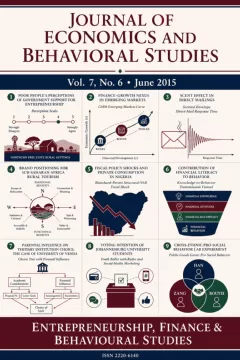 Vol. 7 No. 6(J) (2015)
Entrepreneurship, Finance & Behavioural Studies
View issue contents
Published
Submissions
Have research to publish? Journal of Economics and Behavioral Studies welcomes submissions.
Make a Submission