Abstract
Voting intention has become an issue of concern worldwide with regard to successful political elections. With only 6% of South Africa’s youth having registered to vote in the 2014 elections, it is of vital importance to get a better understanding of the main reasons behind these statistics and factors that have influenced voting intentions. Although several studies have explored this area of research, it remains a topic of interest. This research paper aims to examine the factors behind voting intention of the youth in South Africa, as most are in their first or second democratic election. This study adds to existing literature on political parties as brands and factors influencing the youth’s intention to vote. These factors include advertising mediums, convenience factors of location and registration, and social pressures from peers or family on voting intention. By means of quantitative research, two hundred and fifty questionnaires were distributed amongst students from the University of Witwatersrand. The findings indicate that five of the six hypotheses are insignificant with the exception of radio advertising. The results of this study provide political parties with a better understanding of the factors that prove to be ineffective when targeting Generation Y consumers in South Africa. It further provides political parties with an opportunity to more successfully reach such individuals through other media platforms.
Keywords
- Voting Intention Search this journal for Voting Intention (opens in a new tab)
- Advertising Search this journal for Advertising (opens in a new tab)
- Convenience Search this journal for Convenience (opens in a new tab)
- Social Pressure Search this journal for Social Pressure (opens in a new tab)
- Youth Culture Search this journal for Youth Culture (opens in a new tab)
- South Africa Search this journal for South Africa (opens in a new tab)
References
- Ajzen, I. (1991). The theory of planned behaviour. Organisational Behavioural and Human Decision Process, 50, 179-211.
- Ajzen, I. (2002) Perceived Behavioral Control, Self-Efficacy, Locus of Control, and the Theory of Planned Behavior. Journal of Applied Social Psychology , 32, (4), 665-683.
- Ajzen, I. (2011). The theory of planned behavior: Reactions and reflections. Psychology & Health, 26(9), 11131127.
- Anderson, R. & Heath, A. (2003). Social identities and political cleavages: the role of political context. Journal of the Royal Statistical Society: Series A (Statistics in Society) , 166(3), 301-327.
- Bandura, A. (1998). Social cognitive theory and self-efficacy. Personality , 1, 384.
- Bearden, W. O., Netemeyer, R. G. & Teel, J. E. (1989). Measurement of consumer susceptibility to interpersonal influence. Journal of Consumer Research, 15(4), 345-356.
- Belanger, P. & Eagles, M. (2007). Partisan Cross-Pressure and VoterTurnout: The Influence of Micro and Macro Environments. Social Science Quarterly, 88(3), 851-867.
- Ben-Ur, J. & Newman, B. I. (2002). Motives, Perceptions and Voting Intention of Voters in the 2000 U.S.Presidential Election. Psychology & Marketing , 19(12), 1047-1065. doi: 10.1002/mar. 10052.
- Celuch, K. & Dill, A. (2011). An Extension of the Theory of Reasoned Action in Ethical Decision Contexts: The Role of Normative Influence and Ethical Judgment. Journal of Education for Business, 86, 201-207.
- Chinomona, R., Lin, J. Y. C., Wang, M. C. H. & Cheng, J. M. S. (2010). Soft power and desirable relationship outcomes: the case of Zimbabwean distribution channels. Journal of African Business , 11(2), 182-200.
- Chinomona, R. & Pretorius, M. (2011). Major dealers' expert power in distribution channels. South African Journal of Economic and Management Sciences , 14(2), 170-187.
- Collier, J. E. & Sherrell, D. L. (2010). Examining the influence of control and convenience in a self-service setting. Journal of the Academic Marketing Science, 38, 490-509. doi: 10.1007/s11747-009-0179-4.
- Cwalina, W., Falkowski, A. & Kaid, L. L. (2005). Advertising and the image of politicians in evolving and established democracies: Comparative study of the Polish and the US presidential elections in 2000. Journal of Political Marketing , 4(2-3), 19-44.
- Durante, R. & Gutierrez. (2014). Political Advertising and voting intentions: Evidence from exogenous variation in ads viewership. Research paper (July, 2014).
- Farrag, D. A. R. & Shamma, H. (2013). Factors influencing voting intentions for Egyptian parliament elections 2011. Journal of islamic Marketing, 5(1),49-70. doi: 10.1108/JIMA-01-2013-0003.
- Farquhar, J. D. & Rowley, J. (2009). Convenience:a services perspective. Marketing Theory, 9(4), 425-438. doi: 10.1177/1470593109346894.
- Franz, M. M., Freedman, P., Goldstein, K. & Ridout, T. N. (2008). Understanding the Effect of Political Advertising on Voter Turnout: A Response to Krasno and Green. Journal of Politics, 70(1), 262 -268. doi: 10. 1017/S0022381607080188.
- Glynn, C. J., Huge, M. E. & Lunney, C. A. (2009). The Influence of Perceived Social Norms on College Students’ Intention to Vote. Political Communication, 26, 48–64. doi: 10.1080/10584600802622860.
- Gronke, P., Galanes-Rosenbaum, E., Miller, P. A. & l Toffey, D. (2008). Convenience Voting. Annual Review of Political Science, 11, 437-455. doi: 10.1146/annurev.polisci.11.053006.190912.
- Han, G. K. (2008). New Media Use, Sociodemographics. Mass Communication & Society , 11, 62-81. doi: 10.1080/15205430701587644.
- Huang, Y., Phau, I. & Lin, C. (2008). Consumer animosity, economic hardship, and normatve influence. European Journal of Marketing, 44(7/8), 909-937. doi: 10.1108/03090561011047463
- Jones, M. A., Mothersbaugh, D. L. & Beatty, S. E. (2003). The effects of locational convenience on customer repurchase intentions across service types. Journal of Services Marketing, 17(7), 701-712. doi: 10.108/08876040310501250.
- Lam, T. & Hsu, C. H. (2006). Predicting behavioral intention of choosing a travel destination. Tourism Management, 27(4), 589-599.
- Lee, M. & Cunningham, L. F. (2001). A cost/benefit approach to understanding service loyalty. Journal of services Marketing , 15(2), 113-130.
- Levy, S. & Gendel-Guterman, H. (2012). Does advertising matter to store brand purchase intention?. Journal of Product & Brand Management, 21(2), 89–97.
- Liao, C. H. & Hsieh, I. Y. (2013). Determinants of consumer’s willingness to purchase gray-market smartphones. Journal of business ethics , 114(3), 409-424.
- Montano, D. E., Kasprzyk, D., Glanz, K., Rimer, B. K. & Viswanath, K. (2008). Theory of reasoned action, theory of planned behavior, and the integrated behavioral model. Wiley, USA
- Moriarty, S., Mitchell, N. D., Wells, W. D., Crawford, R., Brennan, L. & Spence-Stone, R. (2014). Advertising: Principles and Practice . 3rd ed. Australia: Pearson.
- Newman, B. I. & Sheth, J. N. (1985). A model of primary voter behavior. Journal of Consumer Research , 3, 178187.
- Newman, B. I. (1999). A predictive model of voter behavior: The repositioning of Bill Clinton. Handbook of political marketing , 1, 159-173.
- Nunnally, J. C. & Bernstein, I. H. (1994). The assessment of reliability. Psychometric theory , 3, 248-292.
- Nusair, K. & Hua, N. (2010). Comparative assessment of structural equation modeling and multiple regression research methodologies: E-commerce context. Tourism Management , 31(3), 314-324.
- Pfau, M., Houston, J. B. & Semmler, S. M. (2005). Presidential Election Campaigns and American Democracy. The American Behavioral Scientist, 49(1), 48-62. doi: 10.1177/0002764205279429.
- Presse, A. F. (2014). Record number of South Africans register to vote. (2014, February). News Daily.
- Richards, J. I. & Curran, C. M. (2002) Oracles on Advertising: Searching for a Definition. Journal of Advertising, 31(2), 63-77, doi: 10.1080/00913367.2002.10673667
- Qureshi, S. M. & Kang, C. (2015). Analysing the organizational factors of project complexity using structural equation modelling. International Journal of Project Management , 33(1), 165-176.
- Ridout, T. N. & Fowler, E. F. (2012). Explaining Perceptions of Advertising Tone. Political Research Quarterly, 65(1), 62–75.
- Saadeghvaziri, F., Dehdashti, Z. & Askarabad, M. R. K. (2013). Web advertising: Assessing beliefs, attitudes, purchase intention and behavioral responses. Journal of Economic and Administrative Sciences, 29(2), 99-112.
- Schepers, J. & Wetzels, M. (2007). A meta-analysis of the technology acceptance model: Investigating subjective norm and moderation effects. Information & Management , 44(1), 90-103.
- Schulz, W., Zeh, R. & Quiring, O. (2005). Voters in a Changing Media Environment. A Data-Based Retrospective on Consequences of Media Change. European Journal of Communication , 20(1), 55-88.
- Schumacker, R. E. & Lomax, R. G. (2004). A beginner's guide to structural equation modeling. Psychology Press. New Jersey, USA
- Voter turnout in the 20th century. National election patterns and their implications. (2000, October). Congressional Digest, 226 and 256.
- Wolf, S., Weißenberger, B. E., Wehner, M. C. & Kabst, R. (2015). Controllers as business partners in managerial decision-making: Attitude, subjective norm, and internal improvements. Journal of Accounting & Organizational Change , 11(1), 24-46.
- Wu, L. (2011). Beyond satisfaction. The relative importance of locational convenience, interpersonal relationships, and commitment across service types. Managing Service Quality, 21(3), 240-263.
- Vaughan, G. & Hogg, M. A. (2005). Introduction to social psychology. Pearson Education Australia.
- Yoon, K., Pinkleton, B. E. & Ko, W. (2005). Effects of Negative Political Advertising on Voting Intention: An Exploration of the Roles of Involvement and Source Credibility in the Development of Voter Cynicism. Journal of Marketing Communications, 11(2), 95-112.
Downloads
No downloads have been recorded for this article yet. Figures appear here once readers begin downloading the full text.
How to Cite
Share this article
License
Copyright (c) 2015 Anjali Morar, Marike Venter, Tinashe Chuchu (Author)

This work is licensed under a Creative Commons Attribution 4.0 International License.
Author (s) should affirm that the material has not been published previously. It has not been submitted and it is not under consideration by any other journal. At the same time author (s) need to execute a publication permission agreement to assume the responsibility of the submitted content and any omissions and errors therein. After submission of revised paper in the light of suggestions of the reviewers, the editorial team edits and formats manuscripts to bring uniformity and standardization in published material.
This work will be licensed under Creative Commons Attribution 4.0 International (CC BY 4.0) and under condition of the license, users are free to read, copy, remix, transform, redistribute, download, print, search or link to the full texts of articles and even build upon their work as long as they credit the author for the original work. Moreover, as per journal policy author (s) hold and retain copyrights without any restrictions.
Keywords
- Voting Intention Search this journal for Voting Intention (opens in a new tab)
- Advertising Search this journal for Advertising (opens in a new tab)
- Convenience Search this journal for Convenience (opens in a new tab)
- Social Pressure Search this journal for Social Pressure (opens in a new tab)
- Youth Culture Search this journal for Youth Culture (opens in a new tab)
- South Africa Search this journal for South Africa (opens in a new tab)
Section
Published in
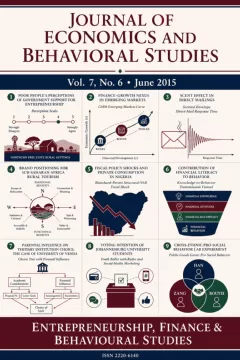 Vol. 7 No. 6(J) (2015)
Entrepreneurship, Finance & Behavioural Studies
View issue contents
Published
Submissions
Have research to publish? Journal of Economics and Behavioral Studies welcomes submissions.
Make a Submission