Abstract
Relationship marketing has been a focus of online studies for a number of years. These studies have indicated that relationships in these environments are driven by commitment, trust, privacy concerns and stickiness. However, research on the use of Facebook as a relationship marketing building platform has received little attention. Therefore, this paper focuses on the constructs of relationship marketing and how they impact on relationships in the Facebook context. Questionnaires were distributed to a convenience sample of 300 students. The study confirmed that the factors influencing relationships on Facebook were similar to the factors influencing relationships in other online environments. The implications of the results of the study are discussed.
Keywords
- Facebook Search this journal for Facebook (opens in a new tab)
- Relationship Marketing Search this journal for Relationship Marketing (opens in a new tab)
- Stickiness Search this journal for Stickiness (opens in a new tab)
- Trust Search this journal for Trust (opens in a new tab)
- Commitment Search this journal for Commitment (opens in a new tab)
References
- Anderson, E. & Weitz, B. (1992). The use of pledges to build and sustain commitment in distribution channels. Journal of Marketing Research, 29(1), 18-34.
- Bagozzi, R. P. & Yi, Y. (1988). On the evaluation of structural equation models. Journal of the Academy of Marketing Science, 16(1), 74-94.
- Bendapudi, N. & Berry, L. L. (1997). Customers' motivations for maintaining relationships with service providers. Journal of Retailing, 73(1), 15-37.
- Boyd, D. M. & Ellison, N. B. (2008). Social network sites: definition, history, and scholarship. Journal of Computer-Mediated Communication, 13(1), 210-230.
- Brown, M. & Muchira, R. (2004). Investigating the relationship between Internet privacy concerns and online purchase behavior. Journal of Electronic Commerce Research, 5(1), 62-70.
- Brown, M., Gottlieba, U. & Muchira, R. (2005). Privacy concerns and purchase of travel product online. In Proceedings of the International Conference of Information and Communication Technologies in Tourism, Innsbruck, Austria, pp.285-295.
- Calder, B. J., Phillips, L. W. & Tybout, A. M. (1981). Designing research for application. Journal of Consumer Research, 8(2), 197-207.
- Cater, B. & Zabkar, V. (2009). Antecedents and consequences of commitment in marketing research services: The client's perspective. Industrial Marketing Management, 38(7), 785-797.
- Colquitt, J. A., Scott, B. A. & LePine, J. A. (2007). Trust, trustworthiness, and trust propensity: a meta-analytic test of their unique relationships with risk taking and job performance. Journal of Applied Psychology, 92(4), 909-927.
- Culnan, M. J. & Armstrong, P. K. (1999). Information privacy concerns, procedural fairness, and impersonal trust: An empirical investigation. Organization Science, 10(1), 104-115.
- De Ruyter, K., Moorman, L. & Lemmink, J. (2001). Antecedents of commitment and trust in customer–supplier relationships in high technology markets. Industrial Marketing Management, 30(3), 271-286.
- De Ruyter, K. & Semeijn, J. (2002). Forging buyer-seller relationships for total quality management in international business: the case of the European cement industry. Total Quality Management, 13(3), 403-417.
- Dwyer, C., Hiltz, S. & Passerini, K. (2007). Trust and privacy concern within social networking sites: A comparison of Facebook and MySpace. AMCIS 2007 Proceedings, 339.
- eMarketer. (2014). Facebook's US Ad Revenues Outpace Users' Average Daily Time Spent on the Site - See more at: http://www.emarketer.com/Article/Facebooks-US-Ad-Revenues-Outpace-Users-AverageDaily-Time-Spent-on-Site/1011215#sthash.8tG2miDe.dpuf [Accessed 30 November 2014].
- eMarketer. (2014). Facebook's New Focus Changes the Game for Brand Advertisers. /[Online] Available: http://www.emarketer.com/Article/Facebooks-New-Focus-Changes-Game-BrandAdvertisers/1010944#sthash.hkno7hZE.dpuf [Accessed 30 November 2014].
- Eastlick, M. A., Lotz, S. L. & Warrington, P. (2006). Understanding online B-to-C relationships: An integrated model of privacy concerns, trust, and commitment. Journal of Business Research, 59(8), 877-886.
- Evans, J. R. & Laskin, R. L. (1994). The relationship marketing process: A conceptualization and application. Industrial Marketing Management, 23(5), 439-452.
- Gefen, D. (2002). Reflections on the dimensions of trust and trustworthiness among online consumers. ACM Sigmis Database, 33(3), 38-53.
- Geyskens, I., Steenkamp, J. B. E., Scheer, L. K. & Kumar, N. (1996). The effects of trust and interdependence on relationship commitment: A trans-Atlantic study. International Journal of Research in Marketing, 13(4), 303-317.
- Goldie, J. (2006). Virtual Communities and the Social Dimension of Privacy. University of Ottawa Law & Technology Journal, 3(1), 133-167.
- Grönroos, C. (2000). Creating a relationship dialogue: communication, interaction and value. The marketing Review, 1(1), 5-14.
- Gummesson, E. (1994). Making relationship marketing operational. International Journal of Service Industry Management, 5(5), 5-20.
- Gummesson, E. (2002). Relationship marketing in the new economy. Journal of Relationship Marketing, 1(1), 37-57.
- Gundlach, G. T., Achrol, R. S. & Mentzer, J. T. (1995). The structure of commitment in exchange. Journal of Marketing, 59(1), 78-92.
- Harridge-March, S. & Quinton, S. (2009). Virtual snakes and ladders: social networks and the relationship marketing loyalty ladder. The Marketing Review, 9(2), 171-181.
- Hennig-Thurau, T. & Hansen, U. (2000). Relationship marketing—some reflections on the state-of-the-art of the relational concept. In Relationship Marketing (pp. 3-27). Springer Berlin Heidelberg.
- Hoffman, D. L., Novak, T. P. & Peralta, M. (1999). Building consumer trust online. Communications of the ACM, 42(4), 80-85.
- Hsu, Y. L. (2012). Facebook as international eMarketing strategy of Taiwan hotels. International Journal of Hospitality Management, 31(3), 972-980.
- Hsu, C. L. & Liao, Y. C. (2014). Exploring the linkages between perceived information accessibility and microblog stickiness: The moderating role of a sense of community. Information & Management, 51(7), 833-844.
- Jayachandran, S., Sharma, S., Kaufman, P. & Raman, P. (2005). The role of relational information processes and technology use in customer relationship management. Journal of Marketing, 69, 177-192.
- Kang, I., Lee, K. C., Lee, S. & Choi, J. (2007). Investigation of online community voluntary behavior using cognitive map. Computers in Human Behavior, 23(1), 111-126.
- Kim, W. G. & Cha, Y. (2002). Antecedents and consequences of relationship quality in hotel industry. International Journal of Hospitality Management, 21(4), 321-338.
- Kim, Y. H. & Kim, D. J. (2005, January). A study of online transaction self-efficacy, consumer trust, and uncertainty reduction in electronic commerce transaction. In Proceedings of the 38th Annual Hawaii International Conference on System Sciences (pp. 170c-170c). IEEE.
- Kim, Y. H., Kim, D. J. & Hwang, Y. (2009). Exploring online transaction self-efficacy in trust building in B2C ecommerce. Journal of Organizational and End User Computing, 21(1), 37-59.
- Li, D., Browne, G. J. & Wetherbe, J. C. (2006). Why do internet users stick with a specific web site? A relationship perspective. International Journal of Electronic Commerce, 10(4), 105-141.
- Liu, C., Marchewka, J. T., Lu, J. & Yu, C. S. (2004). Beyond concern: a privacy–trust–behavioral intention model of electronic commerce. Information & Management, 42(1), 127-142.
- Lwin, M. O. & Williams, J. D. (2003). A model integrating the multidimensional developmental theory of privacy and theory of planned behavior to examine fabrication of information online. Marketing Letters, 14(4), 257-272.
- Malhotra, N. K., Kim, S. S. & Agarwal, J. (2004). Internet users' information privacy concerns (IUIPC): The construct, the scale, and a causal model. Information Systems Research, 15(4), 336-355.
- Malhotra, N. K. (2010). Marketing research: An applied orientation. Upper Saddle River, NJ: Pearson.
- McDonald, R. P. & Ho, M. H. R. (2002). Principles and practice in reporting structural equation analyses. Psychological Methods, 7(1), 64-82.
- McKnight, D. H. & Chervany, N. L. (2002). What trust means in e-commerce customer relationships: an interdisciplinary conceptual typology. International Journal of Electronic Commerce, 6, 35-60.
- Meyer, J. P., Allen, N. J. & Smith, C. A. (1993). Commitment to organizations and occupations: Extension and test of a three-component conceptualization. Journal of Applied Psychology, 78(4), 538-551.
- Moorman, C., Deshpande, R. & Zaltman, G. (1993). Factors affecting trust in market research relationships. Journal of Marketing, 57(1), 81-101.
- Morgan, R. M. & Hunt, S. D. (1994). The commitment-trust theory of relationship marketing. The Journal of Marketing, 58(3), 20-38.
- Mukherjee, A. & Nath, P. (2003). A model of trust in online relationship banking. International Journal of Bank Marketing, 21(1), 5-15.
- Mukherjee, A. & Nath, P. (2007). Role of electronic trust in online retailing. European Journal of Marketing, 41(9/10), 1173-1202.
- Nemzow, M. (1999). Ecommerce stickiness for customer retention. Journal of Internet Banking and Commerce, 4(1), 1-5.
- Nicholas, D., Rowlands, I., Clark, D. & Williams, P. (2011). Google Generation II: web behaviour experiments with the BBC. Aslib Proceedings, 63(1), 28-45.
- Nunnally, J. M. (1978). Psychometric Theory. 2nd ed. New York: McGraw-Hill.
- Park, N., Song, H. & Lee, K. M. (2014). Social networking sites and other media use, acculturation stress, and psychological well-being among East Asian college students in the United States. Computers in Human Behavior, 36, 138-146.
- Peterson, R. A. (2001). On the use of college students in social science research: Insights from a second-order meta-analysis. Journal of Consumer Research, 28(3), 450-461.
- Reinartz, W. J. & Kumar, V. (2003). The impact of customer relationship characteristics on profitable lifetime duration. Journal of Marketing, 67(1), 77-99.
- Roblyer, M. D., McDaniel, M., Webb, M., Herman, J. & Witty, J. V. (2010). Findings on Facebook in higher education: A comparison of college faculty and student uses and perceptions of social networking sites. The Internet and Higher Education, 13(3), 134-140.
- Rusbult, C. E., Martz, J. M. & Agnew, C. R. (1998). The investment model scale: Measuring commitment level, satisfaction level, quality of alternatives, and investment size. Personal Relationships, 5(4), 357-387.
- Ryff, C. D. (1989). Happiness is everything, or is it? Explorations on the meaning of psychological wellbeing. Journal of Personality and Social Psychology, 57(6), 1069-1081.
- Selnes, F. (1998). Antecedents and consequences of trust and satisfaction in buyer-seller relationships. European journal of Marketing, 32(3/4), 305-322.
- Sharma, A., Tzokas, N., Saren, M. & Kyziridis, P. (1999). Antecedents and consequences of relationship marketing: Insights from business service salespeople. Industrial Marketing Management, 28(6), 601-611.
- Shani, D. & Chalasani, S. (1992). Exploiting Niches Using Relationship Marketing. Journal of Consumer Marketing, 9(3), 33 - 42.
- Sheth, J. N. & Parvatiyar, A. (1995). The evolution of relationship marketing. International Business Review, 4(4), 397-418.
- Shore, L. M. & Wayne, S. J. (1993). Commitment and employee behavior: comparison of affective commitment and continuance commitment with perceived organizational support. Journal of Applied Psychology, 78(5), 774-780.
- Smith, H. J., Milberg, S. J. & Burke, S. J. (1996). Information privacy: measuring individuals' concerns about organizational practices. MIS Quarterly, 20(2), 167-196.
- Wang, F., Zhang, H., Zang, H. & Ouyang, M. (2005). Purchasing pirated software: an initial examination of Chinese consumers. Journal of Consumer Marketing, 22(6), 340-351.
- Wang, H., Gu, G., An, S. & Zhou, G. (2014). Understanding Online Consumer Stickiness in E-commerce Environment: A Relationship Formation Model. International Journal of U-& E-Service, Science & Technology, 7(3), 151-162.
- Wells, W. D. (1993). Discovery-oriented consumer research. Journal of Consumer Research, 19(4), 489-504.
- Wilson, D. T. (1995). An integrated model of buyer-seller relationships. Journal of the Academy of Marketing Science, 23(4), 335-345.
- Wu, J. J., Chen, Y. H. & Chung, Y. S. (2010). Trust factors influencing virtual community members: A study of transaction communities. Journal of Business Research, 63(9), 1025-1032.
- Xu, J. & Liu, Z. (2010). Study of online stickiness: its antecedents and effect on repurchase intention. In eEducation, e-Business, e-Management, and e-Learning, 2010. IC4E'10. International Conference on (pp. 116-120). IEEE.
- Yan, L. (2013). The Value of Social Media for Patients: Social Supports, Networking, and Learning in Online Healthcare Communities (Doctoral dissertation).
- Yousafzai, S., Pallister, J. & Foxall, G. (2009). Multi-dimensional role of trust in Internet banking adoption. The Service Industries Journal, 29(5), 591-605.
- Zineldin, M. (2000). Beyond relationship marketing: technological ship marketing. Marketing Intelligence & Planning, 18(1), 9-23.
- Zott, C., Amit, R. & Donlevy, J. (2000). Strategies for value creation in e-commerce: best practice in Europe. European Management Journal, 18(5), 463-475.
Downloads
No downloads have been recorded for this article yet. Figures appear here once readers begin downloading the full text.
How to Cite
Share this article
License
Copyright (c) 2016 Hilda Bongazana Dondolo (Author)

This work is licensed under a Creative Commons Attribution 4.0 International License.
Author (s) should affirm that the material has not been published previously. It has not been submitted and it is not under consideration by any other journal. At the same time author (s) need to execute a publication permission agreement to assume the responsibility of the submitted content and any omissions and errors therein. After submission of revised paper in the light of suggestions of the reviewers, the editorial team edits and formats manuscripts to bring uniformity and standardization in published material.
This work will be licensed under Creative Commons Attribution 4.0 International (CC BY 4.0) and under condition of the license, users are free to read, copy, remix, transform, redistribute, download, print, search or link to the full texts of articles and even build upon their work as long as they credit the author for the original work. Moreover, as per journal policy author (s) hold and retain copyrights without any restrictions.
Keywords
- Facebook Search this journal for Facebook (opens in a new tab)
- Relationship Marketing Search this journal for Relationship Marketing (opens in a new tab)
- Stickiness Search this journal for Stickiness (opens in a new tab)
- Trust Search this journal for Trust (opens in a new tab)
- Commitment Search this journal for Commitment (opens in a new tab)
Section
Published in
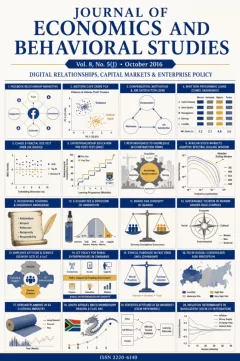 Vol. 8 No. 5(J) (2016)
Digital Relationships, Capital Markets & Enterprise Policy
View issue contents
Published
Submissions
Have research to publish? Journal of Economics and Behavioral Studies welcomes submissions.
Make a Submission