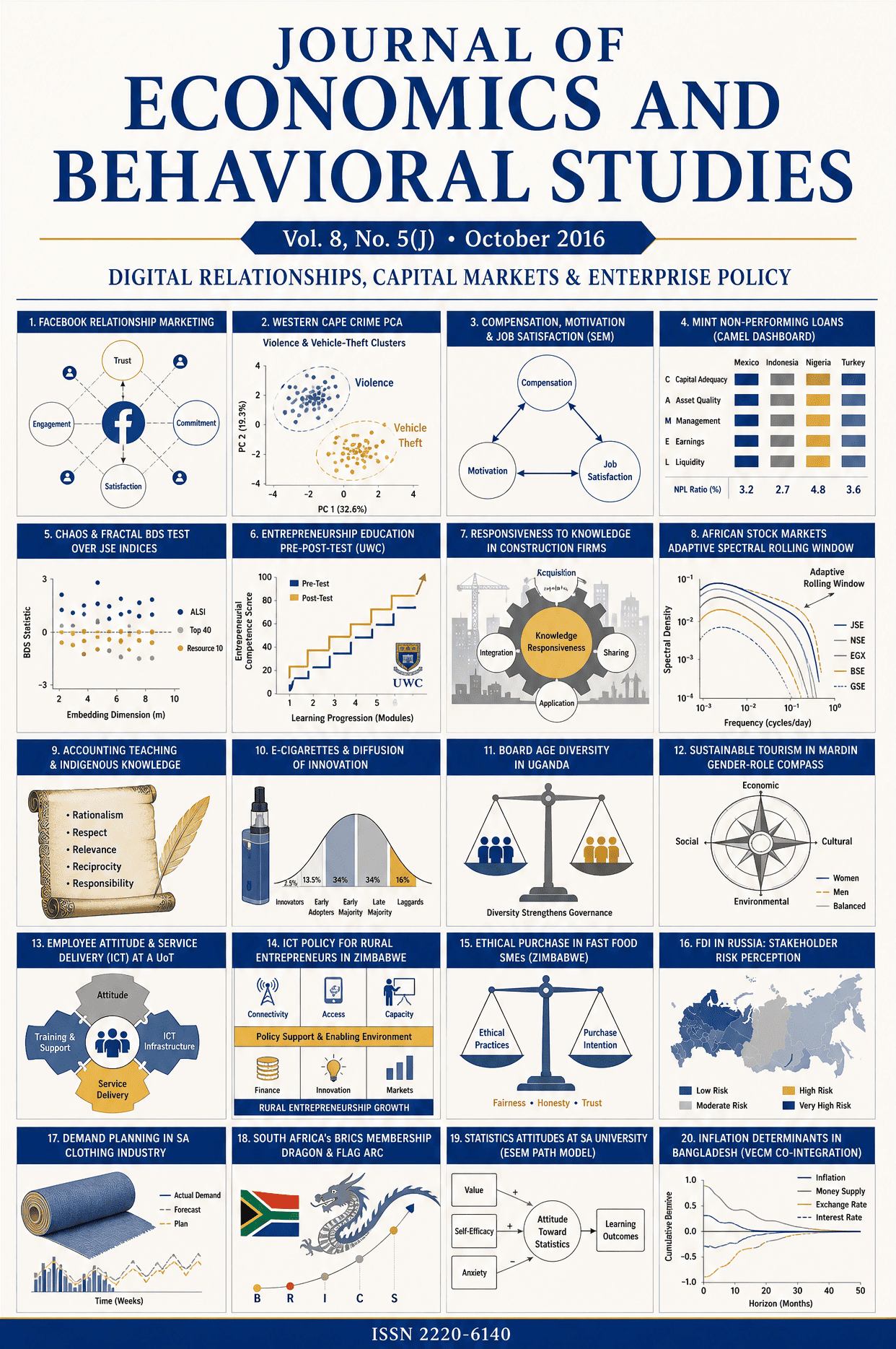
Articles 1–10 of 20

  • Article 1 in this issue

    Facebook: The Holy Grail of Relationship Marketing?

    • Author: Hilda Bongazana Dondolo

    Relationship marketing has been a focus of online studies for a number of years. These studies have indicated that relationships in these environments are driven by commitment, trust, privacy concerns and stickiness. However, research on the use of Facebook as a relationship marketing building platform has received little attention. Therefore, this paper focuses on the constructs of relationship marketing and how they impact on relationships in the Facebook context. Questionnaires were distributed to a convenience sample of 300 students. The study confirmed that the factors influencing relationships on Facebook were similar to the factors influencing relationships in other online environments. The implications of the results of the study are discussed.

    Pages 6-17

    PDF - Facebook: The Holy Grail of Relationship Marketing? (opens in a new tab)
  • Article 2 in this issue

    Different Crime Types in Western Cape Province: Principal Component Analysis

    • Author: Kyei KA, Tshisikhawe TH, Dube LM

    South Africa has a very high crime rate compared to most countries. Crime affects the society, business and psychology of the people. It compels people to move out or come into a particular area. It is most prevalent in the urban areas where poverty gap is conspicuous. Western Cape and Gauteng Provinces are the best developed provinces in the country and therefore have higher crime levels. But the question is: what types of crime are prevalent in the Western Cape Province? And what are the major causes of these crimes? The purpose of this paper is to identify the different types of crimes committed in the Western Cape Province which are prominent. Principal Component analysis (PCA) has been use in this study to gauge the patterns of crime and the distinct important factors affecting the level of crime. Secondary data from a website have been used in the analysis. The results show that violence and vehicle thefts are the most committed crimes in the province. The areas where crime occurs most frequently are Bellville, Cape Town Central, Gugulethu, Harare, Khayelisha, Mitchells Plain, Nyanga and Parow. Firearms have been identified as major means for committing crime. The paper recommends that attempts be made by the provincial government to clamp down unlicensed fire arm holders/dealers. Amnesty should be granted to encourage holders of unlicensed fire arms to surrender without punishment and the public should report to the police all those dealing in unlicensed firearms in order to root out crime in the province.

    Pages 18-26

    PDF - Different Crime Types in Western Cape Province: Principal Component Analysis (opens in a new tab)
  • Article 3 in this issue

    Structural Determinants of Job Satisfaction: The Mutual Influences of Compensation Management and Employees’ Motivation

    • Author: Abayomi Olarewaju Adeoye, Sulaiman Olusegun Atiku, Ziska Fields

    The importance of job satisfaction as an antecedent to employees’ productivity and firm outcomes cannot be overrated in the world of business, especially in the service industry. This paper adds to the understanding of job satisfaction in insurance business by investigating the structural causes of task fulfilment. The mutual influences of compensation administration and employees’ motivation on job satisfaction was assessed using multivariate analysis. This research embraced a quantitative method and 212 employees were drawn using a convenience sampling technique. Three propositions were tested employing inferential statistical analyses run through SPSS statistics version 23 and SPSS Analysis of Moment Structures (AMOS) version 23. AMOS was used to structurally determine job satisfaction through structural equation modelling (SEM). SPSS statistics version 23 was instrumental in assessing the psychometric properties via exploratory factor analysis and Cronbach’s alpha coefficients. The results indicate a substantial affiliation between reward administration and motivation. Statistically, this study found that compensation management exerts more direct influence on employees’ job satisfaction than the indirect tie through motivation. There may be a need to redesign human resource practices in the industry to improve the degree of employees’ gratification and duty fulfilment.

    Pages 27-38

    PDF - Structural Determinants of Job Satisfaction: The Mutual Influences of Compensation Management and Employees’ Motivation (opens in a new tab)
  • Article 4 in this issue

    The Determinants of Non-Performing Loans in the ‘MINT’ Economies

    • Author: Akinola Ezekiel Morakinyo, Mabutho Sibanda

    This paper investigates the major determinants of non-performing loans in the MINT (Mexico, Indonesia, Nigeria and Turkey) economies. Identifying major determinants of non-performing loans, which are observed to be growing in these countries in recent time, will also guide policy and forecasting future levels that will be useful for pre-emptive policies and actions. It uses static panel data and dynamic panel model analyses. Evidence suggests that in the four economies, capital adequacy ratio, liquidity ratio, total bank credit andreturn on assets are significant bank-specific determinants of non-performing loans. Also, while the return on assets, liquidity ratio and capital adequacy ratioshow a negative and significant relationship with non-performing loans, nominal exchange rate, money supply growth rate, total bank credit and lending rate show positive and very significant relationships with non-performing loans. Finally, corruption, an institutional variable, shows a very strong positive relationship with non-performing loans.

    Pages 39-55

    PDF - The Determinants of Non-Performing Loans in the ‘MINT’ Economies (opens in a new tab)
  • Article 5 in this issue

    Investigating Chaos on the Johannesburg Stock Exchange

    • Author: Prince Kwasi Sarpong, Mabutho Sibanda, Merle Holden

    This study investigates the existence of chaos on the Johannesburg Stock Exchange (JSE) and studies three indices namely the FTSE/JSE All Share, FTSE/JSE Top 40 and FTSE/JSE Small Cap. Building upon the Fractal Market Hypothesis to provide evidence on the behavior of returns time series of the above mentioned indices, the BDS test is applied to test for non-random chaotic dynamics and further applies the rescaled range analysis to ascertain randomness, persistence or mean reversion on the JSE. The BDS test shows that all the indices examined in this study do not exhibit randomness. The FTSE/JSE All Share Index and the FTSE/JSE Top 40 exhibit slight reversion to the mean whereas the FTSE/JSE Small Cap exhibits significant persistence and appears to be less risky relative to the FTSE/JSE All Share and FTSE/JSE Top 40contrary to the assertion that small cap indices are riskier than large cap indices.

    Pages 56-67

    PDF - Investigating Chaos on the Johannesburg Stock Exchange (opens in a new tab)
  • Article 6 in this issue

    Evidence-Based Practices of Promoting Entrepreneurship Education in Higher Education Institutions in Africa

    • Author: Fawzy Basardien, Chris Friedrich, Michael Twum-Darko

    This research applies the changing of cognitive mechanisms of University students through Entrepreneurship Education (EE). The study hypothesises that entrepreneurial orientation (achievement orientation, personal control, innovation and self-esteem) improves after completing the entrepreneurship module. The context of this research involves undergraduate commerce students from the University of the Western Cape (UWC) in South Africa. The study involves quantitative research using questionnaires through a longitudinal approach. The research design consists of a pre-test, post-test and post-test after the intervention. The impact of the training intervention was assessed over a 12 month period based on a randomised control design. This study indicates that entrepreneurial orientation was influenced through this Entrepreneurship module. The practical implications of this study emphasises the importance of training approaches that are based on empirical research. The uniqueness of this paper lies in the pedagogy used that allows the effectiveness of assessing a training program.

    Pages 68-81

    PDF - Evidence-Based Practices of Promoting Entrepreneurship Education in Higher Education Institutions in Africa (opens in a new tab)
  • Article 7 in this issue

    Responsiveness to Knowledge and Organisational Performance of Listed-Companies in the Construction Sector

    • Author: Eresia-Eke, CE, Makore, S.

    In order to improve performance, the place of tangible and intangible resources deployed in operations has become critical. However, reliance on tangible resources as the bastion of better organisational performance seems to be waning; partly due to the ease with which these are copied. This implies that reliance on intangible resources, of which knowledge is a prime component, becomes inevitable. Rather than take on the titanic knowledge management construct holistically, the interest of this study is in the sub-construct of responsiveness to knowledge (RTK) largely because of its relevance in the construction sector in South Africa where client expectations, work methods and indeed, project employees are in a constant state of flux. Empirical in nature, the study uses a census of construction companies listed on the Johannesburg stock exchange (JSE) and focussed on the issue of responsiveness to knowledge and its association with the organisational performance (OP). Quantitative data collected from employees in a crosssectional manner, were analysed. In terms of results, the study points to a positive association between RTK and OP in construction companies. Despite this finding, it would appear that companies undertake knowledge management on an ad-hoc and informal manner rather than by following a systematic process. Consequently, the study contends that attention, investment and institutionalisation of a mechanism for responding to knowledge as an integral part of the knowledge management bouquet, can enhance organisational performance.

    Pages 82-90

    PDF - Responsiveness to Knowledge and Organisational Performance of Listed-Companies in the Construction Sector (opens in a new tab)
  • Article 8 in this issue

    African Stock Markets and Return Predictability

    • Author: Gyamfi N.E, Kyei K.A, Gill R

    This article re-examines the return predictability of eight African stock markets. When returns of stocks are predictable, arbitrageurs make abnormal gains from analyzing prices. The study uses a nonparametric Generalised Spectral (GS) test in a rolling window approach. The rolling window approach tracts the periods of efficiency over time. The GS test is robust to conditional heteroscedasticity and it detects the presence of linear and nonlinear dependencies in a stationary time series. Our results support the Adaptive Market Hypothesis (AMH). This is because, indices whose returns were observed to be predictable by analyzing them in absolute form and therefore weak - form inefficient showed trends of unpredictability in a rolling window.

    Pages 91-99

    PDF - African Stock Markets and Return Predictability (opens in a new tab)
  • Article 9 in this issue

    Modeling South African Accounting Academic Staff Teaching Rationalism Factors for the Preservation of Indigenous Knowledge

    • Author: Zwelihle Wiseman Nzuza

    South African universities are under pressure to maximize the amount of accounting students, with specific reference to expand the number of qualified black African accountants, especially the Chartered Global Management Accountants (CGMA). Accountants are at the center of countries’ economy and act as lecturers in the academic institutions. Therefore, the issue of inadequate production of a new brand black qualified accountants may have something to do with accounting academic staff teaching rationalism, and this study seeks to address that subject. Literature has been used to investigate factors influencing accounting academic staff teaching rationalism and to propose a suitable model for accounting academic staff teaching rationalism factors for the preservation of South African indigenous knowledge. The proposed model forms the basis of the study results and is grounded on sound perception theories: bottom-up theory and top-down theory. The significance of a proposed model is subject to experiments by other scholars within the boundaries of the republic of South Africa or even outside.

    Pages 100-107

    PDF - Modeling South African Accounting Academic Staff Teaching Rationalism Factors for the Preservation of Indigenous Knowledge (opens in a new tab)
  • Article 10 in this issue

    Factors Affecting Consumer Resistance to Innovation Diffusion of E-Cigarettes

    • Author: Nastasje Johnson, Marike Venter

    With increasing concern over the harmful effects of smoking tobacco cigarettes, the use of alternate smoking devices such as the e-cigarette has grown. Although gaining popularity globally, consumer resistance has slowed the diffusion of e-cigarettes in emerging markets, especially in South Africa. The aim of this paper is to explore how consumer resistance affects the diffusion of e-cigarettes among university students in Johannesburg. The study predicts consumer resistance through exploring relative advantage, compatibility, complexity, trialability, observability, and perceived risk. By means of a quantitative methodology, selfadministered questionnaires were completed by 400 students from the University of the Witwatersrand. The data analysis was conducted using SPSS 22 and AMOS for structural equation modelling, which yielded results indicative of support for three of the six hypotheses proposed. This indicates that although marketers should apply relative advantage (β=0.03) and complexity (β=0.16) to marketing strategies, the focus should be on perceived risk (β=0.88) in order to increase the diffusion of e-cigarettes in the youth market. The results further provide marketing practitioners with a better understanding on how to limit consumer resistance and how to improve product diffusion of e-cigarettes. This study contributes to existing literature on innovation diffusion, and contextually to buying behaviour among the youth in South Africa. By gaining insight into this, marketers will positively influence behavioural change among smokers and so contribute to the reduction in smoking-related deaths.

    Pages 108-119

    PDF - Factors Affecting Consumer Resistance to Innovation Diffusion of E-Cigarettes (opens in a new tab)