Abstract
Much investments have been tailored towards organic farming by several stakeholders in recent years. Reasons for these are poverty mitigation, income generation as well as food security and good dietary diets. Unfortunately, there are no significant improvements in those areas where organic farming has been funded and encouraged. The study aims at identifying factors affecting the perceptions of small-scale organic farmers using ordinary least square regression model (OLS). One hundred and sixty structure questionnaires were administered on 160 small-scale organic farmers in Amathole District Municipality to gather data for the study. The results revealed that gender and educational level are the major factors affecting the perceptions of small-scale organic farmers in South Africa. Nevertheless, to open the prospective of smallscale organic farmers, the study suggested that these farmers should have greater access to extension services and support. This will go a long way in assisting the farmers to diversify and improve their production, thus enhancing livelihoods and creating markets for organic foods.
Keywords
- Food Security Search this journal for Food Security (opens in a new tab)
- Livelihood Search this journal for Livelihood (opens in a new tab)
- OLS Regression Model Search this journal for OLS Regression Model (opens in a new tab)
- Organic Farming Search this journal for Organic Farming (opens in a new tab)
- Perception Search this journal for Perception (opens in a new tab)
References
- Adesope, O. M., Matthews-Njoku, E. C., Oguzor, N. S. & Ugwuja, V. C. (2012). Effect of socio-economic characteristics of farmers on their adoption of organic farming practices. In Crop Production Technologies. InTech.
- Augustine, A. J., Jokthan, G. E., Zarafi, I. C. & Bivan, G. M. (2013). Optimizing opportunities for sustainable development through organic agriculture in Nigeria. Journal of Agriculture and Veterinary Science, 4, 07-11.
- Borges, J. A. R., Foletto, L. & Xavier, V. T. (2015). An interdisciplinary framework to study farmers’ decisions on adoption of innovation: Insights from Expected Utility Theory and Theory of Planned Behavior. African Journal of Agricultural Research, 10(29), 2814-2825.
- Codex Alimentarius Commission, & Codex Alimentarius Commission. (2010). Guidelines for the production, processing, labelling and marketing of organically produced foods. CAC/GL, 32-2010.
- Cole, M. J., Bailey, R. M. & New, M. G. (2014). Tracking sustainable development with a national barometer for South Africa using a downscaled “safe and just space” framework. Proceedings of the National Academy of Sciences, 111(42), E4399-E4408.
- Doss, C., Meinzen-Dick, R., Quisumbing, A. & Theis, S. (2017). Women in agriculture: Four myths. Global Food Security.
- Doss, C. (2014). If women hold up half the sky, how much of the world’s food do they produce? In Gender in Agriculture (pp. 69-88). Springer Netherlands.
- Fasona, M. & Ogunkunle, O. J. (2018). Some Aspects of Natural Resource Exploitation and Management in Nigeria. In Handbook of Research on Environmental Policies for Emergency Management and Public Safety (pp. 22-39). IGI Global.
- Gido, E., Lagat, J., Ithinji, G., Mutai, B., Sibiko, K. & Mwangi, J. (2013). Maize farmers’ perceptions towards Organic Soil Management Practices in Bungoma County, Kenya. Research Journal of Environmental and Earth Sciences, 5(2), 41-48.
- Gujarati, D. N. & Porter, D. C. (2011). Econometria Básica-5. AMGH Editora.
- Hardy, M. C. (2014). Resistance is not futile: It shapes insecticide discovery. Insects, 5(1), 227-242.
- Herath, C. S. & Wijekoon, R. (2013). Study on the attitude and perception towards organic cultivation in organic and non-organic coconut producers. Idesia (Arica), 31(2), 5-14.
- Kafle, B. (2011). Factors affecting adoption of organic vegetable farming in Chitwan District, Nepal. World Journal of Agricultural Sciences, 7(5), 604-606.
- Kisaka-Lwayo, M. & Obi, A. (2014). Analysis of production and consumption of organic products in South Africa.
- Madhavan, G., Oakley, B., Green, D., Koon, D. & Low, P. (Eds.). (2012). Practicing sustainability. Springer Science & Business Media.
- Moyer, J. (2013). Perspective on Rodale Institute's Farming Systems Trial. Crop Management, 12(1).
- Nhemachena, C. & Hassan, R. (2007). Micro-level analysis of farmer’s adaption to climate change in Southern Africa. Intl Food Policy Res Inst.
- Palacios-Lopez, A., Christiaensen, L. & Kilic, T. (2017). How much of the labor in African agriculture is provided by women? Food Policy, 67, 52-63.
- Pinthukas, N. (2015). Farmers’ perception and adaptation in organic vegetable production for sustainable livelihood in Chiang Mai Province. Agriculture and Agricultural Science Procedia, 5, 46-51.
- Roychowdhury, R., Banerjee, U., Sofkova, S. & Tah, J. (2013). Organic farming for crop improvement and sustainable agriculture in the era of climate change. Online Journal of Biological Sciences, 13(2), 50-65.
- Safa, M. S. (2005). Socio-Economic factors affecting the income of small-scale agroforestry farms in hill country areas in Yemen: A comparison of OLS and WLS determinants. Small-Scale Forestry, 4(1), 117-134.
- Treadwell, D., Riddle, J., Barbercheck, M., Cavanaugh-Grant, D. & Zaborski, E. (2010). What is organic farming? Unpublished manuscript, Cooperative Extension System, University of Massachusetts, Amherst, MA. Online. http://www. extension. org/article/18655.
- Van Driesche, R. & Hoddle, M. (2009). Control of pests and weeds by natural enemies: an introduction to biological control. John Wiley & Sons.
- Yadav, S. K., SubhashBabu, M. K. Yadav, K. S., Yadav, G. S. & Suresh, P. (2013). A review of organic farming for sustainable agriculture in Northern India. International Journal of Agronomy, 2(2).
Downloads
No downloads have been recorded for this article yet. Figures appear here once readers begin downloading the full text.
How to Cite
Share this article
License
Copyright (c) 2018 Gabriel Adewunmi Eyinade, Celestine Ohi Akharume (Author)

This work is licensed under a Creative Commons Attribution 4.0 International License.
Author (s) should affirm that the material has not been published previously. It has not been submitted and it is not under consideration by any other journal. At the same time author (s) need to execute a publication permission agreement to assume the responsibility of the submitted content and any omissions and errors therein. After submission of revised paper in the light of suggestions of the reviewers, the editorial team edits and formats manuscripts to bring uniformity and standardization in published material.
This work will be licensed under Creative Commons Attribution 4.0 International (CC BY 4.0) and under condition of the license, users are free to read, copy, remix, transform, redistribute, download, print, search or link to the full texts of articles and even build upon their work as long as they credit the author for the original work. Moreover, as per journal policy author (s) hold and retain copyrights without any restrictions.
Keywords
- Food Security Search this journal for Food Security (opens in a new tab)
- Livelihood Search this journal for Livelihood (opens in a new tab)
- OLS Regression Model Search this journal for OLS Regression Model (opens in a new tab)
- Organic Farming Search this journal for Organic Farming (opens in a new tab)
- Perception Search this journal for Perception (opens in a new tab)
Section
Published in
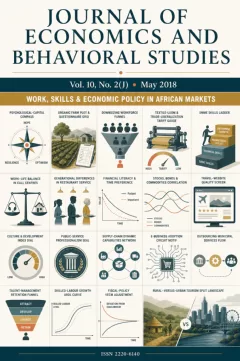 Vol. 10 No. 2(J) (2018)
Work, Skills & Economic Policy in African Markets
View issue contents
Published
Submissions
Have research to publish? Journal of Economics and Behavioral Studies welcomes submissions.
Make a Submission