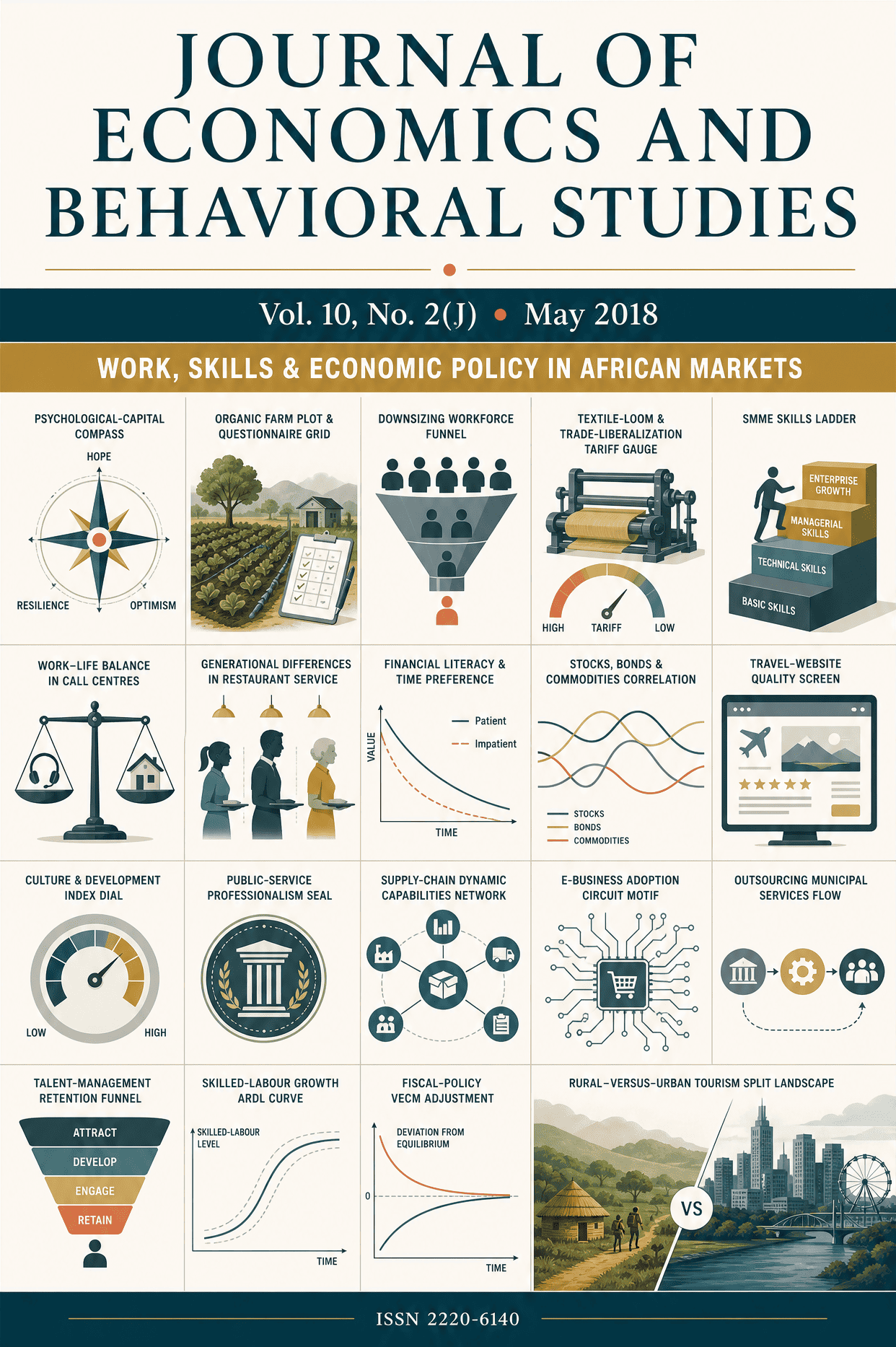
Articles 1–10 of 22

  • Article 1 in this issue

    Role of Psychological Capital in Effective Management of Work-stress among Tertiary Institutions’ Staff in Nigeria

    • Author: John K. Aderibigbe, Themba Q. Mjoli, Kolawole S. Adebisi

    Work-stress is synonymous to occupational stress. It is a common form of strain that is usually experienced by employees, in the course of performing their official duties and responsibilities. In the contemporary world of work, including the Nigerian work environment, work-stress is identified as a ‘corporate epidemic’. Its symptoms are mostly observed physically, psychologically and socially in the lives of affected employees, while the negative effect of occupational stress is specifically, measured on employee performance and organizational effectiveness. It is for the above-described nature and effect of work-stress that this study examined the role of psychological capital in effective management of work-stress among the staff of tertiary institutions in Nigeria. It adopted the explanatory survey research design, purposive and convenience sampling techniques in sampling a total number of 202 (male = 116, 57.4% and female = 86, 42.6%) academic and administrative staff of five (5) public and private tertiary institutions, in the western region of Nigeria, who served as participants in the study. All participants were Nigerians English speakers. Research participation eligibility was strictly based on the current enlistment of employees on the pay-roll of the institutions as at the time of the study. A structured validated questionnaire was used as an instrument. Hypotheses were stated and analyzed based on the data collected. Results revealed that the four psychological capital states jointly influenced work-stress management F(4,197) = 8.375; R2 = 0.128; p<.05; resilience (β=0.145; t=1.983; p<.05) and optimism (β=0.294; t=3.756; p<.05) independently influenced workstress management; optimism (r=.224, P(.001)<.01), resilience (r=.350, P(.000)<.01) and hope (r=.247,P(.000)<.01) significantly correlated with work-stress management. The study concluded that psychological capital is one of the important factors that effectively helps in managing work-stress, and suggested that the management of institutions or organizations should sensitize employees on the importance of psychological capital in effective management of work-stress through seminars, trainings and conferences.

    Pages 6-13

    PDF - Role of Psychological Capital in Effective Management of Work-stress among Tertiary Institutions’ Staff in Nigeria (opens in a new tab)
  • Article 2 in this issue

    Factors Affecting the Perceptions of Small-Scale Organic Farmers in South Africa: An OLS Approach

    • Author: Gabriel Adewunmi Eyinade, Celestine Ohi Akharume

    Much investments have been tailored towards organic farming by several stakeholders in recent years. Reasons for these are poverty mitigation, income generation as well as food security and good dietary diets. Unfortunately, there are no significant improvements in those areas where organic farming has been funded and encouraged. The study aims at identifying factors affecting the perceptions of small-scale organic farmers using ordinary least square regression model (OLS). One hundred and sixty structure questionnaires were administered on 160 small-scale organic farmers in Amathole District Municipality to gather data for the study. The results revealed that gender and educational level are the major factors affecting the perceptions of small-scale organic farmers in South Africa. Nevertheless, to open the prospective of smallscale organic farmers, the study suggested that these farmers should have greater access to extension services and support. This will go a long way in assisting the farmers to diversify and improve their production, thus enhancing livelihoods and creating markets for organic foods.

    Pages 14-19

    PDF - Factors Affecting the Perceptions of Small-Scale Organic Farmers in South Africa: An OLS Approach (opens in a new tab)
  • Article 3 in this issue

    The Impact of Labour Force Reduction on the Financial Performance of Manufacturing Companies

    • Author: Wadesango N, Gwangwadza D. C, Mhaka C, Wadesango V. O

    This study attempts to corroborate the impact of labour force reduction on financial performance of manufacturing companies in a developing country. Despite the on-going use of labour force reduction, literature and research on this approach continues to yield mixed results. This desktop research was therefore conducted with the aim of determining the impact of employing labour force reduction initiatives on financial performance of manufacturing companies. The study reviews the results and findings of empirical and qualitative literature on labour force reduction by previous scholars for a period of 6 years ranging from 2012 to 2017. The phenomenon of labour force reduction has facilitated the research and studies on the area in the past six years, with researchers reaching different conclusions on the practise’s effect on organisations. This has prompted the researchers of this study to critically study labour force reduction methods, factors affecting their success, employees’ reaction to the strategy, the practise effect on productivity and the relationship between labour force reduction and organisation performance.

    Pages 20-32

    PDF - The Impact of Labour Force Reduction on the Financial Performance of Manufacturing Companies (opens in a new tab)
  • Article 4 in this issue

    Trade Liberalization and Performance of the Nigerian Textile Industry

    • Author: Florence Oluremi Okeowo, Rafiu Adewale Aregbeshola

    Nigeria textile industry is characterized by questionable incentives, political uncertainty, acute power shortage, poor infrastructure, smuggling and red-tape bureaucracy, among others. The study modified the endogenous growth model within a time series (1986 and 2015) estimation techniques of Autoregressive Distributed Lagged model (ARDL). Findings revealed that the effect of simple tariff rate on textile industry is negative and statistically significant in the long-run; while trade liberalization policy measure through simple tariff rate has a lag effect before it can be effective in the textile industry. In both short and long run, real effective exchange rate depreciation worsens the performance of the textile industry in Nigeria. In the long run, a 1.0% rise in trade openness would decrease the level of textile industry performance by about 17.49%, while factor affecting textile industry performance in the short run are simple tariff rate, financial development, exchange rate changes, trade openness and labor and capital inputs respectively. The study concluded that Trade liberalization has a lag effect on textile industry performance and a significant effect on the performance of the Nigerian textile industry. It is therefore recommended that government should make concerted efforts toward providing a favorable business environment, reducing inflation and improve the infrastructural facilities for the textile industry to strive.

    Pages 33-47

    PDF - Trade Liberalization and Performance of the Nigerian Textile Industry (opens in a new tab)
  • Article 5 in this issue

    The Role of Basic Business Skills Development and Their Influence on South African Small, Medium and Micro Enterprise Sustainability

    • Author: Juan-Pierré Bruwer, Judith Smith

    South African Small, Medium and Micro Enterprises (SMMEs) have received vast amounts of attention from both government and scholars over the years, mainly due to the socio-economic value they add to the national economy. Notwithstanding the importance of these business entities to the South African economy, prior research suggests that South African SMMEs have one of the worst sustainability rates in the world; mainly attributable to the influence of unmanaged economic factors. Included in these economic factors is the matter of a scarcity of skills, particularly that of basic business skills. Though limited research has been conducted on the individual business skills which require development in South African SMMEs the perception was formulated that the development of basic business skills in these business entities may have a positive influence on their attainment of key businesses objectives in the foreseeable future. As such, empirical research was performed which fell within the positivistic research paradigm; data were gleaned from South African SMME management through means of a questionnaire. Stemming from the results, it was found that although there is a dire need for the development of basic business skills in South African SMMEs. It can be argued that some basic business skills were more important to develop than others as only a few had a positive influence on the attainment of business objectives.

    Pages 48-62

    PDF - The Role of Basic Business Skills Development and Their Influence on South African Small, Medium and Micro Enterprise Sustainability (opens in a new tab)
  • Article 6 in this issue

    The Moderating Effect of Work-Life Balance on Job Satisfaction

    • Author: Simone Gounder, Patsy Govender

    In emerging cultures, job satisfaction and work-life balance are ongoing factors in gaining the ultimate competitive advantage for organizations. Work-life balance is a core ingredient for job satisfaction and for quality work performance, and employees need to have a sense of commitment to their jobs. The study attempts to determinethe extent to which work-life balance has a moderating effect onjob satisfaction in a call centre organization. The approach for the study was quantitative, and a self-developed questionnaire was the research instrument. The sample was107 employees and, both descriptive and inferential statistics were utilized. A probability random sampling technique was chosen. As evidenced in the study, room for improvement was required with both job satisfaction and work-life balance and; the validity and reliability for the study were high. The hypothesis for the study was partially accepted. In addition to a significant relationshipthat exists between the main constructs, work-life balance does have a moderating effect onjob satisfaction. The results and recommendations provide anecdotal evidence to call centre managers and policy makers to reach new levels of operations in order to meet their strategic intent and goal attainment.

    Pages 63-73

    PDF - The Moderating Effect of Work-Life Balance on Job Satisfaction (opens in a new tab)
  • Article 7 in this issue

    Work-Family Stressors and Work-Family Satisfaction: Effect of Sense of Coherence at a Metropolitan Municipality

    • Author: Ethel N. Abe, Isaac I. Abe, Ziska Fields, Ganiyu O. Idris

    This article contributes to emergent research by examining the linkage between work–family stressors and their effect on work-family satisfaction (WFS) at a metropolitan municipality in South Africa. Extant literature on stress has either not adequately examined the linkage between domain specific stressors and domain specific satisfaction or have suggested models with direct connections. The present study suggests a mediating model and assesses the mediation. Specifically, it claims that sense of coherence (SOC) plays a mediating part in the in the work and family stressors - WFS relationship. This mixed methods research applied a variance-based structural equation modelling (Partial Least Squares) to a sample of 307 professional level employees at a metropolitan municipality in South Africa. The finding supports the importance of SOC and its influence on WFS. Additionally, mediation hypotheses theorise how SOC plays a critical mediating influence in the work-family stressor-WFS relationship. Data analysis suggest that (a) work stressors and WFS interrelated in a manner that SOC fully mediated the effect of work stressors on WFS (b) SOC partially mediated the relationship between family stressors and WFS. The findings have both theoretical and practical implications.

    Pages 74-88

    PDF - Work-Family Stressors and Work-Family Satisfaction: Effect of Sense of Coherence at a Metropolitan Municipality (opens in a new tab)
  • Article 8 in this issue

    Perceptions of Different Generations Regarding Managerial Competencies in Restaurants

    • Author: Carina Kleynhans, Malome Prince Shai, Antoinette Roeloffze

    Managerial competencies of restaurant managers play a major role in motivating employees to be productive and to provide excellent service which, in turn, will lead to customer satisfaction. Drawing upon generational differences in work ethics and values, the authors examine the importance of managerial competencies in three age cohorts. A quantitative research design was selected using a structured questionnaire consisting of five competency domains. Data were collected from 180 restaurant managers and employees in restaurants in the City of Tshwane. The results of the Fisher exact test indicated that the importance of managerial competencies differed significantly in the three age groups. Significant differences existed for three leadership domains, two management domains, one interpersonal and one intrapersonal domain. No significant differences were recorded for the perceptions of the different age groups regarding the importance of the technical domain. For the younger generation, the ability to grant employees the opportunity to grow was regarded as highly important by all respondents. The ability to maintain discipline in the workforce was perceived as less important by the youngest age group when it was compared to the other age groups. The youngest employees felt that the ability to be innovative was not as important unlike the perception of the older age groups. The findings of this study could lead restaurant managers to a better understanding of the different generational groups, how to motivate them thereby ensuring job satisfaction and service quality.

    Pages 89-102

    PDF - Perceptions of Different Generations Regarding Managerial Competencies in Restaurants (opens in a new tab)
  • Article 9 in this issue

    Incentivized Time Preferences, Level of Education in a Household and Financial Literacy: Laboratory Evidence

    • Author: Calvin Mudzingiri, John W. Muteba Mwamba, Jacobus Nicolaas Keyser

    This study investigates the impact of financial literacy, level of education in a household and gender differences on time preferences of students at a university in South Africa. The study relies on a convenient sample of (N=85, female=48%) pursuing a financial literacy course. The study uses a questionnaire, a financial literacy test and a simple binary choice experimental game that elicited individual time discount rate to gather data. Ten percent of the participants were paid (in South African rands) for their time preference choices by way of quota random sampling. Female university students’ individual time discount rate was found to be on average higher than that of their male counterparts, indicating that female university students are generally impatient, especially those with low levels of financial literacy. Our results (using a Negative Binomial Regression analysis and Ordinary Least Squares regression analysis) show that time preferences of university students aresignificantly influenced by highest level of education in the household. The OLS regression model shows that financial literacy, measured using financial literacy test, significantly influence time preferences for all subjects. The study concluded that patience levels among male university students increase as financial literacy increases. Gender, income, age and family size significantly influence time preferences of university students. Highest level of education in a household, financial literacy and gender differences have a bearing on individual time preferences.

    Pages 103-119

    PDF - Incentivized Time Preferences, Level of Education in a Household and Financial Literacy: Laboratory Evidence (opens in a new tab)
  • Article 10 in this issue

    Does Liquidity Risk Explain the Time-Variation in Asset Correlations? Evidence from Stocks, Bonds and Commodities

    • Author: Zintle Twala, Riza Demirer, Rangan Gupta

    The time-variation in asset correlations have broad implications in asset pricing, portfolio management and hedging. Numerous studies in the literature have found that the change in correlations is mainly related to the magnitude of market movements, hence volatility. However, recent research finds that the size of markets fluctuations is not necessarily the primary driver for the time-variation in correlations, but that the effect of market movements is amplified in times of high financial distress, characterised by low liquidity. This paper seeks to investigate the effect of liquidity on time-varying correlations among different asset classes, namely stocks, corporate bonds and commodities. Our findings show that liquidity indeed has a significant effect on the time-variation in asset correlations, particularly in the case of how bond returns comove with other asset classes. We observe that higher liquidity risk is associated with lower correlation of bond returns with stocks as well as commodities. Our findings suggest that measures of liquidity risk can improve models of correlations; and potentially help improve the effectiveness of risk management strategies during periods of financial distress. JEL Codes: C22, G10.

    Pages 120-132

    PDF - Does Liquidity Risk Explain the Time-Variation in Asset Correlations? Evidence from Stocks, Bonds and Commodities (opens in a new tab)