Abstract
Different external interventions prompt people to perceive different motivation which in turn causes different reactions. In our study, we propose that under different circumstances, the degree of the “reciprocal altruism heuristic” varies. This paper is aiming at carrying out an ultimatum game under two scenarios and compares the results to demonstrate the effect of different external interventions on the tendency of reciprocal altruism. All 10 participants in the experiment, as a result, have shown different inclination under the implementation of various external interventions, which strongly suggests the existence of determinants that control the inclination of mutual cooperation and the provide insights for future psychological and educational related research to develop a more advanced system of human cognitive models under external interferences.
Keywords
- Reciprocal Altruism Search this journal for Reciprocal Altruism (opens in a new tab)
- Ultimatum Search this journal for Ultimatum (opens in a new tab)
- Heuristic Search this journal for Heuristic (opens in a new tab)
- External Intervention Search this journal for External Intervention (opens in a new tab)
References
- Axelrod, R. (1984). The evolution of cooperation. New York: Basic Books.
- Camerer, C. (2003). Behavioral Game Theory: Experiments in Strategic Interactions. Princeton: Princeton University Press.
- Chitiyo, M. & Wheeler, J. J. (2009). Analyzing a treatment efficiency of a technical assistance model for providing behavioral consultation to schools. Preventing Social Failure, 53, 85-88.
- Conroy, M. A., Sutherland, K. S., Snyder, A., Al-Hendawi, M. & Vo, A. (2009). Creating a positive classroom atmosphere: Teachers’ use of effective praise and feedback. Beyond Behavior, 18-26.
- Cooley, C. H. (1902). Human Nature and the Social Order. New York: Charles Scribner’s Sons.
- Cosmides, L. (1989). The logic of social exchange: has natural selection shaped how human reason? Studies with the Wason selection task. Cognition, 31, 187-276.
- Cosmides, L. & Tooby, J. (1989). Evolutionary psychology and the generation of culture: Part II. A computational theory of social exchange. Ethnology and Sociobiology, 10, 51-97.
- Diedrich, J. L. (2010). Motivating Students Using Positive Reinforcement. Education and Human Development Master’s Theses, 9.
- Fehr, E. & Gächter, S. (2002). Altruistic punishment in humans. Nature, International journal of science.
- Güth, W. R. S. (1982). An Experimental Analysis of Ultimatum Bargaining. Journal of Economic Behavior and Organization, 3(1982), 367-388.
- Haldane, J. B. S. (1955). Population Genetics. New Biology, 18, 34-51.
- Kiyonari, T., Tanida, S. & Yamagashi, T. (2000). Social exchange and reciprocity: confusion of a heuristic? Evolution and Human Behavior, 21(2000), 411-427.
- Kollock, P. (1997). Transforming social dilemmas: group identity and cooperation. In: P. Danielson (Ed.). Modeling Rational and Moral agents (pp. 186-210). Oxford: Oxford Univ. Press.
- Miltenberger, R. G. (2008). Behavior Modification: Principles and procedures (4th ed,). Belmont: Thomson Wadsworth.
- Poling, A., Austin, J., Snycerski, S. & Laraway, S. (2002). Negative Punishment. Encyclopedia of Psychotherapy, 2.
- Poling, A., Ehrhardt, K. E. & Ervin, R. A. (2002). Positive Punishment. Encyclopedia of Psychology, 2.
- Pruitt, D. G. & Kimmel, M. J. (1977). Twenty years of experimental gaming: critique, synthesis, and suggestions for the future. Annual Review of Psychology, 28, 363-392.
- Roth, Alvin E., Vesna, P., Masahiro, O. F. & Shmuel, Z. (1991). Bargaining and Market Behavior in Jerusalem, Ljubljana, Pittsburgh, and Tokyo: An Experimental Study. American Economic Review 81, 5(1991), 1068-1095.
- Tauber, R. T. (1988). Overcoming Misunderstanding about the Concept of Negative Reinforcement. Teaching of Psychology.
Downloads
No downloads have been recorded for this article yet. Figures appear here once readers begin downloading the full text.
How to Cite
Share this article
License
Copyright (c) 2019 Yutong Zhang, Huannan Huang (Author)

This work is licensed under a Creative Commons Attribution 4.0 International License.
Author (s) should affirm that the material has not been published previously. It has not been submitted and it is not under consideration by any other journal. At the same time author (s) need to execute a publication permission agreement to assume the responsibility of the submitted content and any omissions and errors therein. After submission of revised paper in the light of suggestions of the reviewers, the editorial team edits and formats manuscripts to bring uniformity and standardization in published material.
This work will be licensed under Creative Commons Attribution 4.0 International (CC BY 4.0) and under condition of the license, users are free to read, copy, remix, transform, redistribute, download, print, search or link to the full texts of articles and even build upon their work as long as they credit the author for the original work. Moreover, as per journal policy author (s) hold and retain copyrights without any restrictions.
Keywords
- Reciprocal Altruism Search this journal for Reciprocal Altruism (opens in a new tab)
- Ultimatum Search this journal for Ultimatum (opens in a new tab)
- Heuristic Search this journal for Heuristic (opens in a new tab)
- External Intervention Search this journal for External Intervention (opens in a new tab)
Section
Published in
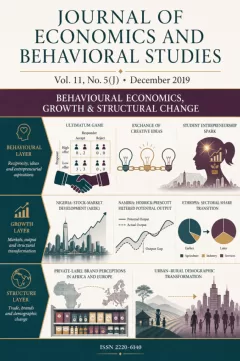 Vol. 11 No. 5(J) (2019)
Behavioural Economics, Growth & Structural Change
View issue contents
Published
Submissions
Have research to publish? Journal of Economics and Behavioral Studies welcomes submissions.
Make a Submission