Articles

  • Article 1 in this issue

    Social Preferences in Behavioral Economics: The Study of Reciprocal Altruism under Different Conditions

    • Author: Yutong Zhang, Huannan Huang

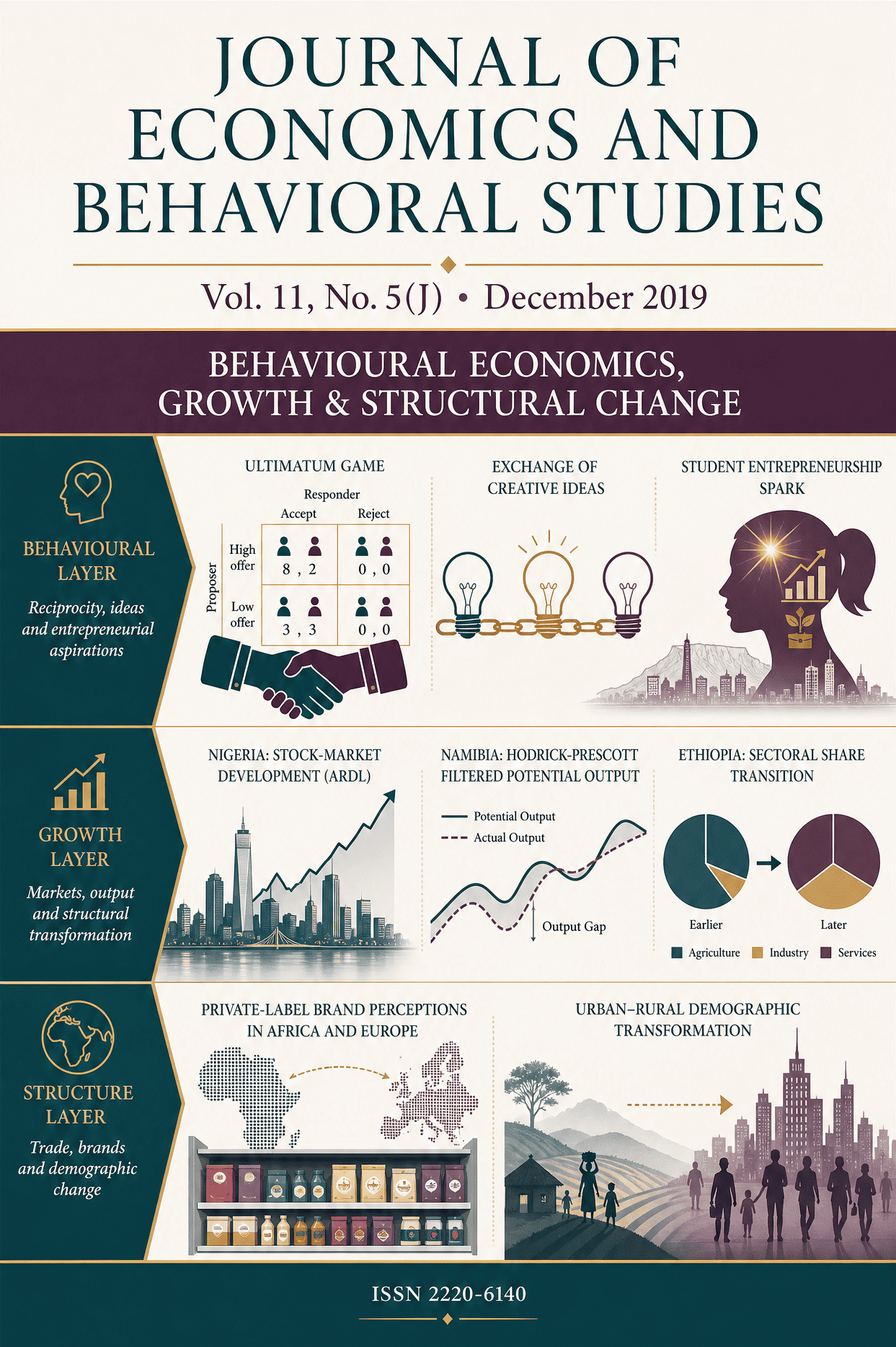
    Different external interventions prompt people to perceive different motivation which in turn causes different reactions. In our study, we propose that under different circumstances, the degree of the “reciprocal altruism heuristic” varies. This paper is aiming at carrying out an ultimatum game under two scenarios and compares the results to demonstrate the effect of different external interventions on the tendency of reciprocal altruism. All 10 participants in the experiment, as a result, have shown different inclination under the implementation of various external interventions, which strongly suggests the existence of determinants that control the inclination of mutual cooperation and the provide insights for future psychological and educational related research to develop a more advanced system of human cognitive models under external interferences.

    Pages 1-10

    PDF - Social Preferences in Behavioral Economics: The Study of Reciprocal Altruism under Different Conditions (opens in a new tab)
  • Article 2 in this issue

    Perceptions of University Students on Entrepreneurship; A South African Case Study

    • Author: Harris Maduku, Makhosazana Faith Vezi-Magigaba

    South Africa currently suffers from high levels of poverty, inequality and unemployment. However, the involvement of citizens in entrepreneurship is still very low for the country to rely on entrepreneurship as a solution to curb its socio-economic crisis. Survival rates of established businesses have also proved to be worrisome in the country with lack of skills cited as one of the most contributing factors. The country is in need of more entrepreneurs with better skills and understanding of business as that can facilitate job creation, poverty alleviation and economic growth. The objective of this paper is to analyse how University students perceive entrepreneurship in South Africa. Using random sampling, the study used a structured questionnaire to gather data from University of Zululand students. Employing the probit logistic regression technique on 152 observations, the study finds Age, family business background, business course and entrepreneurial interest statistically significant on influencing perceptions of students towards entrepreneurship. The study recommends that the South African Universities’ curricular be revised so as to start equipping all registered students with entrepreneurship skills as this impact on their perceptions to starting their own businesses after graduation. Also Universities should start acting as innovation and entrepreneurial hubs for both their students and the business community.

    Pages 11-19

    PDF - Perceptions of University Students on Entrepreneurship; A South African Case Study (opens in a new tab)
  • Article 3 in this issue

    Creative Production and Exchange of Ideas

    • Author: Iryna Sikora

    This paper explores the relationship between individual creative productivity and learning about ideas of others. I report evidence from a two-stage real-effort lab experiment, in which subjects perform ideageneration tasks. In the first stage some subjects observe creative output of other players, while the others not. This design makes possible to assess whether learning ideas of others is an important input for idea generation and quantify its importance. In the second stage, I make ideas costly and study the subjects’ willingness to pay for them. I compare the costs of ideas to the expected monetary benefits from increased creative productivity and characterize investment behavior of the subjects. The results show that observing output of others boosts productivity in creative tasks, but only when it shows truly new, previously unknown by the subject items. When ideas of others become costly, I find that the subjects do not act in a profitmaximizing way. To minimize the costs they choose to see the ideas of less creative players, which usually do not contribute many original items. As a result, the participants get less than optimum benefits. This effect is more pronounced for subjects of lower creative ability, more risk-averse or self-confident participants and females. In aggregate, such behavior does not lead to the highest possible level of creative production. These findings make an argument for policies that encourage exchange of information at a workplace (e.g. teamwork, workshops) and at the same time show the need for oversight, central planning of collaborative activities or other actions that may help to creative professionals to invest efficiently, when access to ideas of others is costly.

    Pages 20-44

    PDF - Creative Production and Exchange of Ideas (opens in a new tab)
  • Article 4 in this issue

    Long and Short Run Relationship between Stock Market Development and Economic Growth in Nigeria

    • Author: Anthony Olugbenga Adaramola, Modupe F. Popoola

    We examined the long and short run association subsisting between stock market development (market capitalisation, value of transactions, number of deal and all share index), and Nigerian economic growth (RGDP) with quarterly data from 1986 to 2017. The Autoregressive Distributed Lag (ARDL) model is applied for the purpose of estimation. The ARDL bound test result revealed that all the indicators of market development exert positive effect on the RGDP in the short run. Further, all the indicators except number of deals, have direct and significant relationship with economic growth. Moreover, we find that market development causes economic growth. Consequently, we recommend a need for the implementation of policies and procedures capable of enhancing investors’ confidence and boosting market because of their perceived multiplier impacts on economic growth. Effort should also be focused on the enhancement of stock market size which in turn will provide the needed fund for investment and thus resulting in rise in the RGDP.

    Pages 45-53

    PDF - Long and Short Run Relationship between Stock Market Development and Economic Growth in Nigeria (opens in a new tab)
  • Article 5 in this issue

    Does the Declining Share of Agricultural Output in GDP Indicate Structural Transformation? The Case of Ethiopia

    • Author: Adisu Abebaw Degu, Admassu Tesso Huluka

    It is not uncommon that different government officials and practitioners infer the falling agricultural share in GDP to the underpinning of structural transformation in an economy. By using various studies result and a time series of data spanning from 1981 up to 2017, this paper investigated, whether the declining share of agricultural output in GDP is indicating structural transformation or not in Ethiopian economy. The study showed that the service is the fastest-growing sector in Ethiopia, and it covers more than 40% of GDP. The share of agriculture sector was 45% of GDP until 2011, while the industry sector has been stagnating. Thus, it shows how the falling share of the agriculture sector in GDP is being superseded by the service sector. Empirical works also reveal that even though the share of the agricultural sector in GDP is falling, it is the primary source for the overall economic growth of Ethiopia. The share of the rural population has decreased from 89 percent in 1981 to 80% in the year 2017. So the vast population of the country is living in rural areas where agricultural-based activities are common. Lack of labor shift from the agricultural sector to the industrial sector can also be attributed to the insufficient expansion of the modern industrial sector to absorb the growing force labor. Furth more, the demographic transition also showed a relative decline. Since structural transformation involves several interrelated processes, the declining share of agriculture output to GDP alone cannot explain the prevalence of structural change; the other processes like; industrialization, urbanization, and demographic transition need to be scrutinized.

    Pages 54-68

    PDF - Does the Declining Share of Agricultural Output in GDP Indicate Structural Transformation? The Case of Ethiopia (opens in a new tab)
  • Article 6 in this issue

    The Output Gap and Potential Output in Namibia

    • Author: Emmanuel Ziramba, Bernie Zaaruka, Johanna Mumangeni, Charlotte Tjeriko, Jaungura Kaune

    The study analysed the behaviour of potential output and output gap for the Namibian economy using annual data from 1980 to 2016. The study employed the Hodrick-Prescott (HP) filter method and the production function approaches to estimate potential output before calculating the output gap. The results suggest an annual average growth rate of 3.6 percent in potential output. However, it has been noted that the average annual growth rate in potential output has been shifting during the period under review. In fact, the results suggest an annual average growth rate of 1.6 percent between 1980 and 1985 and an increase to 2.5 percent per year for the period 1986 to 1990. Potential output estimates obtained using the production function approach was smooth and stable throughout the study period. The potential output estimates obtained through the two methods follow the same cyclical movements. The output gap estimates from the two techniques are not different from each other, and they appear to move together.

    Pages 69-75

    PDF - The Output Gap and Potential Output in Namibia (opens in a new tab)
  • Article 7 in this issue

    Prevailing Perceptions and the Growth of Private Label Brands in Africa and Europe: An Overview

    • Author: Sbonelo Ndlovu

    This paper reviewed the existing literature in different parts of the continents, focusing specifically in Africa and Europe, critically reviewing past and recent literature of studies on customers’ perceptions towards private label brands. Such review article enabled the writer to understand the prevailing state of private label brands across different continents; in the process enabling grocery retailers, marketing practitioners and academics a clear view of the state of customers’ perceptions around the globe. The results found that the international state of private label brands has somehow improved in some parts of the globe, especially in Europe and Americas, where private label brands have enormously improved customers perceptions of their private label brands and in the process actively competing with national brands for the market share. Opposing such success, In Africa there seems to be somehow lack of improvement in the early perceptions of private label brands in the process not fully challenging national brands. Noticeably, in Africa there seems customers still perceive private label brands as alternatives of national brands in tough economic conditions. Hence, grocery retailers need to extensively invest on their private label brands in order to competitively challenge and change existing customer perceptions. Key investments should be in branding, promoting and educating customers about private label brands.

    Pages 76-83

    PDF - Prevailing Perceptions and the Growth of Private Label Brands in Africa and Europe: An Overview (opens in a new tab)