Abstract
This paper explores the relationship between individual creative productivity and learning about ideas of others. I report evidence from a two-stage real-effort lab experiment, in which subjects perform ideageneration tasks. In the first stage some subjects observe creative output of other players, while the others not. This design makes possible to assess whether learning ideas of others is an important input for idea generation and quantify its importance. In the second stage, I make ideas costly and study the subjects’ willingness to pay for them. I compare the costs of ideas to the expected monetary benefits from increased creative productivity and characterize investment behavior of the subjects. The results show that observing output of others boosts productivity in creative tasks, but only when it shows truly new, previously unknown by the subject items. When ideas of others become costly, I find that the subjects do not act in a profitmaximizing way. To minimize the costs they choose to see the ideas of less creative players, which usually do not contribute many original items. As a result, the participants get less than optimum benefits. This effect is more pronounced for subjects of lower creative ability, more risk-averse or self-confident participants and females. In aggregate, such behavior does not lead to the highest possible level of creative production. These findings make an argument for policies that encourage exchange of information at a workplace (e.g. teamwork, workshops) and at the same time show the need for oversight, central planning of collaborative activities or other actions that may help to creative professionals to invest efficiently, when access to ideas of others is costly.
Keywords
References
- Anderson, A. & Cabral, L. (2007). Go for broke or play it safe? Dynamic competition with choice of variance. RAND Journal of Economics, 38(3), 593–609.
- Amabile, T. (1996). Creativity in context, Update to The Social Psychology of Creativity. (Westview Press, Ed.) New York.
- Ariely, D., Gneezy, U., Loewenstein, G. & Mazar, N. (2009). Large Stakes and Big Mistakes. Review of Economic Studies, 76, 451–469.
- Bala, V. & Goyal, S. (2000). A Noncooperative Model of Network Formation. Econometrica, 68(5), 1181-1229.
- Berninghaus, S. K., Ehrhart, K. M. & Ott, M. (2006). A Network Experiment in Continuous Time: The Influence of Link Costs. Experimental Economic, 9, 237-251.
- Bradler, C., Neckermann, S. & Warnke, A. J. (2019). Incentivizing Creativity: A Large-Scale Experiment with Performance Bonuses and Gifts. Journal of Labor Economics, 37(3), 793-851.
- Burt, R. S. (2004). Structural Holes and Good Ideas. American Journal of Sociology, 110(2), 349-399.
- Byron, K. & Khazanchi, S. (2012). Rewards and creative performance: A meta-analytic test of theoretically derived hypotheses. Psychological Bulletin, 138(4), 809–830.
- Cabral, L. (2003). R&D Competition When Firms Choose Variance. Journal of Economics & Management Strategy, 12(1), 139–150.
- Callander, S. & Plott, C. R. (2005). Principles of Network Development and Evolution: An Experimental Study. Journal of Public Economics, 89, 1469-1465.
- Charness, G. & Grieco, D. (2019). Creativity and Incentives. Journal of the European Economic Association, 17(2), 454-496.
- Charness, G., Corominas-Bosch, M. & Frechette, G. R. (2007). Bargaining and Network Structure: An experiment. Journal of Economic Theory, 136, 28-65.
- Christensen, P. R., Guilford, J. P. & Wilson, R. C. (1957). Relations of Creative Responses to Working Time and Instructions. Journal of Experimental Psychology, 53(2), 82-88.
- Collins, M. A. & Amabile, T. M. (1999). Motivation and Creativity. In R. J. Sternberg (Ed.), Handbook of Creativity (pp. 297–312). Cambridge, England: Cambridge University Press.
- Conte, A., Schweizer, P., Dierx, A. & Ilzkovitz, F. (2009). An Analysis of the Efficiency of Public Spending and National Policies in the Area of R&D. European Economy Occasional Papers.
- Corbae, D. & Duffy, J. (2008). Experiments with Network Formation. Games and Economic Behavior, 64, 81-120.
- Cross, R., Hargadon, A., Parise, S. & Thomas, R. (2008). Critical Connections: Driving Innovation With A Network Perspective. Sloan Management Review and Wall Street Journal Weekend Edition.
- Ductor, L., Fafchamps, M., Goyal, S. & van der Leij, M. (2014). Social networks and research output. Review of Economics and Statistics.
- Dugosh, K. L., Paulus, P. B., Roland, E. J. & Yang, H. C. (2000). Cognitive Stimulation in Brainstorming. Journal of Personality and Social Psychology, 79, 722-735.
- Eisenberg, R. & Rhoades, L. (2001). Incremental effects of Reward on Creativity. Journal of Personality and Social Psychology, 81, 728-741.
- Fischbacher, U. (2007). z-Tree: Zurich Toolbox for Ready-made Economic Experiments. Experimental Economics, 10(2), 171-178.
- Galenson, D. (2004). A Portrait of the Artist as a Very Young or Very Old Innovator: Creativity at the Extremes of the Life Cycle. NBER Working Paper No. 10213.
- Galeotti, A., Goyal, S. & Kamphorst, J. (2006). Network Formation with Heterogeneous Players. Games and Economic Behavior, 54, 353-372.
- Gneezy, U. & Rustichini, A. (2000). Pay Enough or Don’t Pay at All. Quarterly Journal of Economics, 115, 791–810.
- Goyal, S., van der Leij, M. J. & Moraga-Gonzalez, J. L. (2006). Economics: An emerging small world. Journal of Political Economy, 114(2), 403-412.
- Goeree, J. K., Riedl, A. & Ule, A. (2009). In Search of Stars: Network Formation among Heteroheneous Agents. Games and Economic Behavior, 67, 445-466.
- Gross, D. P. (2018). Creativity Under Fire: The Effects of Competition on Creative Production. SSRN 2520123.
- Guilford, J. P. (1950). Creativity. American Psychologist, 5, 444–454.
- Guilford, J. P. (1967). The Nature of Human Intelligence. New York: McGraw-Hill.
- Hey, J. D. & Orme, C. (1994). Investigating Generalizations of Expected Utility Theory Using Experimental Data. Econometrica, 62(6), 1291-1326.
- Heckman, J. (1979). Sample selection bias as a specification error. Econometrica, 47(1), 153-161.
- Hennessey, B. A. & Amabile, T. M. (1998). Reward, Intrinsic Motivation, and Creativity. American Psychologist, 53, 674–675.
- Hoelzl, E. & Rustichini, A. (2005). Overconfident: Do You Put Money On It? The Economic Journal, 115, 305–318.
- Kachelmeier, S. J., Reichert, B. E. & Williamson, M. G. (2008). Measuring and Motivating Quantity, Creativity, or Both. Journal of Accounting Research, 46.
- Kahneman, D. (2011). Thinking, Fast and Slow. New York: Farrar, Straus and Giroux.
- Kim, K. (2006). Can we trust creativity tests? A review of the Torrance Tests of Creative Thinking (TTCT). Creativity Research Journal, 18(1), 3-14.
- Kohn, A. (1993). Punished by Rewards. Boston: Houghton Mifflin.
- Manski, C. F. (1993). Identification of endogenous social effects: The reflection problem. Review of Economic Studies, 60(3), 531–542.
- Meusburger, P. (2009). Milieus of Creativity: The Role of Places, Environments and Spatial Contexts. In P. Meusburger, J. Funke, & E. Wunder (Eds.), Milieus of Creativity: An Interdisciplinary Approach to Spatiality of Creativity. Springer.
- Moffitt, R. A. (2001). Policy interventions, low-level equilibria, and social inter-actions. In S. Durlauf, & P. Young (Eds.), Social Dynamics. Cambridge, MA: MIT Press.
- Mumford, M. D. (2003). Where have we been, where are we going? Taking stock in creativity research. Creativity Research Journal, 15, 107–120.
- Nickerson, R. S. (1999). Enhancing Creativity. In Handbook of Creativity.
- Nielsen, B. D. & Simonton, D. K. (2008). Conceptual versus Experimental Creativity: Which Works Best on Convergent and Divergent Thinking Tasks? Psychology of Aesthetics, Creativity, and the Arts, 2, 131–138.
- Nijstad, B. A. & Stroebe, W. (2006). How the Group Affects the Mind: A Cognitive Model of Idea Generation in Groups. Personality and Social Psychology Review, 10(3), 186-213.
- Nijstad, B. A., Stroebe, W. & Lodewijkx, H. F. (2002). Cognitive Stimulation and Inference in Groups: Exposure Effects in an Idea Generation Task. Journal of Experimental Social Psychology, 38, 535-544.
- Paulus, P. B. & Yang, H. C. (2000). Idea Generation in Groups: A Basis for Creativity in Organizations. Organizational Behavior and Human Decision Process, 82, 76-87.
- Runco, M. A. (2006). Creativity: Theories and Themes: Research, Development, and Practice. San Diego: Academic Press.
- Runco, M. A. (2007). Correcting the Research on Creativity. Creativity Research Journal, 17, 321–327.
- Rutstrom, E. E. & Williams, M. B. (2000). Entitlements and Fairness: An Experimental Study of Distributive Preferences. Journal of Economic Behavior & Organization, 43, 75–89.
- Shalley, C. & Perry-Smith, J. (2001). Effects of social-psychological factors on creative performance: The role of informational and controlling expected evaluation and modeling experience. Organizational Behavior and Human Decision Processes, 84, 1-22.
- Stanovich, K. & West, R. (2000). Individual Difference in Reasoning: Implications for the Rationality Debate? Behavioural and Brain Sciences, 23, 645–726.
- Stein, M. I. (1974). Stimulating Creativity. New York: Academic Press.
- Sternberg, R. J. (2006). The Nature of Creativity. Creativity Research Journal, 18(1), 87-98.
- Stroebe, W. & Diehl, M. (1994). Why Groups Are Less Effective than Their Members: On Productivity Losses in Idea-Generating Groups. European Review of Social Psycholigy, 5, 271-303.
- Torrance, E. P. (1974). Torrance Tests of Creative Thinking. Scholastic Testing Service, Inc.
- Treffinger, D. J., Isaksen, S. G. & Dorval, K. B. (2006). Creative Problem Solving: An Introduction. Waco, TX: Prufrock.
- Woodman, R. W., Sawyer, J. I. & Griffin, R. W. (1993). Toward a Theory of Organizational Creativity. Academy of Management Review, 18, 293–321.
Downloads
No downloads have been recorded for this article yet. Figures appear here once readers begin downloading the full text.
How to Cite
Share this article
License
Copyright (c) 2019 Iryna Sikora (Author)

This work is licensed under a Creative Commons Attribution 4.0 International License.
Author (s) should affirm that the material has not been published previously. It has not been submitted and it is not under consideration by any other journal. At the same time author (s) need to execute a publication permission agreement to assume the responsibility of the submitted content and any omissions and errors therein. After submission of revised paper in the light of suggestions of the reviewers, the editorial team edits and formats manuscripts to bring uniformity and standardization in published material.
This work will be licensed under Creative Commons Attribution 4.0 International (CC BY 4.0) and under condition of the license, users are free to read, copy, remix, transform, redistribute, download, print, search or link to the full texts of articles and even build upon their work as long as they credit the author for the original work. Moreover, as per journal policy author (s) hold and retain copyrights without any restrictions.
Keywords
Section
Published in
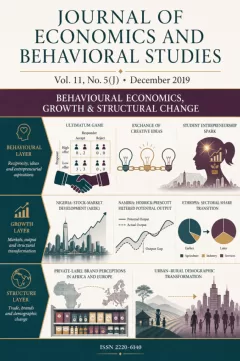 Vol. 11 No. 5(J) (2019)
Behavioural Economics, Growth & Structural Change
View issue contents
Published
Submissions
Have research to publish? Journal of Economics and Behavioral Studies welcomes submissions.
Make a Submission