Abstract
We examined the long and short run association subsisting between stock market development (market capitalisation, value of transactions, number of deal and all share index), and Nigerian economic growth (RGDP) with quarterly data from 1986 to 2017. The Autoregressive Distributed Lag (ARDL) model is applied for the purpose of estimation. The ARDL bound test result revealed that all the indicators of market development exert positive effect on the RGDP in the short run. Further, all the indicators except number of deals, have direct and significant relationship with economic growth. Moreover, we find that market development causes economic growth. Consequently, we recommend a need for the implementation of policies and procedures capable of enhancing investors’ confidence and boosting market because of their perceived multiplier impacts on economic growth. Effort should also be focused on the enhancement of stock market size which in turn will provide the needed fund for investment and thus resulting in rise in the RGDP.
Keywords
References
- Abbas, I. O., Pei, Y. X. & Rui, Z. (2016). Impact of Stock Market on Economic Growth Evidence: Dar-es Salaam Stock Exchange –Tanzania. J Fin Acc, 4, 321-327.
- Adamu, J. A. & Sanni, I. (2005). Stock Market Development and Nigerian Economic Growth. Journal of Economic and Allied Fields, 2(2), 116-132.
- Adeusi, S. O., Suliaman, L. A. & Azeez, B. A. (2013). Impact of Capital Market Development on the Nigerian Economy: A Post–SAP Analysis. Journal of Economics and Behavioural Studies, 5(1), 1-7.
- Agu, B. O. (2018). Economic Growth and Capital Market Development in Nigeria an Appraisal. Journal of Business Management and Economic Research, 2(4), 27-38.
- Al-Faki, M. (2006). The Nigerian Capital Market and Socio-economic Development: A Paper Presented at the 4th distinguished Faculty of Social Science, Public Lectures, University of Benin, Nigeria.
- Almahmoud, A. I. (2014). Country Risk Ratings and Stock Market Movements: Evidence from Emerging Economy. International Journal of Economics and Finance, 6(10), 88-96.
- Anne, C. M. & Kevin, O. O. (2013). Financial Market Structure and Economic Growth: Evidence from Nigeria Data. Asian Economic and Financial Review, 3(1), 75-98.
- Araoye, F. E., Ajayi, E. O. & Aruwaji, A. M. (2018). The Impact of Stock Market Development on Economic Growth in Nigeria. Journal of Business and African Economy, 4(1), 1-15.
- Arunma, O. (2010). Testimony on the Global Financial Crisis and Financial Reform in Nigeria: A Capital Market Perspective: A Paper Presented before the United States House of Representatives Committee on Financial Services Sub-Committee on International Monetary Policy and trade, Tuesday, November 16. Available online http://www.e3journals.org.
- Azeez, B. A. & Obalade, A. A. (2019). Macroeconomic Determinants of Stock Market Development in Nigeria: (1981-2017). ACTA UNIVERSITATIS DANUBIUS, 15(1), 203-216.
- Bouzid, A. (2012). McKinnon’s Complementarity Hypothesis: Empirical evidence for the Arab Maghrebean Countries. Romanian Economic Journal, 15(44), 23-36.
- Cameron, Rondo, et al. (1967). Banking in the Early Stages of Industrialization. Oxford University Press.
- Dike, C. (2016). Stock Market Efficiency Promotes Economic Development: Empirical Evidence from Africa. International Journal of Economics and Financial Issues, 6(3), 1287-1298.
- Ewah, S. O., Esang, A. E. & Bassey, J. U. (2009). Appraisal of Capital Market Efficiency on Economic Growth in Nigeria. International Journal of Business and management, 4(12), 219-228.
- Ezeoha, A., Ebele, O. & Okereke, O. (2009). Stock Market Development and Private Investment Growth in Nigeria. Journal of Sustainable Development Africa, 11, 20-35.
- Fama, E. F. (2005). Random Walk in Stock Market Prices. Journal of Financial Analysis, 16(3), 21-27.
- Isu, O. H. & Okpara, C. (2013). Does Financial Deepening follow Supply Leading or Demand Following Hypothesis? A look at Nigerian Evidence. Journal of Financial Accounting, 6(1), 26-34.
- Japelli, T. & Pagano, M. (1994). Saving, Growth and Liquidity Constraints. Quarterly Journal of Economics, 109(1), 83-109.
- Jhingan, M. L. (2004). The Economic of Development and Planning. New Delhi, Vrinda Publications Limited.
- Josiah, M., Samson, A. A. & Akpeti, O. E. (2012). Capital Market as a Veritable Source of Development in Nigeria Economy. Journal of Accounting and Taxation, 4(1), 7-18.
- Kolapo, F. T. & Adaramola, A. O. (2012). The Impact of Capital Market on Economic Growth. Int. J. Dev Societies, 1, 11-19.
- Mbat, D. O. (2001). Financial Management. Domes Associates Publishers. Uyo, Nigeria First Edition.
- McKinnon, R. (1973). Money and Capital in Economic Development. Washington, D.C.: Brookings Institution.
- Njiforti, P. (2015). Impact of the 2007/2008 Global Financial Crisis on the Stock Market in Nigeria. CBN Journal of Applied Statistics, 6(1), 49-68.
- Obalade, A. A. & Obisesan, O. G. (2015). Relative Potency of Internal and External Sources of Financing Nigerian Economic Growth: 1983-2012. IOSR Journal of Economics and Finance, 6(3), 39-47.
- Ogochukwu & Raifu (2017). Stock Market Development and Economic Growth: Evidence from Africa. EuroAsian Journal of Economics and Finance, 5(1), 23-22.
- Ogunleye, E. O. & Adeyemi, P. A. (2015). The Impact of Stock Market Development on Economic Growth in Nigeria. Journal of Economics and Sustainable Development, 6(23), 21-28.
- Oke, M. O. (2013). Capital Market Operation and Economic Growth in Nigeria (1985-2011). International Journal of Business and Social Studies, 4(7), 166-172.
- Okonkwo, I. V., Ananwude, A. & Echekoba, F. N. (2015). Nigeria Stock Market Development and Economic Growth: A Time Series Analysis (1993 – 2013). Sch. J. Econ Bus Manag, 2(3), 280-293.
- Okoye, L. U., Modebe, N. J., Taiwo, J. N. & Okorie, U. E. (2016). Impact of Capital Market Development on the Growth of the Nigerian Economy. Research Journal of Financial Sustainability Reporting, 1(1), 24-32.
- Olokoyo, F. O. & Ogunnaike, O. O. (2011). An Empirical Analysis of the effect of Stock Market Crisis on Economic Growth: The Nigerian Case. ACTA Universitatis Danubius, 7(4), 172-186.
- Oluwatosin, E. O., Adekanye, T. & Yusuf, S. A. (2013). Empirical Analysis of the Impact of Capital Market Efficiency on Economic Growth and Development in Nigeria. International Journal of Academic Research in Economics and Management Sciences, 2(6), 44-53.
- Osakwe, C. I. & Ananwunde, A. (2017). Stock Market Development and Economic Growth: A Comparative Evidence from two Emerging Economies in Africa – Nigeria and South Africa. Archives of Current Research International, 11(1), 1-15.
- Ananwude, A. C. & Osakwe, C. I. (2017). Stock Market Development and Economic Growth in Nigeria: A Camaraderie Reconnaissance. Research Journal of Economics, 1(3), 1-6.
- Osaseri, G. & Osamwonyi, I. O. (2019). Impact of Stock Market Development on Economic Growth in BRICS. International Journal of Financial Research, 10(1), 23-30.
- Osundina, A. J. & Osundina, K. C. (2016). Stock Market Development and Welfare in Nigeria: A VECM Approach. Research Journal of Finance and Accounting, 7(16), 145-150.
- Ozurumba, B. A. & Chigbu, E. E. (2013). An econometric analysis of capital market performance and economic growth of Nigeria. Interdisciplinary Journal of Contemporary Research in Business, 4(10), 165-170.
- Patrick, H. T. (1966). Financial Development and Economic Growth in Underdeveloped Countries. Economic Development and Cultural Change, 14, 174-189.
- Pesaran, M. H., Shin, Y. & Smith, R. (2001). Bound Testing Approaches to the Analysis Level Relationships. Journal of Applied Econometrics, 16, 289-326.
- Pesaran, M. & Pesaran, B. (1999). An Autoregressive Distributed Lag modelling approach to co-integration Analysis. In S. Storm (Ed.), Econometrics and Economic Theory in the 20th Century: The Ragnar Frish Centennial Symposium, Cambridge University Press, Cambridge.
- Raymond, N. (2013). Relationship between Stock Market Development and Economic Growth in Kenya. School of Business, University of Nairobi.
- Rayyanu, A. K. (2015). Financial Liberalisation and Economic Growth in Nigeria. An Empirical Analysis. IOSR Journal of Economics and Finance, 6(3), 15-24.
- Sanusi, S. (2010). Global Financial meltdown and the Reforms in the Nigerian Banking Sector. Paper Retrieved from http://www.cenbank.org/out/speechless/2010/govATBU%20convocation%20lecture.pdf.
- Sanusi, S. L. (2012). Banking reform in Nigeria and its impact on the economy. Abuja: Central Bank of Nigeria.
- Taiwo, J. N., Alaka, A. & Afieroho, E. (2016). Capital Market and Economic Growth in Nigeria. Account and Financial Management Journal, 1(8), 497-525.
- Tari, M. K. & Oliver, E. O. (2017). Financial Deepening and Economic Growth Nexus in Nigeria: Supply-Leading or Demand-Following? Economics, 5(4), 1-18.
- Tsaurai, K. (2016). The Nexus between Stock Market Development and economic growth. Corporate Ownership & Control, 14(1), 276-277.
- Veronika, K. & Petr, R. (2016). Stock Market Development and Economic Growth: Evidence from the European Union. Acta Universitatis Agriculturae et Silviculturae Mendelianae Brunensis, 64(6), 1927-1936.
Downloads
No downloads have been recorded for this article yet. Figures appear here once readers begin downloading the full text.
How to Cite
Share this article
License
Copyright (c) 2019 Anthony Olugbenga Adaramola, Modupe F. Popoola (Author)

This work is licensed under a Creative Commons Attribution 4.0 International License.
Author (s) should affirm that the material has not been published previously. It has not been submitted and it is not under consideration by any other journal. At the same time author (s) need to execute a publication permission agreement to assume the responsibility of the submitted content and any omissions and errors therein. After submission of revised paper in the light of suggestions of the reviewers, the editorial team edits and formats manuscripts to bring uniformity and standardization in published material.
This work will be licensed under Creative Commons Attribution 4.0 International (CC BY 4.0) and under condition of the license, users are free to read, copy, remix, transform, redistribute, download, print, search or link to the full texts of articles and even build upon their work as long as they credit the author for the original work. Moreover, as per journal policy author (s) hold and retain copyrights without any restrictions.
Keywords
Section
Published in
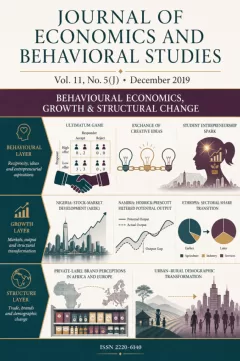 Vol. 11 No. 5(J) (2019)
Behavioural Economics, Growth & Structural Change
View issue contents
Published
Submissions
Have research to publish? Journal of Economics and Behavioral Studies welcomes submissions.
Make a Submission