Abstract
The study analysed the behaviour of potential output and output gap for the Namibian economy using annual data from 1980 to 2016. The study employed the Hodrick-Prescott (HP) filter method and the production function approaches to estimate potential output before calculating the output gap. The results suggest an annual average growth rate of 3.6 percent in potential output. However, it has been noted that the average annual growth rate in potential output has been shifting during the period under review. In fact, the results suggest an annual average growth rate of 1.6 percent between 1980 and 1985 and an increase to 2.5 percent per year for the period 1986 to 1990. Potential output estimates obtained using the production function approach was smooth and stable throughout the study period. The potential output estimates obtained through the two methods follow the same cyclical movements. The output gap estimates from the two techniques are not different from each other, and they appear to move together.
Keywords
References
- Alkhareif, R. M. & Alsadoun, N. A. (2016). Estimating the Output Gap for Saudi Arabia. WP/16/1.
- Claus, I. (2000). Is the output gap a useful indicator of inflation? Reserve Bank of New Zealand.
- De Brouwer, G. (1998). Estimating output gaps. Reserve Bank of Australia: Research Discussion Papers rdp9809.
- De Masi, P. R. (1997). IMF Estimates of Potential Output: Theory and Practice. International Monteray Fund: WP/97/177.
- Eita, J. H. & Ashipala, J. M. (2010). Determinants of Unemployment in Namibia. International Journal of Business and Management, 92-104.
- Fedderke, J. W. & Mengisteab, D. K. (2016). Estimating South Africa's Output Gap Potential Growth Rate. Economic Research Southern Africa, Working Paper 585.
- Harvey, A. C. & Jaeger, A. (1993). Detrending, Stylized Facts and the Business Cycle. Journal of Applied Econometrics, 8, 231-247.
- Huang, Y. & Luo, S. (2017). Potential output and inflation dynamics after the great recession. Empir Econ, 495-517.
- Jemec, N. (2012). Output Gap in Slovenia what can we learm from different methods? Banka Slovenije.
- Jovicic, G. (2017). Estimating Potential Growth and Output Gap in Croatia. Croatian National Bank.
- Kanyenze, G. & Lapeyre. (2012). Growth, employment and decent work in Namibia: A situation analysis. International Labout Organization.
- Kasabov, D., Kotseva, P., Vassilev, A. & Yanchev, M. (2017). Relationship between inflation, potential output and structural unemployment in Bulgaria. Bulgarian National Bank .
- Kloudova, D. (2015). Estimating output gap and potential output for Russia and its usefulness by forecasting inflation. International Journal of Economics, 45-59.
- Namibia Statistics Agency. (2017). Namibia Labour Force Survey 2016 Report. Windhoek: Namibia Statistics Agency.
- Njuguna, A. E., Karingi, S. N. & Kimenyi, M. S. (2005). Measuring Potential Output and Output Gap and Macroeconomic Policy: The Case of Kenya. University of Connecticut, Economics Working papers.
- Podpiera, J., Raei, F. & Stepanyan, A. (2017). A Fresh Look at Potential Output in Central, Eastern, and Southeastern European Countries. IMF Working paper.
- Shahin, H. (2010). Estimation of Egypt's potential output and output gap. Euroindicators working papers, European Union.
Downloads
No downloads have been recorded for this article yet. Figures appear here once readers begin downloading the full text.
How to Cite
Share this article
License
Copyright (c) 2019 Emmanuel Ziramba, Bernie Zaaruka, Johanna Mumangeni, Charlotte Tjeriko, Jaungura Kaune (Author)

This work is licensed under a Creative Commons Attribution 4.0 International License.
Author (s) should affirm that the material has not been published previously. It has not been submitted and it is not under consideration by any other journal. At the same time author (s) need to execute a publication permission agreement to assume the responsibility of the submitted content and any omissions and errors therein. After submission of revised paper in the light of suggestions of the reviewers, the editorial team edits and formats manuscripts to bring uniformity and standardization in published material.
This work will be licensed under Creative Commons Attribution 4.0 International (CC BY 4.0) and under condition of the license, users are free to read, copy, remix, transform, redistribute, download, print, search or link to the full texts of articles and even build upon their work as long as they credit the author for the original work. Moreover, as per journal policy author (s) hold and retain copyrights without any restrictions.
Keywords
Section
Published in
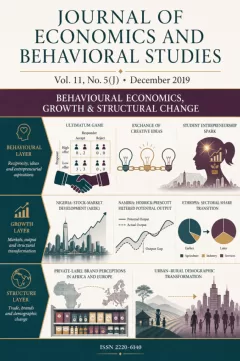 Vol. 11 No. 5(J) (2019)
Behavioural Economics, Growth & Structural Change
View issue contents
Published
Submissions
Have research to publish? Journal of Economics and Behavioral Studies welcomes submissions.
Make a Submission