Abstract
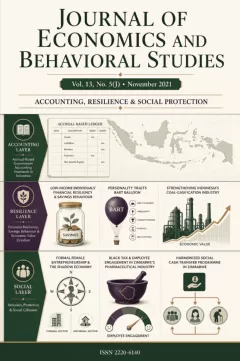
Employees in the Pharmaceutical industry are coming late to work and knocking off early. These actions unveiled by the employees are likely to incur economic costs on the employer, occasioned by low employee productivity. Owners of production have expressed concern over the general low staff morale in the pharmaceutical sector. While most studies have concentrated on internal job-related factors as drivers of employee engagement, this study seeks to assess employee engagement as being influenced by black tax, an external factor. The main aim of the research was to establish the influence of black tax on employee engagement, being mediated by idiocentrism-allocentrism, particularly focussing on the pharmaceutical manufacturing and retailing industry in Bulawayo, Zimbabwe. The study employed the philosophical approach of pragmatism to guide the whole research. The researcher adopted a multi-stage sampling technique supported by the census technique to pick participants from the population. Closed and openended questionnaires were used to collect data from qualified pharmacists who are working in both the manufacturing and retailing industry in Bulawayo. Statistical Package for Social Sciences v23 (Process v3.5 by Andrew F. Hayes) was used to test the hypothesised relationship among variables. Qualitative data were analysed using thematic analysis. The results suggest that black tax directly influence employee engagement in the presence of a mediator (idiocentrism-allocentrism). Furthermore, the results indicate that the indirect coefficient was partially significant, which means that idiocentrism-allocentrism has a partial influence on employee engagement. The researchers recommend that management should ensure that employees are motivated all the time. They should implement an open-door policy so that employees can share their issues that affect their engagement level at work.
Keywords
- Black Tax Search this journal for Black Tax (opens in a new tab)
- Employee Engagement Search this journal for Employee Engagement (opens in a new tab)
- Idiocentrism-Allocentrism Search this journal for Idiocentrism-Allocentrism (opens in a new tab)
- Social Exchange Search this journal for Social Exchange (opens in a new tab)
- Behavioural Search this journal for Behavioural (opens in a new tab)
References
- Andriani, L. (2013). SS-A Road Map of Theoretical Frameworks and Empirical Limitations.pdf. January, 1–26.
- Azeem, M. F., Paracha, A. T., Akbar, A. & Kamili, S. (2010). Training Delivery and Methodology in Banks: An Empirical Study. ASBM Journal of Management , III(1&2), 64–77.
- Balaji, R. (2007). Issues and Challenges Faced By HR Managers in Employee Engagement in IT Sectors. International Journal of Innovative Research in Science, Engineering and Technology (An ISO Certified Organization) , 3(6), 13114–13116.
- Breevaart, K., Bakker, A. B., Demerouti, E. & Hetland, J. (2012). The Measurement of state work engagement: A multilevel factor analytic study. European Journal of Psychological Assessment , 28(4), 305–312.
- Bryman, A. & Bell, E. (2007). Business Research Method.
- Coyle-Shapiro, J. A. M. & Diehl, M. R. (2018). Social Exchange Theory. The Routledge Companion to Trust, May, 197–217.
- De Waal, J. J. & Pienaar, J. (2013). Towards understanding causality between work engagement and psychological capital. SA Journal of Industrial Psychology , 39(2), 1–10.
- Drake, T. J. (2012). Assessing Employee Engagement: a Comparison of the Job Engagement Scale and the Utrecht Work Engagement Scale.
- Edmore, M. (2011). Literature Review on Small and Medium Enterprises’ access to credit and support in South Africa. National Credit Regulator, 1–92.
- Gabel-Shemueli, R., Westman, M., Chen, S. & Bahamonde, D. (2019). Does cultural intelligence increase work engagement? The role of idiocentrism-allocentrism and organizational culture in MNCs. CrossCultural & Strategic Management.
- Habimana, T. (2013). Data Collection Instruments (Questionnaire & Interview). Training in Sexual and Reproductive Health Research Geneva, 1(Geneva Workshop 2013), 18
- Johnson, J. A. (2016). T he Perilous Voyage of Indian Himalayan ‘ Ambassadors ’ Amidst Anthropogenic Pressures , 33(1), 2014–2017.
- Knight, R. & A. (2009). A study of employee engagement at Topaz‟s South Dublin Region Service Stations. Journal of Workplace Learning , 12(1), 103–110.
- Maag, J. W. (2014). Persistent issues in behavioural theory and practice. The SAGE Handbook of Special Education: 2(Second), 281–298.
- Magubane, N. N. (2016). Black tax : The emerging middle-class reality. November, 1–64.
- Mhlungu, G. (2015). Black tax is not real | City Press. https://city-press.news24.com/Voices/Black-tax-is-notreal-20150508
- Montshiwa, V. T. & Moroke, N. D. (2014). Assessment of the Reliability and Validity of Student-Lecturer Evaluation Questionnaire: A Case of North-West University. Mediterranean Journal of Social Sciences , 5(14), 352–364.
- OKOYE, Lawrence Uchenna MODEBE, Nwanneka J. ACHUGAMONU, Uzoma ISIOR, A. (2016). Performance in Nigeria , 5(0), 79–81.
- Ongel, E. (2010). The relationship between employee engagement and organisational performance: Implementations of organisations. The International Journal of Social Sciences , 25(1), 1–10.
- Ratlebjane. (2015). Black Tax And Saving.
- Singh, A. S. & Masuku, M. B. (2014). King of charcoal: Japanese create a new life for dying industry. International Journal of Economics, Commerce and Management , 2(11), 1–22.
- Singh, S. (2018). The Impact of employee engagement on organisational performance – a case of an Insurance Brokerage company in Gauteng , 20(6), 66–76.
- Tanto, H. W., Lambey, L. & Pandowo, M. (2017). Analysing the relation between employee engagement and employee performance, at the hotel Gran PuriI Manado Menganalisa Hubungan Antara Keterikatan Karywan Dan Performa , 5(3), 3654–3663.
- Thygesen, L. C. & Ersbøll, A. K. (2014). When the entire population is the sample: Strengths and limitations in register-based epidemiology. European Journal of Epidemiology , 29(8), 551–558.
- Tran. (2018). Employee engagement: How does the organisation increase engagement? From the view-point of HR representatives in Finland: Accessed at http://www.doria.fi/handle/10024/152929 on 21/10/2020 at 13:00 Hours.
- Truss, C. (2013). What is engagement? Employee Engagement in Theory and Practice, 15–35.
- Zainol, S. S. B., Hussin, S., Binti, M. & Othman, M. S. (2016). Determinants of Employee Engagement in Hotel Industry in Malaysia. A Theoretical Model. International Journal of Academic Research in Accounting, Finance and Management Sciences , 6(3), 1–9.
Downloads
No downloads have been recorded for this article yet. Figures appear here once readers begin downloading the full text.
How to Cite
Share this article
License
Copyright (c) 2021 Vakira, E., Nikisi, D., Ndlovu, N., Shumba, V., Ncube, C. M., Mpofu, B. D. (Author)

This work is licensed under a Creative Commons Attribution 4.0 International License.
Author (s) should affirm that the material has not been published previously. It has not been submitted and it is not under consideration by any other journal. At the same time author (s) need to execute a publication permission agreement to assume the responsibility of the submitted content and any omissions and errors therein. After submission of revised paper in the light of suggestions of the reviewers, the editorial team edits and formats manuscripts to bring uniformity and standardization in published material.
This work will be licensed under Creative Commons Attribution 4.0 International (CC BY 4.0) and under condition of the license, users are free to read, copy, remix, transform, redistribute, download, print, search or link to the full texts of articles and even build upon their work as long as they credit the author for the original work. Moreover, as per journal policy author (s) hold and retain copyrights without any restrictions.
Keywords
- Black Tax Search this journal for Black Tax (opens in a new tab)
- Employee Engagement Search this journal for Employee Engagement (opens in a new tab)
- Idiocentrism-Allocentrism Search this journal for Idiocentrism-Allocentrism (opens in a new tab)
- Social Exchange Search this journal for Social Exchange (opens in a new tab)
- Behavioural Search this journal for Behavioural (opens in a new tab)
Section
Published
Submissions
Have research to publish? Journal of Economics and Behavioral Studies welcomes submissions.
Make a Submission