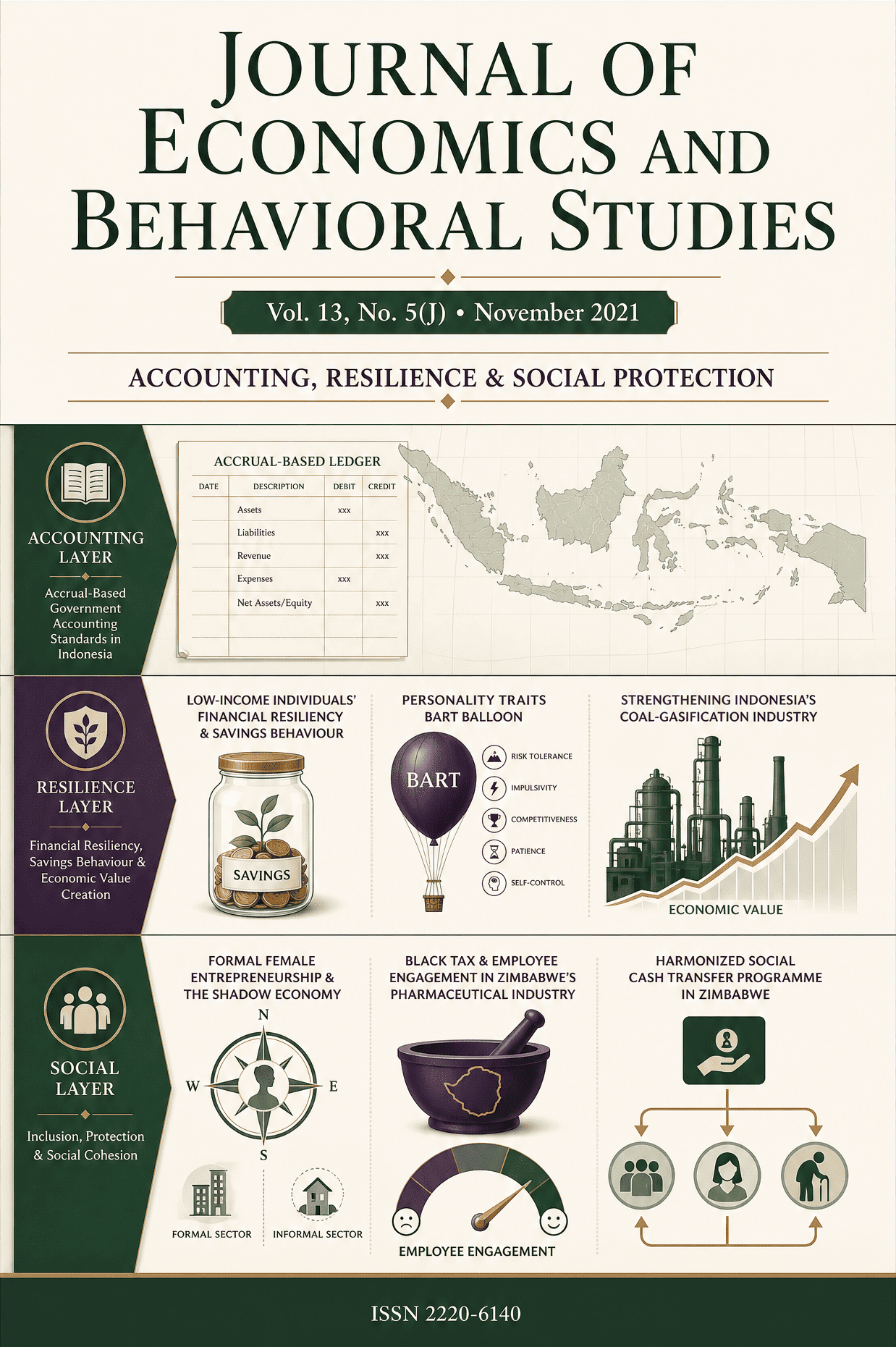
Articles

  • Article 1 in this issue

    The Effect of Black Tax on Employee Engagement: The Mediating Role of Idiocentrism-Allocentrism-A Case of Pharmaceutical Industry in Zimbabwe

    • Author: Vakira, E., Nikisi, D., Ndlovu, N., Shumba, V., Ncube, C. M., Mpofu, B. D.

    Employees in the Pharmaceutical industry are coming late to work and knocking off early. These actions unveiled by the employees are likely to incur economic costs on the employer, occasioned by low employee productivity. Owners of production have expressed concern over the general low staff morale in the pharmaceutical sector. While most studies have concentrated on internal job-related factors as drivers of employee engagement, this study seeks to assess employee engagement as being influenced by black tax, an external factor. The main aim of the research was to establish the influence of black tax on employee engagement, being mediated by idiocentrism-allocentrism, particularly focussing on the pharmaceutical manufacturing and retailing industry in Bulawayo, Zimbabwe. The study employed the philosophical approach of pragmatism to guide the whole research. The researcher adopted a multi-stage sampling technique supported by the census technique to pick participants from the population. Closed and openended questionnaires were used to collect data from qualified pharmacists who are working in both the manufacturing and retailing industry in Bulawayo. Statistical Package for Social Sciences v23 (Process v3.5 by Andrew F. Hayes) was used to test the hypothesised relationship among variables. Qualitative data were analysed using thematic analysis. The results suggest that black tax directly influence employee engagement in the presence of a mediator (idiocentrism-allocentrism). Furthermore, the results indicate that the indirect coefficient was partially significant, which means that idiocentrism-allocentrism has a partial influence on employee engagement. The researchers recommend that management should ensure that employees are motivated all the time. They should implement an open-door policy so that employees can share their issues that affect their engagement level at work.

    Pages 1-11

    PDF - The Effect of Black Tax on Employee Engagement: The Mediating Role of Idiocentrism-Allocentrism-A Case of Pharmaceutical Industry in Zimbabwe (opens in a new tab)
  • Article 2 in this issue

    The Harmonized Social Cash Transfer Program in Zimbabwe: Achievements and Challenges

    • Author: Witness Chikoko, Kudzai Nyabeze, Kwashirai Zvokuomba, Kudzai Mwapaura, Samson Mhizha

    The research article reviews the achievements and challenges that bewilder the harmonized social cash transfer (HSCT) program in Zimbabwe. World over HSCT programming has grown in terms of importance as a social protection service vehicle. Deploying a qualitative research design and documentary analytical framework corroborated by the capability approach, the study unpacks and brings to the fore the challenges and opportunities as nuances of HSCT programming in Zimbabwe. The study supports and adds another dimension to existing literature and challenges previous findings of HSCT programming in the Zimbabwean environment. Thus the study argues that HSCT programming in Zimbabwe registered noticeable achievements which make it a critical social protection program that ought to be integrated into the broader national framework of protecting the vulnerable groups. The study further argues that the HSCT program contributes immensely to raising the dignity of those on the margins through the promotion of resiliency and the general well-being of the communities. Thus the study recommends that the HSCT program in Zimbabwe be part of the government and not-for-profit organisations’ comprehensive package for administering social protection services.

    Pages 12-21

    PDF - The Harmonized Social Cash Transfer Program in Zimbabwe: Achievements and Challenges (opens in a new tab)
  • Article 3 in this issue

    Implementation of Accrual-Based Government Accounting Standards in Indonesia: A Review of Organizational Factors

    • Author: Vania Talitha, Khoirul Aswar

    The purpose of this quantitative research is to test and prove empirically the effect of applying accrual-based accounting standards in Indonesia. The population in this study is the head of the financial subdivision and the financial staff of the regional government organizational unit in the DKI Jakarta province. The study used the random sampling method and managed to collect 84 respondents. Structural Equation Modeling (SEM) is used in this study as a data analysis test tool using Smart PLS software version 3.0. The results show that the quality of human resources and organizational commitment has a significant effect on the application of accrual-based accounting standards in Indonesia. Meanwhile, training and organization culture does not have a significant influence on the implementation of accrual-based accounting standards in Indonesia. The contribution for local government to improve their performance in reporting local government financial statements (LKPD) and assess their conformity with accounting standards in accordance with PP No. 71 of 2010 and ensure that the adoption of accrual-based accounting standards has been thoroughly established in local governments.

    Pages 22-31

    PDF - Implementation of Accrual-Based Government Accounting Standards in Indonesia: A Review of Organizational Factors (opens in a new tab)
  • Article 4 in this issue

    Towards an Understanding of Low-Income Individuals’ Financial Resiliency: Exploration of Risk Preferences, Personality Traits, and Savings Behavior

    • Author: Carlos M. Parra, Ranjita Poudel, Matthew T. Sutherland

    The Coronavirus disease 2019 (COVID-19) pandemic has helped expose and exacerbate individuals’ and households’ financial vulnerability worldwide. Meanwhile, behavioral elements affecting low-income populations’ ability to save and become more financially resilient have yet to receive sufficient academic attention. This exploratory study aims at beginning to help elucidate the determinants of lowincome individuals’ real-life savings behavior by utilizing laboratory performance measures (to characterize participants’ risk preferences by using the Balloon Analog Risk Task – BART, in study 1), as well as self-report surveys (to characterize participants’ personality traits, in study 2). Combining results from both studies, latent personality traits (i.e., attitude towards risk, perseverance, distractibility, and state anxiety) are found to affect the risk preferences of low-income individuals (captured using a novel BART performance measure indicative of an individual’s strategic risk preference adaptation), which in turn impact their ability to successfully complete matched savings programs and, thus, their ability to save and enhance their financial resilience.

    Pages 32-54

    PDF - Towards an Understanding of Low-Income Individuals’ Financial Resiliency: Exploration of Risk Preferences, Personality Traits, and Savings Behavior (opens in a new tab)
  • Article 5 in this issue

    Strengthening of the Coal-Gasification Industry: Evidence from Indonesia

    • Author: Ragimun Abdullah, Haula Rosdiana, Milla Sepliana Setyowati

    The purpose of this research is to analyze Indonesia's coal-gasification industry policy. This research needs to map the undeveloped coal-gasification industry. In fact, the coal-gasification industry can increase the economic value of coal, increase local income, absorb the labor force, and reduce pollution. It also has some strategic roles in national fiscal revenue and foreign exchange reserves and is of great significance to regional development. The research methods used are quantitative and qualitative. The results of this study indicate that government needs to provide some financial incentives for the coal-gasification industries, especially for pioneer companies for having coal-gasification works, and ensure that policies taken will be able to encourage economic growth and investment in Indonesia’s coal-gasification industry. To support investment in the coal-gasification industry, it is necessary to formulate policies and rules to provide a sign for its implementation.

    Pages 55-62

    PDF - Strengthening of the Coal-Gasification Industry: Evidence from Indonesia (opens in a new tab)
  • Article 6 in this issue

    Formal Female Entrepreneurship and the Shadow Economy

    • Author: Cassandra E. DiRienzo, Jayoti Das

    Although female entrepreneurship yields products, markets, and business models that might not exist otherwise and are relevant to economic growth and development as well as issues related to gender equality, the factors that drive female entrepreneurship is largely understudied. The primary objective of this study is to examine the relationship between the size of a country’s informal sector and the prevalence of female entrepreneurship in the formal economy. This relationship is empirically tested using a regression analysis that employs a cross-country data set of 70 countries. The analysis results indicate a significant inverse relationship between the size of the informal sector and the prevalence of formal sector female entrepreneurship. It is argued that a larger informal economy implies a greater number of women working in the informal sector due to discriminatory barriers to the formal economy. Both formal sector entrepreneurship and work in the informal economy can lessen the barrier to entry women face related to work-life balance by allowing greater flexibility in work hours; however, employment in the informal sector is a relatively poor substitute to formal sector employment as informal sector work does not include benefits, nor is it taxed or included in official statistics. Policy recommendations for encouraging formal female entrepreneurship are made. Promoting female entrepreneurship in the formal sector not only helps to close gender, inequality gaps, but also serves to improve tax systems, lessen distortions in national accounts and official indicators, and improve the provision of public goods.

    Pages 63-72

    PDF - Formal Female Entrepreneurship and the Shadow Economy (opens in a new tab)